
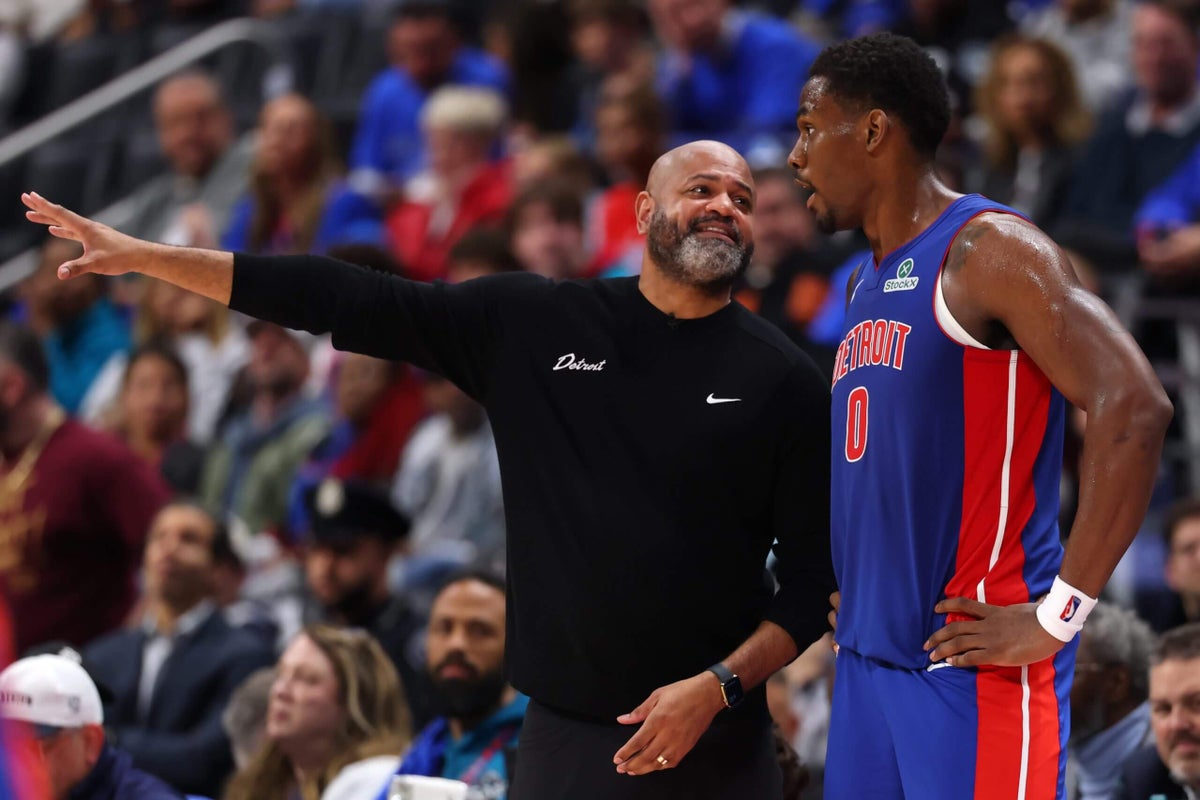
Optionality has been at the core of the Detroit Pistons’ principles since Trajan Langdon took over as president of basketball operations two summers ago. It’s contributed to the tug-of-war in contract negotiations between restricted free agent Jalen Duren and the team.
Re-signing the 22-year-old All-NBA center is presumably the last big offseason priority for the Pistons before looking to extend Defensive Player of the Year finalist Ausar Thompson.
But Duren’s contrasting levels of productivity in the regular season versus the playoffs complicate conversations. Duren wants to secure his first long-term, non-rookie deal with a considerable raise from $6.5 million last season to potentially six times that. Detroit wants to make sure it doesn’t handicap itself financially moving forward by overpaying its big man on the heels of postseason struggles.
Duren aside, the Pistons added several new players, lost locker-room staples and re-signed multiple members of last season’s team. We’ll start our breakdown of Detroit’s summer with the new additions.
Acquisitions
So far, the Pistons’ splashiest offseason acquisition was veteran forward John Collins.
Detroit acquired Collins from the LA Clippers along with forward Taurean Prince and guard Garry Harris from the Milwaukee Bucks in a six-team deal on July 8. The trade also sent forward Isaiah Stewart to the Memphis Grizzlies and Caris LeVert to the Bucks and Marcus Sasser to the Dallas Mavericks. The Washington Wizards were also included in the deal.
Langdon also shipped two second-round picks to the Oklahoma City Thunder in exchange for guard Isaiah Joe. Before those moves, the Pistons drafted and signed Stanford freshman guard Ebuka Okorie and Virginia forward Ugonna Onyenso. Detroit picked up a potential long-term fit at the four, proven shooters off the bench and young talent.
The Pistons brought back veteran guard Kevin Huerter, who was involved in the three-team deal that allowed Detroit to jump from pick No. 28 to pick No. 21 and eventually No. 17, and forward Javonte Green. Green was the last Pistons added to the roster ahead of last regular season, and Huerter was with the team for 25 games before an adductor injury limited his playoff run.
Why Jalen Duren is still a free agent
Hunter Patterson and Jeshua Kidd
Collins, Prince, Harris and Joe all shot at least 40 percent from beyond the arc last season. Huerter and Green are both at least 36 percent shooters from deep for their careers. And although Okorie is just 19 years old, through his breakout freshman season and NBA Summer League, he’s shown signs of potentially developing into an additional playmaker for Detroit.
These might not have been the biggest moves, but the Pistons improved spacing while picking up a $15 million trade exception for Stewart, shed roughly $42.6 million in salary and got younger.
Players lost
Stewart is the most notable loss for Detroit considering he was the longest-tenured Pistons before his departure and had strong ties to the city. It was a financial decision Detroit felt it had to make with the understanding it wanted Duren back and retaining him would be expensive. Paul Reed being owed $5.6 million next season was an additional consideration.
Factoring Stewart’s $15 million salary for next year and the $30 to 40 million Duren could earn, the Pistons could’ve been handing out $50 to $60 million to just their center room. Detroit opted to ship Stewart, shed salary and elevate Reed’s role after his postseason showing against the Orlando Magic and Cleveland Cavaliers.
Tobias Harris, who’d affectionately been dubbed the “unc” of the Pistons’ locker room and Detroit coach J.B. Bickerstaff’s “safety blanket,” was also a financial casualty. While the Pistons are paying Collins $17 million over three years and Harris signed with the San Antonio Spurs for $15.4 million over two years, Detroit might be getting more for its money long term with the Collins signing.
Sasser and LeVert both stumbled out of the gate with injuries last season and never found their groove off the bench. Sasser had his spot taken by Daniss Jenkins, and while LeVert had a longer leash than Sasser, he never carved out a consistent role. Both were dealt to places that could offer more minutes than Detroit.
In theory, the Pistons swapped Tobias Harris, Stewart, Sasser and LeVert for Collins, Prince, Joe and Gary Harris.
To be determined
Not much has changed since the last time we discussed Duren.
His All-NBA selection makes him eligible for a five-year, $287.1 million contract from Detroit, which equates to an average annual value of $57.4 million. That would put Duren behind only Stephen Curry ($62.6 million), Nikola Jokić ($59 million), Jayson Tatum ($58.5 million), Anthony Davis ($58.5 million), Giannis Antetokounmpo ($58.5 million) and Joel Embiid ($58.1 million).
Not to mention, Duren would be making more than his two-time All-NBA teammate Cade Cunningham ($50.1 million).
It’s difficult to justify that valuation of Duren’s talent after his most recent playoff appearance, hence the Pistons’ reluctance to commit to that much money. Detroit maintains Duren is its top priority. But the longer negotiations continue, the more likely Duren could come back disgruntled — though Duren handled last offseason’s contract disagreement professionally.
Projected depth chart
Assuming Duren is re-signed, Gary Harris is waived and not including two-way contracts.
Starters: Cunningham, Duncan Robinson, Thompson, Collins, Duren
Second unit: Jenkins, Joe, Ron Holland II, Green, Reed
Depth: Okorie, Chaz Lanier, Huerter, Prince, Tolu Smith
Overall offseason outlook
This evaluation hinges entirely on how Duren’s contract negotiations conclude. If the Pistons can get Duren back on a somewhat favorable deal with yearly salary cap increases and he continues improving, I’d consider this a successful summer for Detroit.
It might be lackluster for those who wanted a “big-swing trade,” but it’s consistent with Langdon’s messaging and preserves the Pistons’ optionality. I’m particularly high on the addition of Joe and am intrigued by the thought of him having a role similar to former Detroit 3-point shooter Malik Beasley.
Beasley played in Bickerstaff’s system alongside Cunningham and set a franchise and career high with 319 made triples. Joe is a better career 3-point shooter than Beasley, plus outside of one season with James Harden, Cunningham will be the best facilitator Joe has played with. Though I’d be remiss if I didn’t mention how helpful Shai Gilgeous-Alexander’s gravity is for a 3-point shooter.
I’m curious to see how Collins slots in for Tobias Harris. He’s more of a lob threat with a higher 3-point percentage, but less of an isolation scorer than Harris. Collins’ play — coupled with the growth of guys like Duren, Thompson, Holland and Lanier — could be the deciding factor in how competitive the Pistons can become.
But even the prospect of being a better team than the 60-win group last season signals Detroit made the most of its offseason with a chance to build on its recent success.