

Add topic to email alerts
Receive an email when new articles are posted on
Please provide your email address to receive an email when new articles are posted on .
” data-action=subscribe>
Subscribe
We were unable to process your request. Please try again later. If you continue to have this issue please contact customerservice@slackinc.com.
Back to Healio
Key takeaways:
Rates of GLP-1 discontinuation were high in patients with type 2 diabetes.
However, more than half reinitiated therapy within 1 year, and about two-thirds reinitiated within 2 years.
CHICAGO — Among patients with type 2 diabetes who discontinued use of a GLP-1 receptor agonist, more than half reinitiated within 1 year and about two-thirds reinitiated within 2 years, researchers reported at ENDO 2026.

Sanjeev Rampam
“The question we were asking is, of the patients who do go on GLP-1s, who have type 2 diabetes, how many of them actually stay on treatment?” Sanjeev Rampam, MD, resident physician at the University of Michigan, told Healio. “The adherence rates are fine in clinical trials, but in the real world, how often are patients discontinuing these drugs, and of those who discontinue, how often are they reinitiated?”
Data were derived from Sontha S, et al. SUN-639. Presented at: ENDO annual meeting; June 13-16, 2026; Chicago.
Using data from the Komodo Health U.S. claims database, Rampam and colleagues performed a discontinuation analysis in 60,222 patients with type 2 diabetes and a reinitiation analysis in 14,196 patients. All patients had initiated liraglutide (Victoza/Saxenda, Novo Nordisk), semaglutide (Ozempic/Wegovy, Novo Nordisk) or tirzepatide (Mounjaro/Zepbound, Eli Lilly) between January 2019 and June 2025.
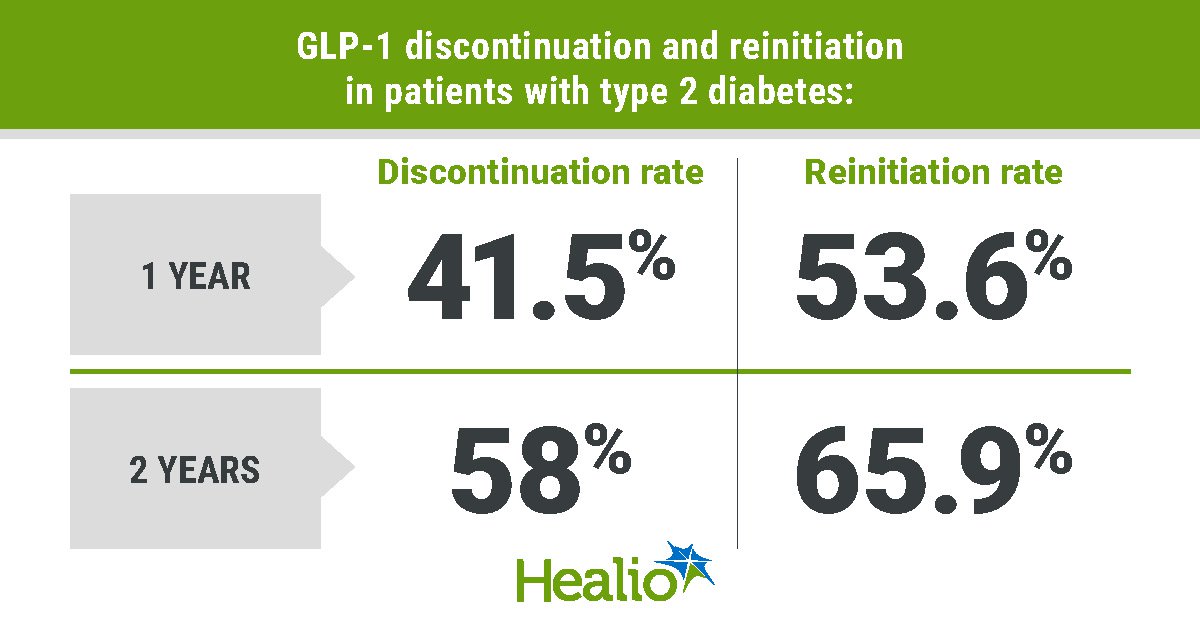
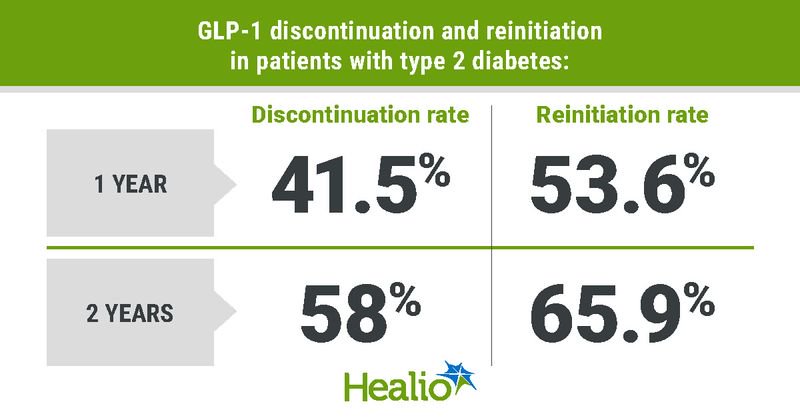
The rates of discontinuation, defined as a gap of 60 days or longer in GLP-1 fills, were 41.5% at 1 year and 58% at 2 years, the researchers found.
However, the rates of reinitiation, defined as a new fill following discontinuation, were 53.6% at 1 year and 65.9% at 2 years, according to the researchers.
Predictors of discontinuation were Black/African American race, Hispanic/Latino ethnicity, Medicaid or Medicare insurance, index visit with a surgeon, adverse gastrointestinal events and concomitant heart disease or coronary atherosclerosis, whereas more recent initiation year, increasing BMI, use of tirzepatide or semaglutide, index visit with an endocrinologist and weight loss of at least 5% were predictors of staying on a GLP-1, the researchers found.
Predictors of reinitiation were Black/African American race, Hispanic/Latino ethnicity, increasing BMI, use of tirzepatide or semaglutide and weight gain of at least 5%, whereas Medicaid or Medicare insurance was linked to lower odds of reinitiation, according to the researchers.

Sainikhil Sontha
“We are very optimistic that if you’re able to address some modifiable risk factors, including insurance status, whether their prescription is being provided by an endocrinologist or primary care provider, the amount of weight loss, their gastrointestinal side effects, then we can ensure that people who are discontinuing reduce their incidence of discontinuing, and then they are able to restart medications and stay on them for longer,” Sainikhil Sontha, MS, research associate at Boston University School of Public Health, told Healio. “One factor we found consistently was adverse gastrointestinal side effects. Another risk factor was the amount of weight loss. If they tended to have experienced a lot of weight loss, then they were less likely to discontinue. But then there were some nonmodifiable risk factors, including whether they identified as Black or Hispanic, which I think just points more toward equity access, in terms of who are gaining access to these medications, and whether they have access to close follow-up.”
For more information:
Sanjeev Rampam, MD, can be reached at endocrinology@healio.com.
Sainikhil Sontha, MS, can be reached at endocrinology@healio.com.
Published by:
Sources/Disclosures
Source:
Sontha S, et al. SUN-639. Presented at: ENDO annual meeting; June 13-16, 2026; Chicago.
Disclosures:
Rampam and Sontha report no relevant financial disclosures.

Ask a clinical question and tap into Healio AI’s knowledge base.
PubMed, enrolling/recruiting trials, guidelines
Clinical Guidance, Healio CME, FDA news
Healio’s exclusive daily news coverage of clinical data
Learn more
Add topic to email alerts
Receive an email when new articles are posted on
Please provide your email address to receive an email when new articles are posted on .
” data-action=subscribe>
Subscribe
We were unable to process your request. Please try again later. If you continue to have this issue please contact customerservice@slackinc.com.
Back to Healio