
Interim summary
In case you’re just joining us, here’s a snapshot of the latest developments in the Middle East as the threat of a new front opens up in the US-Iran war. It’s 9.30am in Tehran and 2am in Washington.
Yemen’s Iran-backed Houthi militia said it attacked two Saudi Arabian oil tankers in the Red Sea, with a Saudi news agency later confirming one of the vessels was ablaze on Thursday. The strikes came after the Houthis declared a maritime blockade of Saudi Arabia – a move that current and former US officials said could significantly widen the US-Iran war and strain the American military.
The US launched its 12th successive night of strikes against Iran, saying military targets were hit to degrade Tehran’s ability to attack commercial vessels.
Iranian state TV said two people were killed and 11 wounded in what a Khuzestan provincial official described as a US missile attack on the Shalamcheh border crossing with Iraq.
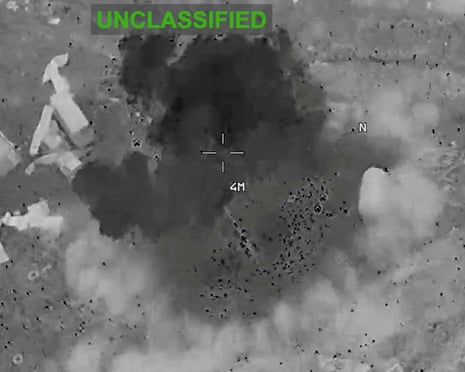 Scattered debris and smoke at an unknown location during what the US military said were strikes on Iran. Photograph: US Central Command/Reuters
Iran’s Islamic Revolutionary Guard Corps (IRGC) said it attacked US forces in Kuwait’s Al-Adiri camp and Ali Al Salem airbase, while the army said its attacks there included on the Arifjan and Doha camps.
Before the latest US strikes the Islamic republic’s foreign minister warned on social media: “Our defense doctrine is clear: eye for an eye.” Abbas Araghchi also said: “Any aggression against Iran, including our infrastructure, will compel a powerful and decisive response. Those who contribute to such aggression, whatever the kind of support, will also be considered as legitimate targets.”
The US and Saudi Arabia signed a landmark nuclear agreement that could allow the kingdom to enrich uranium in the future. The deal has caused alarm across the Middle East and in Washington. Its full details are yet to be released but, as Patrick Wintour reports, the timing of the announcement is controversial as the US’s war with Iran is being fought in part to prevent Tehran enriching uranium domestically and make it near-impossible for Iran to build a nuclear weapon.
The IRGC said on Thursday it stopped three oil tankers from passing through the strait of Hormuz. It said in a statement quoted by Iranian state media on Thursday that the three oil tankers “provoked” by the US military were trying to pass through a mine-laden route south of the strait “but after one of them exploded and caught fire, the other two quickly turned around and turned back”.
Earlier, Donald Trump warned on Truth Social that from now any time Iran shot at a ship in the Hormuz strait, the US “will bomb and destroy ONE BRIDGE OR POWER PLANT, including those located next to, or in, the Capital City of Tehran””.
The IRGC said its navy “emphasises that the strait of Hormuz is under our control”. US Central Command posted on X: “Iran does not control the Strait of Hormuz. The international waterway remains open for transit regardless of IRGC threats and attacks.”
Two very large Chinese crude carriers carrying a combined 4m barrels of Saudi Arabian oil are heading towards the Bab el-Mandeb strait to exit the Red Sea, shipping data showed on Thursday – a test of how tightly the Houthis will impose their naval blockade on Saudi Arabia.
Updated at 02.27 EDT
Key events
Elsewhere, Egypt is still hopeful that the US and Iran could return to peace talks. The country’s foreign minister Bard Abdelbatty said Egypt is in daily to contact with regional partners as well as the US and Iran, in a bid to end the tit-for-tat attacks that have taken place in the last few weeks.
“There is a specific proposal now under discussions, and we hope that this proposal will contribute to de-escalation,” Abdelfatty said in an interview with Bloomberg.
ShareOman says it is working on resuming Yemen talks after Houthis hit Saudi tanker
The foreign ministry in Oman, a key mediator between Saudi Arabia and Yemen’s Houthis, said it is working to resume talks “to achieve security and stability in the region”.
In a statement on X, the ministry expressed “great concern” at the situation in the Red Sea after the Houthis claimed to have attacked two Saudi tankers. Saudi state media confirmed attacks on a vessel in the Red Sea and said that all crew members were safe.
ShareOil prices near $100 a barrel Jasper Jolly
Oil prices have jumped by 3.7% this morning as the backlash from the US war in Iran appeared to spread to the Red Sea.
The price of futures for Brent crude oil, the global benchmark, rose by 3% on Thursday to reach as high as $97.45 per barrel, approaching the $100 mark for the first time since May.
Follow our business live blog for more updates:
Iran’s Arab neighbours have reported continued attacks this morning. Here’s a summary by AP:
Jordanian authorities said the country’s military had intercepted three missiles Thursday morning, with a fourth falling in an empty area, while six drones were intercepted Wednesday night.
Bahrain’s interior ministry posted on X that sirens had sounded and urged the public to remain calm and head to a safe area.
Overnight, military officials in Kuwait said on social media that their air defences were “confronting attacks by hostile drones”.
Updated at 05.57 EDT
Houthis got ‘snookered’ into war by Iran, says Rubio
Rubio said the Houthis were “smart” to stay out of the Middle East conflict – until the group attacked two Saudi oil tankers in the Red Sea (see post at 02:05)
“The Houthis largely were smart and stayed out of all this throughout the conflict, but they now apparently have gotten themselves suckered into this, going after Saudi Arabia and their ships,” Rubio said on the sidelines of the Asean summit in Manila.
“I hope they will de-escalate, because I think the Houthis, frankly, got snookered into this thing by the Iranians. And they were smart to stay out of it, and they should stay out of it and they should stop. We’ll see what happens there. Obviously, it’s not a positive development.”
Rubio continued to insist that the US had never claimed regime change was an intended goal of its war against Iran.
“He never said regime change was a goal,” he said of Trump.
The US president has made multiple public statements about regime change in Iran, but they have been inconsistent. In March he claimed the US achieved regime change “because the leaders [in Iran] are all very different than the ones that we started off with”. He has since backtracked from that statement and maintains that the US aims to denuclearise Iran.
In the early days of the war, the Israeli prime minister, Benjamin Netanyahu, had called on the Iranian people to rise up against the regime. Trump also made similar comments but later rejected this notion, reportedly saying: “Why the hell should we tell people to take to the streets when they’ll just get mowed down.”
Rubio was asked by a reporter whether he thought “it would be easier to make a deal with Iran if the United States didn’t wipe out so many layers of their leadership?”
The US secretary of state responded: “The first two layers weren’t necessarily the nicest people on earth … We’ll just keep going down the layers, I guess … The first two layers were not like reformers. These were not like Renaissance men. You know what I mean?”
US secretary of state Marco Rubio speaks to the press on the sidelines of the Association of Southeast Asian Nations (Asean) conference in Manila, the Philippines. Photograph: Brendan Smialowski/Pool AFP/AP
He later clarified: “Well, some of them are lunatics. Some of them are evil. Some of them are evil lunatics. You can be both.”
It’s not entirely clear what Rubio meant by “first two layers”, but the US and Israel killed the former Iranian supreme leader, Ayatollah Ali Khamenei, in a joint strike on the first day of the current war, on 28 February. My colleague Jason Burke reported more on that attack:
double quotation markKhamenei was killed along with seven “members of the top Iranian security leadership who had gathered at several locations in Tehran” and about a dozen members of his family and close entourage in near-simultaneous strikes within 60 seconds, military officials in Israel said. Forty other senior Iranian leaders also died in the attack.”
Updated at 04.51 EDT
In further comments to the press at the Asean conference, Rubio lambasted Iran for its “stupid lego videos”, although claimed to have “never seen them”.
AI Lego video posted by Iranian social media accounts. Illustration: Twitter/X
The Guardian’s diplomatic editor Patrick Wintour wrote more on the AI-generated comedy videos and lego animations of Donald Trump that Iran has been pumping out on social media, which has been dubbed “slopaganda”. Here’s what he says:
double quotation markIts once vibrant press has been reduced to reproducing army spokespeople statements, or articles culled from the western press saying Trump is suffering a strategic defeat. Some of Iran’s best newspapers have been shut down, and ordinary Iranians still complain about the unwatchable propagandist official TV news channels.
But out of this darkness comes a creativity aimed at the west. Pro-government accounts are posting AI-generated Lego animations that link the Jeffrey Epstein cases to Trump’s war, or using humour and confidence to puncture the west’s failings.
Read Patrick’s article here:
Here’s Rubio’s comments to reporters (after repeating Iran is “begging” for a deal and will pay a “heavy price”):
double quotation markThey’re probably not ready to do a deal yet, but they will be soon because the price they’re paying is very high, despite their tough talk and their flowery language and their stupid Lego videos they put out, I’ve never seen them, but they put these things out on social media. Despite all that bravado they are suffering tremendously and they’re going to suffer more until they come to their senses. They’re not there yet unfortunately.
Updated at 04.38 EDT
Rubio: ‘Iran is begging for a deal’
Marco Rubio, the US secretary of state, has claimed that Iran is “begging” for a deal with Washington, but that ultimately it is not serious about agreeing to one.
As a result, Iran will “continue to pay a price” that will get “higher and higher and higher”, Rubio added, after the US military announced it conducted a 12th night of strikes against the country yesterday.
US secretary of state Marco Rubio speaks to the press on the sidelines of the Association of Southeast Asian Nations (Asean) foreign ministers meeting in Manila, the Philippines. Photograph: Brendan Smialowski/Reuters
Speaking to reporters on the sidelines of the Association of Southeast Asian Nations (Asean) conference in Manila, Rubio was asked whether Donald Trump intended to make good his threat of hitting Iranian bridges and power plants, and whether this meant bombing civilian infrastructure.
Rubio responded:
double quotation markIran is begging us, OK, both directly and indirectly. Let’s do a deal. Let’s talk. Let’s talk. Iran is begging every day.
The problem with Iran is every time they make a deal, the people that are in charge there, they either break it or they want to change it. So it looks like they’re not ready to make a deal. So they’re going to continue to pay a price, and every night the price gets higher and higher and higher.”
He went further in saying that the price Iran will pay “will continue to get higher every single night until they come to their senses”.
ShareOil giants see profits double amid Middle East war
French oil and gas company TotalEnergies said net profit doubled in the second quarter as conflict in the Middle East pushed up fuel prices.
In a statement, reported by AFP, TotalEnergies said net profit amounted to $5.4bn (about £4.04bn) in the period from April to June, up from $2.7bn (£2.02bn) in the same period last year.
Yesterday, my colleague Kalyeena Makortoff reported profits at Norway’s state oil company Equinor nearly doubled to $11.5bn (£8.6bn) in the three months to the end of June.
Equinor– which is the UK’s biggest gas supplier – benefited from a decision to increase oil and gas production at the start of the conflict, filling a gap in the market after a near-halt to shipping through the strait of Hormuz caused Gulf oil flows to slump. It also profited from the jump in oil prices, with the price of Brent crude, the global benchmark, reaching $95 a barrel mark for the first time in six weeks as the US and Iran escalate attacks in the Middle East.
The climate campaign group Uplift hit out at Equinor for “raking in billions in profits while millions of people across the UK are struggling with unaffordable energy bills”.
You can read Kalyeena’s report here:
Updated at 03.58 EDT
Some images on the newswires from Lebanon, where the health ministry says 4,328 people have been killed and 12,232 wounded in Israeli attacks since 2 March:
This picture, taken from a position in northern Israel, near the border with Lebanon, shows a UN interim force in Lebanon (Unifil) armoured vehicle driving past destroyed buildings in southern Lebanon. Photograph: AFP/Getty ImagesLebanese army soldiers stand near a woman after preventing her from entering the southern village of Zawtar al-Gharbiyah, Lebanon. Photograph: Mohammed Zaatari/APA bulldozer accompanied by Lebanese army soldiers works to clear roads at the entrance of Zawtar al-Gharbiyah following the withdrawal of Israeli forces from the area. Photograph: Lebanese Army Press Service/UPI/ShutterstockLebanese prime minister Nawaf Salam places a national flag along a damaged street in Zawtar al-Gharbiyah on Wednesday, 22 July 2026. Photograph: Lebanese Prime Minister’s media office/UPI/ShutterstockShare
Updated at 03.21 EDT