
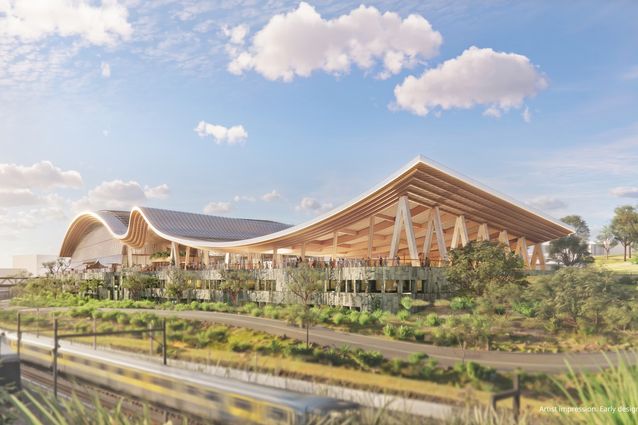
The architects for Brisbane’s National Aquatic Centre have been newly revealed – along with concept imagery of their design – by the Queensland government and the Games Independent Infrastructure and Coordination Authority (GIICA).
GIICA has appointed national firms ARM Architecture and NH Architecture, in partnership with local practice Arkhefield, as principal architects of the proposed Olympic aquatic venue, following what they described as “a rigorous six-month selection process led by an expert panel.” The design team also includes aquatic architecture specialists Liquid Blu.
GIICA chairman Stephen Conry AM, chair of the design evaluation panel, said “The opportunity to create an iconic design that showcased Australia’s obsession with swimming and aquatic sports really captured the imagination of some of the country’s most talented architecture teams, and the quality of the design concepts submitted was truly impressive.
“Ultimately, it was ARM Architecture, NH Architecture and Arkhefield’s design for a centre inspired by the movement of water, cleverly positioned into the landscape, that we felt best reflected the natural beauty of Brisbane.”
View gallery
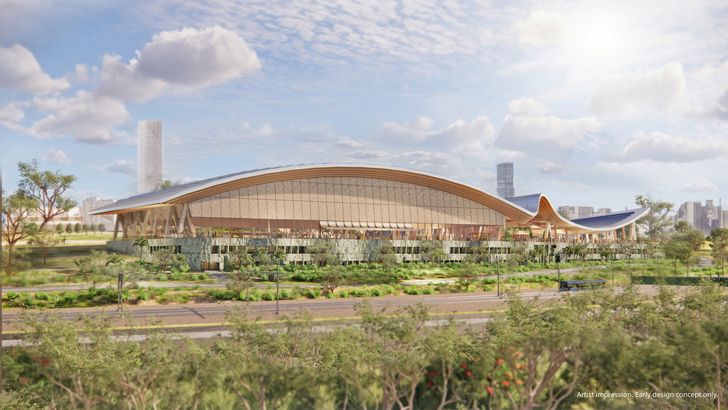
Located at the site of the city’s heritage-listed Centenary Pool in Spring Hill, the team’s multi-storey National Aquatic Centre design is sunken into the sloping landscape and tiered down its southern face “to preserve surrounding parkland while opening the building to light, breeze and greenery,” GIICA’s media release notes.
Above the rippled podium form, a “floating” roof is designed to reflect the circulation of wind and water, and allow ventilation and natural light to enter the building.
ARM Architecture director Andrew Hayne commented, “the design is ultimately about place. It’s architecture shaped by Brisbane’s landscape, subtropical climate and natural environment.”
He added that the building was designed to feel welcome and inspiring from the moment visitors arrive, regardless of “whether [they’re] chasing Olympic gold or teaching [their] kids to swim.”
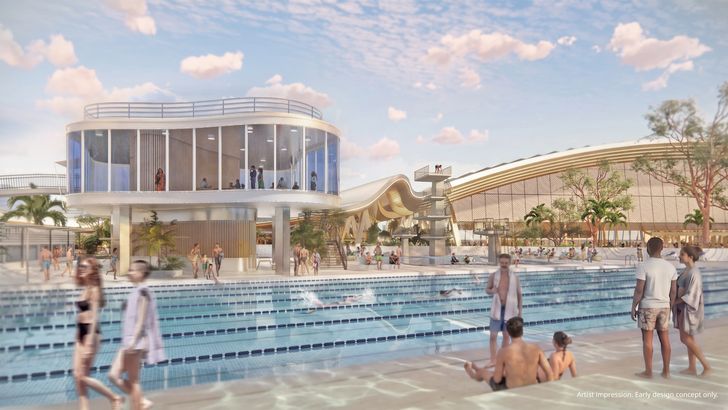
The venue is slated to host swimming, diving, water polo and artistic swimming events during the 2032 Olympic and Paralympic Games, while serving everyday community use in the long-term. The design features three new covered competition pools – two of which will be housed in separate arenas – alongside a gym, high-performance rooms and administration spaces, adding to the site’s three existing outdoor pools and facilities.
View gallery
Conry said the scheme would include “a restored Centenary Pool … ensur[ing] the heritage-listed design is a centrepiece of the complex,” with NH Architecture director Emily Kilvington commenting that the team’s design for the state-of-the-art facilities shows “real respect for the site’s history while positioning Queensland at the forefront of aquatic sport infrastructure.”
“This new national venue will belong to Brisbane, and Centenary Pool will be better than ever because of it,” added Arkhefield founding director Andrew Gutteridge.
GIICA will take possession of Centenary Pool and the surrounding site from 1 September in preparation for early works, which are expected to begin later this year.
According to the Queensland government, a procurement process to select the centre’s builder is currently ongoing, with four contractors shortlisted to submit offers by the end of July. Following their submissions, two of the four contractors will be selected to progress, with the final builder appointed early 2027.
Construction is also planned to commence in 2027, alongside development of the design.
Deputy Premier Jarrod Bleijie said the appointed “design trio will develop an iconic new home for high performance aquatic athletes, as well as a legacy for community sport.”
“This isn’t just a venue for a few weeks in 2032, it’s a lasting investment in Queensland’s future that will support community sport, high-performance athletes and keeping us cool for generations to come,” he said.