
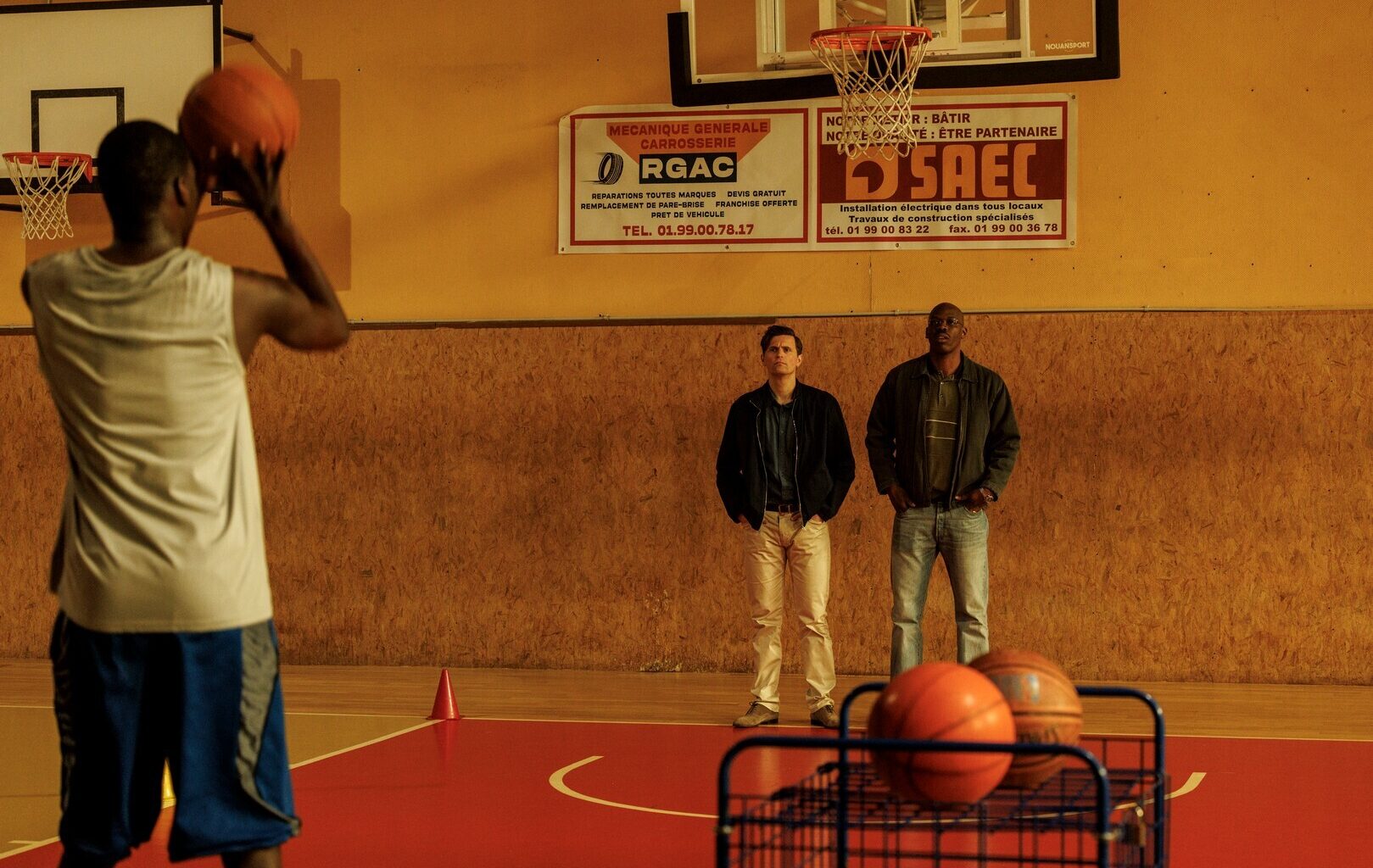
The American Dream (Le Rêve américain) is a film about basketball and about the NBA, but at the same time, this isn’t only a film about basketball. It is a heart-warming story about friendship, about decent, honest, good people trying to fulfil their dream. And their dream is helping other people fulfil their dreams.
The film is inspired by the real story of Jérémy Medjana (played in the film by Raphaël Quenard) and Bouna Ndiaye (played by Jean-Pascal Zadi), two friends who decide to leave their jobs and become basketball agents, helping young talents, many of humble origins, to become basketball stars with the ultimate goal of reaching the NBA, following “the American dream”.
After many, many failures, almost going broke, and despite barely knowing English, eventually they became hugely successful and respected agents and represented players such as Rudy Gobert, Nicolas Batum, Evan Fournier, Didier Mbenga, and most recently, Victor Wembanyama, the 22-year-old “alien”, first pick in the 2023 draft, who was NBA runner-up in his third season with the San Antonio Spurs, and is one of the most recognisable NBA stars now anywhere in the world, cover star of the NBA 2K27 video game.
 DeAPlaneta
Directed by Anthony Marciano, 46-year-old French director also known for the Prime Video comedy series Miskina, Poor Thing (2022), the French-Belgian co-production Play (2019), and the comedy Robin Hood: The True Story (2015), the film was released in February 2026 in French-spoken countries France, Belgium, Switzerland, and Morocco, and will release in Spain, distributed by DeA Planeta, this Friday, July 24.
This is an ad:
Interview with Anthony Marciano, director of The American Dream (Le Rêve américain)
We had the privilege of talking with Marciano before the film released in Spain, who told us about the inspirations, how he learnt about basketball to make this film, why it ultimately isn’t a film about basketball, and what he thinks of Victor Wembanyama, the NBA star whose huge success and popularity in France serves as a reminder of why Medjana and Ndiaye’s work matters.
What drew you to this real story? How did you come across it, and why did it intrigue you?
I’m a basketball fan, and whenever I saw photos of French basketball players, there were always the same two people in the background, and I wondered who they were. So, I tried to find out more, and I realised they were agents, and that they were French.
For me, every French person I see who achieves international success inspires me, so I wanted to read their story without knowing if I could turn it into a film. Beyond basketball, it had all the ingredients of a movie I wanted to make about friendship and perseverance.
This is an ad:
I couldn’t even tell half of the failures they went through because they wouldn’t fit in the film. But it’s impressive that people who face so many failures manage to get back up and try again for the tenth time. I love people who have that mentality; I find it very inspiring. And all of that within friendship and loyalty, those are values that resonate with me.
I didn’t want to make a movie about agents or representatives. I’m not interested in contracts or negotiations. I wanted to make a movie about these specific people because I saw their story, and I saw a story of friendship that was incredible. They could have done anything else, and I would have been just as interested.
 DeAPlanetaHow has the reception for the film been in France, has it caught the attention of people not interested in basketball or sports?
The feedback has been incredible. I’ve never seen anything like it. The reactions have been amazing. But I think people were afraid to go see a movie about basketball because they thought they weren’t interested in basketball.
And that’s why I’d like people to know that it’s not a movie about basketball, and that those who go to see it say, “Oh, I thought it was a movie about basketball”, that they think “I didn’t know anything about basketball, and I loved it so much that I’m going to go back with my children, with my parents”, because it’s a movie about friendship and it’s a human adventure.
Do you have any films that served as a reference or that have influenced you, visually or thematically?
Visually, all the great American comedies of the 80s, 90s, and 2000s. For me, these are people who, when they were little, watched those films. So, it’s an American dream. I wanted the film to resemble the dream they had of the United States. Therefore, I present an image that is close to that. I’ve also created a soundtrack that reflects that.
Regarding the themes I address, If I have to talk about sports, I would cite Jerry Maguire, because it deals with failures, rebuilding, loyalty, and addresses similar themes. But my inspirations aren’t necessarily related to sports, perhaps I would also mention The Intouchables. I’ve been inspired by friendship, by how to build a team in life, and by thousands of films about friendship. And how two people can overcome challenges because they can support each other.
 DeAPlanetaWere you afraid about making a movie about sport agents, who may initially be less interesting to people than the athletes themselves, and who don’t always have the best reputation, and are sometimes seen as people trying to take advantage of them?
I was interested in their mindset. It’s true that they didn’t behave like most agents. For starters, they don’t do it for glory, for money, but for passion. Because it’s something that lives within them, that has always been their passion. And they can’t see themselves doing anything else.
But beyond that, they are people with values. And, for example, there are many of those clients who betray them. Well, they could have taken them to court to get their money back, but they never did. They always look ahead to signing the next player.
They never went into locker rooms to try to steal players from other agents or representatives, something that often happens. Some people find it hard to leave their players in the United States from abroad because they know that as soon as they leave a game, other agents try to take them to other clubs. They never operated like that; they’ve always been honest people. And that’s why it’s not a film about sports, or about agents, but about good people.
 DeAPlanetaDo you think the presence of more French players in the NBA, and now particularly with Wembanyama, has helped basketball to become more popular in France?
Basketball has never been a very popular sport in France, but since the Olympic Games and since Wemby, it has started to become more popular, and now he has even reached the highest levels of the NBA, with the NBA Finals, and all of that has a huge impact. And I know that basketball is growing more and more in France and throughout the world, and I think the NBA has achieved a level of recognition that has never been higher.
I think Wembley has a lot to do with that, that it makes people dream. Because beyond being an athlete with technical skills, he is a person who is level-headed, who has been interested in many things, who has human values, respect, and who has a different kind of intelligence that is rarely found in sports that are very focused on that aspect.
There aren’t many French-owned teams in the EuroLeague or in the top European leagues, and the best players from France go to the United States. Do you think that’s a good thing, or would you like it to change?
I think everything is going to change very soon. There’s always a lot of talk about the NBA starting up in Europe, and I think that’s going to turn the tables and become competition for the EuroLeague. We could have local teams that are also NBA teams, and everyone will benefit.
 DeAPlanetaHow did you film the 2005 NBA Draft, was it technically complicated?
It’s the most difficult scene, technically, because it’s a single take. We filmed it in a stadium, the camera was hanging from the roof and it rotated 360 degrees in a single shot. That’s challenging for everyone, extras, the cameras, and the actors. We all had to do a lot of physical training, it was quite complicated. I also had to recreate the entire stadium, the entire 2005 stands, in 3D.
Was it difficult to find information about how the NBA industry works?
I’m not that much of an NBA expert; I didn’t know about the draft or anything like that. I didn’t have access to anyone who could tell me about it. I contacted people online, on Instagram, who had basketball accounts. “Can you tell me how the draft works? Can you tell me how the combines work?” I was trying to get information for my script because I didn’t have that information.
 DeAPlanetaThe NBA draft scene, where they are eagerly waiting to know if they have been picked by a team, is one of the most dramatic of the film. Do they really play out the way you show in the film?
Yes. I went to New York to visit a draft, and they took two players with them, Tidjane Salaün and Melvin Ajinça. They were two very different players. One had great expectations, and the other less so. So we were able to see both sides. We saw the spectacular side of the player who was in the top ten. (Salaün was the sixth pick overall in 2024 draft).
And we also saw the one waiting in a bar, watching TV, hoping they would call his name. So we experienced that scene with them. And right at the end, when they called number 51 and announced his name (Ajinça’s), we saw what it’s like to be in the first round, what it’s like to be in the second round, or what it’s like to have so many expectations placed on you and then leave empty-handed.
 Victor Velter / ShutterStockFinally, going back to Victor Wembanyama, why do you think this particular player has inspired so many in France?
For me, he’s an incredible inspiration for young people because he sets a good example. He’s a player who behaves very well, who is thoughtful, who is likeable, who is interested in many things, who reads books, who plays chess, who respects other players, and who has many virtues that show that success in life isn’t about having the latest watch or driving the latest car. I think he’s a fantastic example for young people. You don’t have to show off your Ferrari; playing chess and reading a book is also very important.
 DeAPlaneta
The American Dream (Le Rêve américain) released on February 18, 2026 in France and on July 24, 2026 in Spain. It currently has no release date in the United Kingdom.