
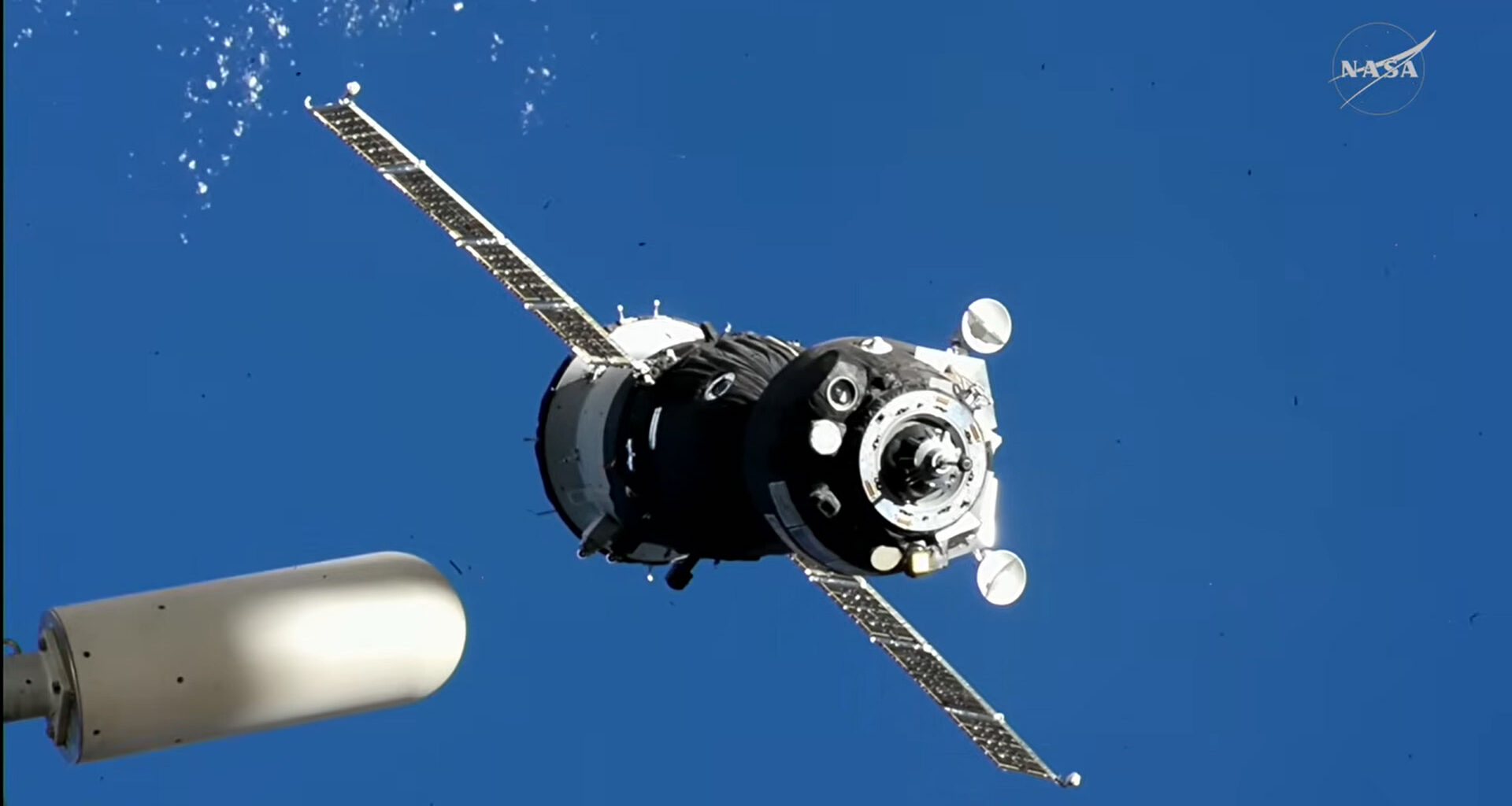
NASA astronaut Chris Williams and Roscosmos cosmonauts Sergey Kud-Sverchkov and Sergei Mikaev are set to depart the International Space Station this Sunday, closing out eight months that produced promising advances in space-manufactured cancer nanomaterials and semiconductor crystal growth — research that depends on orbital conditions that the ISS itself, now four years from scheduled deorbit, will not be able to offer indefinitely. Soyuz MS-28 is scheduled to undock from the station’s Rassvet module at 3:02 a.m. ET on Sunday, July 26, and is expected to land on the Kazakh steppe southeast of Dzhezkazgan at 6:26 a.m. ET (3:26 p.m. local time), under a parachute-assisted descent covered by the NASA Media Advisory M26-057. NASA updated its coverage advisory on July 23, 2026 to confirm the timeline. Live coverage will stream on NASA+.
Before the crew departs, NASA astronaut Jessica Meir is scheduled to assume command of the orbital complex on Saturday, July 25, at 9:40 a.m. ET, in a formal change-of-command ceremony that will end Kud-Sverchkov’s tenure and begin Expedition 75. That expedition — already staffed with a seven-member crew that includes three newcomers who arrived aboard Soyuz MS-29 on July 14 — is set to continue the orbital research agenda through spring 2027, when the station’s deorbit deadline becomes less an abstraction and more a countdown.
Williams Brought Physics and Oncology to Orbit, and Leaves With Results
For Williams, this marks the end of his first spaceflight, and its scientific focus reflected his unusual background. A former medical physicist and assistant professor at Harvard Medical School, he arrived with a research portfolio anchored in oncology and materials science, and he worked it through to the end of the mission — confirmed by his NASA astronaut biography.
The centerpiece of that portfolio was a study of Janus base nanomaterials, or JBNs — synthetic molecules engineered from DNA-inspired building blocks that self-assemble into hollow nanotubes capable of carrying a therapeutic payload directly to a solid tumor. The challenge with producing JBNs on Earth is that gravity-driven convection and sedimentation disrupt the self-assembly process, yielding nanotubes with inconsistent dimensions that reduce both drug-loading capacity and therapeutic precision. In microgravity, those convective forces are absent. Earlier ISS National Lab research sponsored by Eascra Biotech and UConn demonstrated that JBNs manufactured in orbit form more uniform and durable structures than their Earth-produced counterparts, with corresponding improvements in therapeutic performance. An ISS National Lab announcement from April 9, 2026 confirmed the research was advancing Williams’s work toward application-stage candidates targeting triple-negative breast cancer, high-grade ovarian cancer, and select bone cancers — among the most drug-resistant tumor types in clinical oncology.
He also contributed to experiments growing semiconductor crystals in the station’s microgravity environment. On Earth, thermal gradients inside a crystal-growth furnace cause buoyancy-driven convection — cooler, denser material sinks while warmer, lighter material rises — and these currents introduce lattice defects that degrade electron mobility in the finished crystal. In orbit, convective mixing is suppressed, enabling the growth of crystals that are structurally purer and, in some cases, significantly larger. A 2024 meta-analysis published in npj Microgravity reviewed 160 semiconductor crystals grown in space between 1973 and 2016 and found improvement in at least one reported metric in 86 percent of the materials. That research lineage runs directly through the work conducted during Expedition 74, and its applications — more efficient AI chips, higher-performance medical imaging hardware, components for advanced computing infrastructure — depend on a platform that is now running out of operational years.
On two separate spacewalks alongside Meir — including the June 2026 excursion that replaced a broken wrist joint on Canadarm2 and cleared the path for the Soyuz MS-29 launch — Williams worked outside the station to prepare its exterior for a future roll-out solar array installation. The two spacewalks combined for 13 hours and 7 minutes of extravehicular activity, confirmed in Expedition 74 records, logged entirely on a first mission.
Kud-Sverchkov and Mikaev Tested Technology to Get Crews Back on Their Feet
Kud-Sverchkov, who commanded Expedition 74 and is on his second ISS mission, spent the final days of the expedition packing cargo and conducting tests of a lower-body negative pressure (LBNP) suit — a device that creates a partial vacuum around an astronaut’s lower body, counteracting the cephalad (head-ward) fluid shift that occurs in microgravity and accelerating the post-landing cardiovascular readaptation process. This fluid shift, in which blood and other fluid redistribute toward the upper body in the absence of gravity’s normal pull, is one reason returning astronauts are briefly unable to stand without support after landing. The LBNP suit aims to shorten that recovery window, with implications for any future crew that must act quickly after landing on the Moon or Mars. Mikaev, on his first spaceflight, participated in the same countermeasure research program.
Meir Takes Command of a Station Running Out of Time
When Kud-Sverchkov formally transfers station command to Meir at Saturday’s ceremony, Meir will become commander of both the Crew Dragon Freedom spacecraft and the ISS — a dual role that reflects the increasingly intertwined nature of commercial and government human spaceflight operations, as detailed on the Expedition 75 mission page.
Meir, who first flew to the ISS in 2019 during Expeditions 61 and 62, is Norwegian-American, holds a doctorate in marine biology, and carried out the first all-female spacewalk with Christina Koch in October 2019. She launched as Crew-12 commander from Cape Canaveral Space Force Station on February 13, 2026, aboard the Dragon Freedom, alongside NASA pilot Jack Hathaway, ESA mission specialist Sophie Adenot, and Roscosmos mission specialist Andrey Fedyaev, arriving at the station after a 34-hour transit on February 14 — details confirmed in the Crew-12 mission overview.
The crew she will command until Crew-12’s departure in September 2026 includes Hathaway, Adenot, Fedyaev, and the three crew members who arrived on Soyuz MS-29 on July 14: NASA flight engineer Anil Menon, and Roscosmos cosmonauts Pyotr Dubrov and Anna Kikina, who docked at the Prichal module. Crew-13, carrying NASA astronaut Jessica Watkins, Luke Delaney, CSA astronaut Joshua Kutryk, and Roscosmos cosmonaut Sergey Teteryatnikov, is slated for September 2026.
What Meir now commands is a laboratory under a closing deadline. The ISS is scheduled for a controlled deorbit at the end of 2030, when a SpaceX-built deorbit vehicle will guide it into a controlled reentry over a remote section of the Pacific Ocean. A June 2026 report from the U.S. Government Accountability Office found that NASA faces a genuine risk of a gap in continuous human presence in low Earth orbit if commercial successor stations from Axiom Space, Blue Origin, and others are not certified in time. That finding means that research programs now running on the ISS — including the semiconductor crystal work Williams contributed to and the cancer nanomaterial trials Eascra Biotech is advancing to clinical-candidate stage — may have no platform to run on after 2030 if no successor is ready.
How Does Space Make Better Cancer Drugs?
The question behind the JBN cancer research answers itself in basic physics. On Earth, when a batch of DNA-inspired molecules self-assembles in a solution, gravity constantly pulls the denser material toward the bottom of the container. The assembly process competes against sedimentation. In orbit, that competition does not exist: the self-assembly is governed entirely by chemical binding forces, which produce more geometrically consistent nanotubes at higher yield. Those nanotubes can then be loaded with a chemotherapeutic drug and sized precisely enough to penetrate the dense extracellular matrix of solid tumors — a barrier that smaller, less uniform nanoparticles often cannot reliably cross. The ISS National Lab JBN case study documents this mechanism in detail. The Merck cancer drug Keytruda was reformulated from an IV infusion to a subcutaneous injectable through ISS protein crystal growth experiments — a real-world precedent documented by ITIF for the class of research Williams was advancing.
The same physics suppression logic applies to semiconductor crystal growth. Lattice defects in compound semiconductors — the materials used in high-efficiency photovoltaics, high-frequency communications chips, and specialized AI inference hardware — trace back to convective disruption during crystallization. Space-grown crystals, free of that disruption, can achieve structural purity levels that translate to higher electron mobility, lower operating temperatures, and reduced power consumption in end applications. United Semiconductors LLC signed a Starlab Space payload agreement in March 2026 to move this research from ISS-scale demonstration to commercial-scale production in low Earth orbit — a transition that depends on whether Starlab is operational before the ISS goes dark.
Expedition 75 Will Push Autonomous Medicine to Its Limits Before the Station Closes
The research agenda that Meir’s crew inherits from Expedition 74 extends the ISS’s scientific legacy into territory that has direct implications for how humans will practice medicine during missions to the Moon and Mars. NASA flight engineer Anil Menon — an emergency medicine physician and former SpaceX flight surgeon, now on his first spaceflight — is scheduled to serve as primary science officer for much of Expedition 75’s medical research, per his NASA mission assignment.
Central to his agenda is a suite of AI-guided, augmented-reality ultrasound diagnostics. The operational constraint Menon is testing against is unambiguous: a light-speed signal takes 3 to 22 minutes to travel between Earth and Mars, depending on their orbital positions. Real-time physician guidance of a medical procedure is physically impossible across that delay. The system under test in Expedition 75 uses AI interpretation algorithms and AR overlays to guide an astronaut — who may have limited formal medical training — through diagnostic ultrasound procedures with no real-time Earth-based support, as outlined in NASA’s Menon mission announcement. Validation of this approach in orbit would provide the closest analog available to future deep-space mission conditions. Menon will also serve as a research subject in studies examining how extended microgravity exposure alters blood circulation and vein structure — findings that are foundational to designing countermeasures for multi-year deep-space missions.
The crew will also continue 3D bioprinting of vascular constructs in microgravity. On Earth, gravity causes soft bioprinted tissues to collapse before they can cure and maintain their structure; the ISS environment allows scaffold-free printing of vascular geometries that would be structurally impossible to create at one gravity. The bioprinting research targets cardiovascular disease modeling and aging research — disciplines where the ability to produce reliable human tissue analogs at any scale would represent a methodological step change.
More Than Twenty-Five Years, Counted Down
Soyuz MS-28’s undocking this Sunday will be the latest in an unbroken chain of crew handoffs that has kept humans aboard the station continuously since November 2, 2000 — a stretch of more than a quarter century. Every agency that has contributed to the ISS — NASA, Roscosmos, ESA, JAXA, and others — has maintained that continuity through shuttle retirements, geopolitical crises, and a global pandemic. The handoff from Kud-Sverchkov to Meir on Saturday will follow the same choreography that has repeated roughly every six months for 25 years: a ceremony, a torch passed, a hatch sealed, a capsule falling toward the steppe.
What is different now is the countdown. With the ISS scheduled to deorbit at the end of 2030, and commercial successor stations not yet certified to fill the gap, missions like Expedition 75 carry a weight their predecessors did not. Williams will leave the station carrying data from cancer drug delivery trials and semiconductor crystal experiments that may reshape fields on Earth. The question for the crew that stays — and for the ones that will follow over the next four years — is whether the results they generate can be handed off to whatever comes next, before the orbital laboratory itself follows Soyuz MS-28 toward reentry.
After landing, Williams will fly by helicopter to Karaganda, Kazakhstan, before returning to NASA’s Johnson Space Center in Houston. Kud-Sverchkov and Mikaev will depart for the Gagarin Cosmonaut Training Center in Star City, Russia.
Frequently Asked QuestionsWhy does microgravity make cancer drug research more effective than what is possible on Earth?
Drug delivery nanoparticles, including the Janus base nanomaterials studied during Expedition 74, rely on molecular self-assembly: synthetic molecules snap into uniform structures that can be loaded with therapeutics and engineered to penetrate tumor tissue. On Earth, gravity-driven convection and sedimentation compete against this self-assembly process, producing particles with variable sizes and inconsistent drug-loading capacity. In orbit, those convective forces are suppressed, allowing chemical binding forces to govern the process without interference. ISS National Lab research confirmed that JBNs manufactured in microgravity form more uniform and durable structures, resulting in better therapeutic performance — an outcome with direct implications for treating aggressive solid tumors that current drug-delivery methods cannot reliably penetrate.
What does the ISS’s 2030 deorbit mean for the space-based research that depends on it?
Most microgravity research — including semiconductor crystal growth, cancer nanoparticle manufacturing, and scaffold-free bioprinting of vascular tissue — requires an orbital platform capable of hosting the necessary hardware for months at a time. The ISS is scheduled for a controlled deorbit at the end of 2030. Commercial successor stations from Axiom Space, Blue Origin, and others are in development but, per a June 2026 U.S. Government Accountability Office report, may not be certified and operational in time to prevent a gap in continuous human presence in low Earth orbit. Research programs that depend on a persistent microgravity environment — including trials that are currently advancing toward clinical candidates on the drug side, and commercial semiconductor manufacturing agreements on the materials side — face an uncertain transition if no platform is ready to receive them when the ISS retires.
How will AI and augmented reality change the practice of medicine in space?
Communication delays between Earth and deep-space destinations make real-time physician guidance physically impossible on missions to the Moon and Mars. A signal from Mars takes 3 to 22 minutes to reach Earth; a doctor cannot talk an astronaut through a diagnostic procedure in real time across that gap. NASA’s experiment with Menon aboard Expedition 75 tests AI interpretation systems and AR overlays that guide a crew member through diagnostic ultrasound without any Earth-based support. If validated on the ISS — whose communication constraints provide the closest available proxy for deep-space conditions — the system could make complex medical diagnostics autonomous for future long-duration missions, and potentially for remote and rural telemedicine applications on Earth where the same barrier of distance and access applies.
Who is Jessica Meir, and why is her role as ISS commander significant?
Meir is a Norwegian-American marine biologist who holds a doctorate from the Scripps Institution of Oceanography; her pre-astronaut research focused on how animals like barnacle geese and bears physiologically manage the equivalent of extended low-oxygen, low-gravity conditions — work that translates directly to understanding human spaceflight physiology. She performed the world’s first all-female spacewalk with Christina Koch in October 2019. Her Crew-12 mission made her commander of both the Dragon spacecraft and the ISS — a dual command role that reflects the current operational structure in which commercial vehicles and government platforms are jointly managed. She will lead a seven-member crew through the remainder of Expedition 75 while the research portfolio begun under Expedition 74 continues toward its results.