
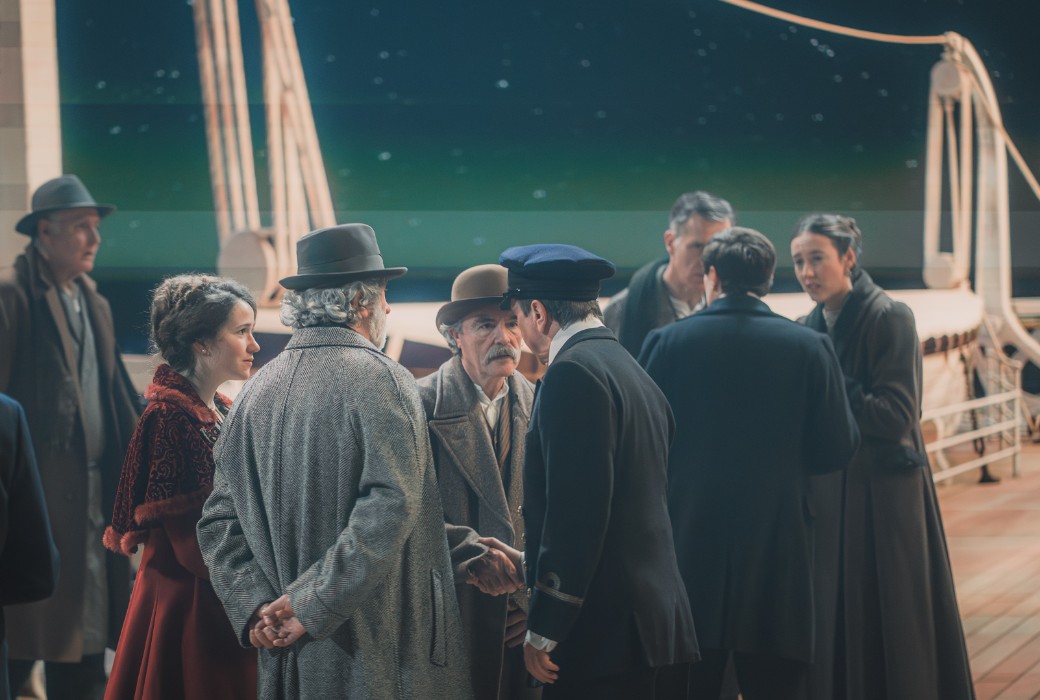
The drama of the 1912 sinking is in the eyewitness accounts, brought to life by actors, rather than the visual recreations of ambitious docudrama.
Firstly, what a great title is Titanic Sinks Tonight.
It immediately tells me what to expect and creates a sense of urgency. This isn’t just another doco on the sinking of the unsinkable luxury liner in 1912.
It’s a docudrama that weaves dramatic recreations with doco-style ‘interviews’ with actors bringing to life archival eyewitness accounts. It’s a creative way, if you like, to revisit a very well-told tale and it makes me wonder why more history sagas haven’t adopted this approach.
This 4 part series also endeavours to tell its story in sort-of-real-time beginning at 11pm on that fateful Sunday April 14th 1912. However, without a Kiefer Sutherland 24 clock ticking, it does make a few cheats, speeding up and slowing down time for storytelling purposes.
There’s no narration to this series, instead relying on actors and experts to unravel what happened, in case you are one of the few people on the planet who never saw Kate Winslet and Leo di Caprio immersed by water and ice (or even 1958’s excellent A Night to Remember).
There are no recognisable actors here, which adds to the credibility of the project. They sit in ‘master interviews’ recalling what happened as if it were Reality TV. Their dialogue is drawn from survivor letters, memoirs, newspaper interviews, telegrams and official inquiries (there’s even the odd question from a producer off camera).
It is dramatised through staged recreations representing the 2208 people who were aboard for the Southampton – New York maiden journey. Almost without exception, there is no dialogue heard by the actors, with voice-overs instead telling us eyewitness accounts by passengers and crew.
Amongst them are Jack Thayer a 17 year old first class passenger returning to America, Charlotte Collyer emigrating from England to the USA, youngest stewardess Violet Jessop, First Class passenger Lucy Lady Duff-Gordon, Celiney Yasbeck emigrating from Lebanon in the lower class decks, Fourth Officer Joseph Boxhall, Second Officer Charles Lightoller and Junior Wireless Operator Harold Bride.
They span a cross-section of class and society across the White Star Line vessel, which experts also remind us, was a significant factor amongst those who survived and perished after it struck ice.
When the moment happens in episode one, the extent of the damage is not fully realised, with memories revealing, “I hardly knew it happened / I was soon awakened by a long grinding sound / a backward jerk followed by a shorter one / a low crunching ripping sound as Titantic shivered.”
A communications system, or lack thereof, in 1912 was also a major contributing factor to those who could have been saved.
Pivotal to the series is the visuals both in terms of set pieces and computer generated visual. On this front the doco is more uneven.
With such a definitive multi-million-dollar movie as that by James Cameron, bringing to life the ship on a TV budget is a tall order. Ambition may have overshot the available budget, I feel.
One is somewhat forgiving of the scaled back sets, but the CGI is hard to deny. It’s very obvious production added in the exhaled icy breaths because it just seems to waft around faces rather than emanate directly from chilly mouths. I found it pretty distracting.
The closing credits indicate “AI has been used responsibly to create a small number of visual effect shots in this series.” No, really?
Yet I still admire the creative approach in realising the series. It does bring to life the drama and urgency of what occurred, and knowing they are real words adds to the poignancy.
Given the detail and the broad approach this has adopted, can we now please put Titanic on the back-burner at SBS? Short of home video footage resurfacing (and I reckon we can rule that out), there’s surely nothing left to tell?
Titanic Sinks Tonight screens 8:40pm Wednesday on SBS.