
Around 3,200 years ago, several major civilizations across the Eastern Mediterranean entered a period of rapid decline. The Mycenaeans, Minoans, and Hittite Empire all faced social and economic collapse. Historians have long linked this period to severe drought. A new study shows those dry years grew from several natural climate cycles acting together, rather than one single event.
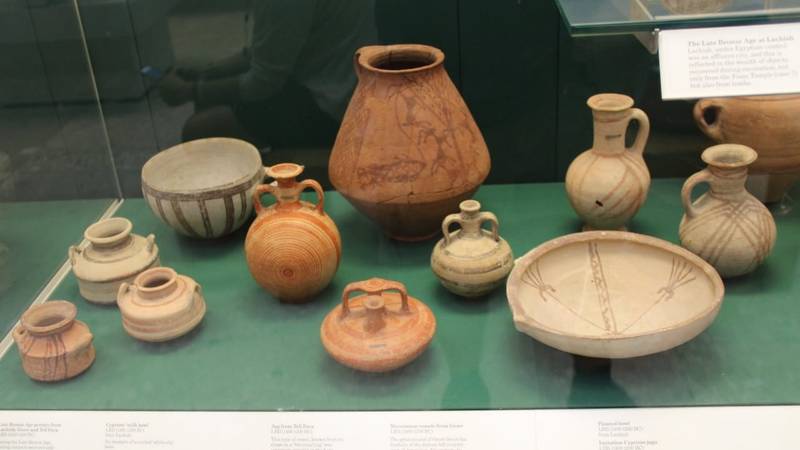 Late Bronze Age pottery from the Ancient Levant Gallery, British Museum, London, England, UK. Credit: Gary Todd
Researchers from Stockholm University rebuilt the region’s climate history over the past 8,000 years. Using the EC-Earth3-Tr8K climate model, they tracked changes in rainfall and moisture across the Eastern Mediterranean. The results matched evidence from natural records and showed a slow shift toward drier conditions after the middle of the Holocene.
The study found this long drying trend came from slow changes in Earth’s orbit around the Sun. Those orbital shifts reduced rainfall across much of the region over thousands of years. The pattern varied from place to place. The Levant became steadily drier, while parts of the Balkans and Anatolia held more moisture because cooler weather reduced water loss from soil and plants.
The worst droughts appeared when long-term drying lined up with natural climate swings in the Atlantic Ocean and atmosphere. Those shifts worked across time spans ranging from centuries to thousands of years. When several of those cycles peaked together, rainfall dropped far below normal across land already short of water.
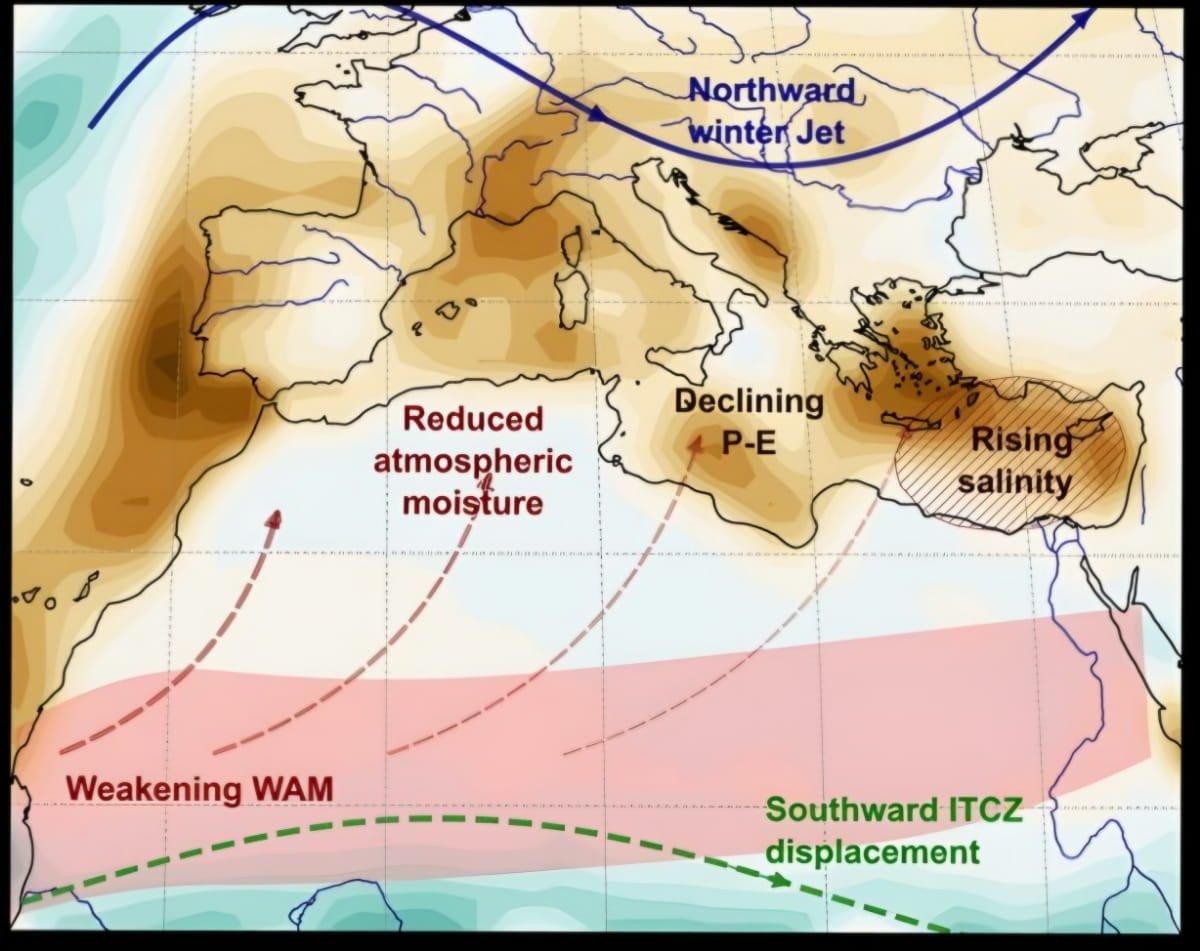 The Eastern Mediterranean dried as part of a broader climate transition; weakening monsoons and shifting atmospheric circulation reduced moisture from Africa and rainfall across the region. Credit: Katherine Power/Stockholm University
Lead author Katherine Power said the strongest droughts formed when several natural climate cycles aligned. Their combined effect created far harsher dry periods than the long-term trend produced on its own.
The team believes these extreme dry spells placed heavy strain on farming and food supplies. Water became scarce, crops suffered, and societies already facing pressure had fewer resources. The findings support earlier ideas linking drought to the Late Bronze Age collapse, while showing the climate story involved several natural processes rather than one sudden change.
The study also carries a message for the present. The Mediterranean faces warmer and drier conditions as Earth’s climate changes. According to the researchers, future drought risk will depend on rising temperatures and on how natural Atlantic climate swings line up with those long-term trends.
By rebuilding thousands of years of climate history, the team showed why some droughts became far more severe than others. The results point to a mix of slow climate change and natural ocean cycles shaping water supplies across the Eastern Mediterranean, with effects large enough to influence the course of human history.
Publication: Power, K., & Zhang, Q. (2026). Holocene ocean-atmosphere coupling and Mediterranean sensitivity to Atlantic circulation: Lessons from the Late Bronze Age collapse. Science Advances, 12(30), eaed5439. doi:10.1126/sciadv.aed5439