
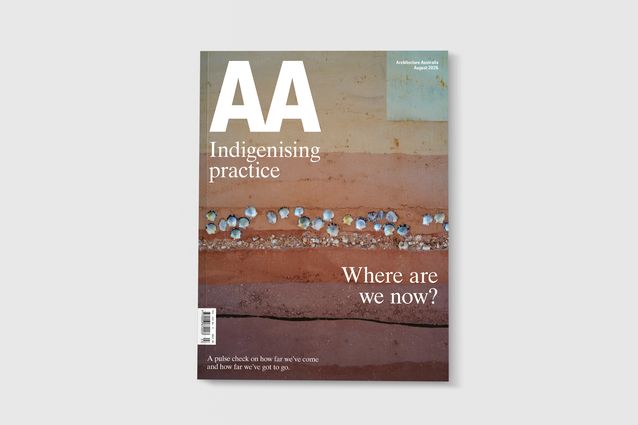
In late 2025, we held a Design Speaks event as a pulse check on how our industry was progressing in its efforts to Indigenise the built environment. Working alongside a curatorial committee of three highly respected First Nations built environment professionals – Sarah Lynn Rees, Carroll Go-Sam and Dillon Kombumerri – we explored both the challenges and opportunities facing a profession in transition.
The discussions and insights that emerged from that day gave multimedia editor Georgia Birks and me confidence that the time was right to publish a fully themed issue exploring the many ways Australian architects and designers are learning to engage with Country, empower Indigenous diversity and reconsider traditional architectural processes.
The lessons we took from working with Sarah, Carroll and Dillon informed the structure of this issue. For example, the data panels that introduce each project review provide a lens for understanding the context in which each team was working. By foregrounding factors such as procurement pathways, Indigenous involvement and community engagement, these panels encourage readers to consider not only the final outcome, but also the parameters, processes, relationships and decisions that informed it.
In selecting the projects featured in this issue, our intention was not to present “perfect” examples of how to work with and champion First Nations knowledge. Rather, we sought to document the progress that has been made, showcase the variations in process and approach, acknowledge the complexity of this ongoing work, and learn from both the successes and challenges encountered along the way.
We hoped to include more projects led by First Nations architects, but as we know, there still aren’t enough Indigenous architectural graduates yet in practice, and the number of Indigenous-led practices is even smaller. This reminds us of the vital role non-Indigenous practitioners have in supporting Aboriginal and Torres Strait Islander colleagues and communities in challenging inequitable systems.
This is also a point raised in this issue’s Dossier, which unpacks findings of the Indigenising the Built Environment in Australia survey, a significant project led by Dr Michael Mossman and Professor Donald McNeill of the University of Sydney’s School of Architecture, Design and Planning. This project aims to explore the impact of the integration of First Nations-focused performance criteria into national architecture competency standards, and the dossier breaks the findings down into key themes and learnings. Thanks to Michael, Dossier guest-editor, for sharing this research.
This issue also marks the relaunch of Architecture Australia as a journal that is not only a record for our profession, but one that shapes that record. Three of our four annual issues will be themed, creating a series of carefully curated editions that we hope readers will keep, revisit and share. Our final issue of each year will take the form of a yearbook, shifting the journal’s editorial mode to provide a snapshot of the year that was. Meanwhile, some of our more time-sensitive content – including awards announcements and industry news – will be published exclusively online at ArchitectureAu.com. In doing so, we hope to make the most of the relationship between our print and digital platforms to better serve our audience.
It has been a collaborative effort by the editorial team to make this relaunch happen, but a special mention must go to Jack Vening, managing editor at Architecture Media, who has been instrumental in steering the project from concept to publication. Finally, we must acknowledge the extraordinary work of graphic designer Mike Giesser, whose thoughtful redesign has also helped bring this vision to life.
We would love to hear what you think of the new Architecture Australia – please don’t hesitate to get in touch.
— Katelin Butler