
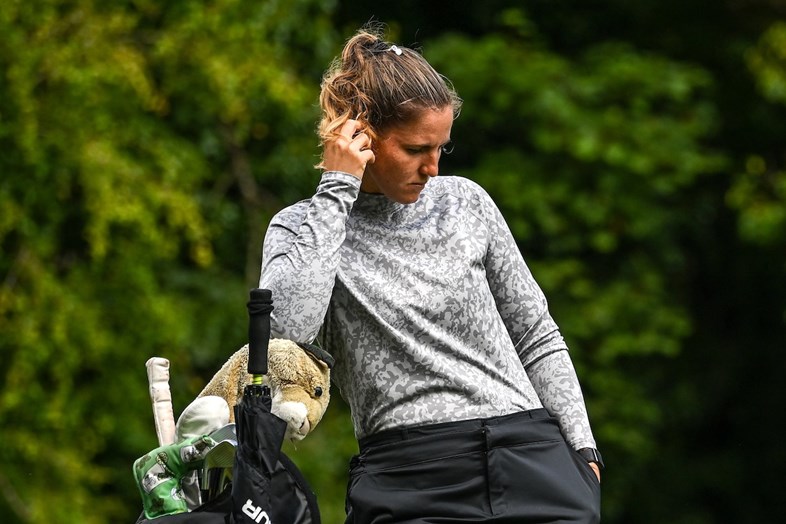
Leonie Harm experienced enough hardship in her youth for many lifetimes. Ahead of the AIG Women’s Open, she tells TG her inspirational story.
“My heart goes out for the version of myself that suffered through 11 years of thinking she’s going to die every single time she hit a bad golf shot.” Leonie Harm is reflecting on the car crash she wasn’t supposed to survive as a teenager and the residual trauma that then slowly enveloped her adult life.
In 2013, the 15-year-old Harm was out for a run in her home city of Heidelberg in south-west Germany when she was struck by a drunk driver traveling at 44 miles-an-hour. Harm was flung across the road, suffering a fractured skull, multiple bone fractures and a collapsed lung. She was given less than a one percent chance of survival and and placed in an induced coma for five days. “They said there’s basically no chance she’s gonna survive this severe brain damage,” she recalls being told in recovery.
Consumed by golf through childhood, Harm was a talented amateur and at this stage was destined for the professional ranks. The first question she asked when she eventually regained consciousness was whether it was viable to play in the upcoming German Girls’ Championship. “Seven weeks later,” she says, “I was back out on the golf course.”
Harm has recollection of her recovery but not the accident itself, a chasm in her memory that she once felt relieved to have. “That whole morning scene of me running was just completely gone,” she says. “Just no memories at all. There’s no out-of-body experience, there’s nothing whatsoever. This whole time I was like, ‘Oh yeah, it’s fine, like my body can’t remember.’”
But two years ago, Harm began to understand the extent to which her near-fatal experience has shaped her life. “It turns out that is the highest trauma response we have, so my body was actually in survival mode for 11 years until I decided to address that in therapy,” she tells TG at Royal Lytham, where she is about to make her fourth appearance in the AIG Women’s Open.
“Finally I was able to process the emotions I had through that accident. My brain could finally find peace again and relax and function like a human and not like someone who’s out in war. Humans are out in the war in a survival fight every day. A bunker in the fairway on the second hole at Lytham is a bunker in the fairway – still not ideal to be in but it’s not a life or death situation which I used to feel like before.
“I had full-on panic attacks on the golf course every single time I tried to hit a tee shot. I experienced it in highest stress situations where I would have blackout moments. I thought at first that this is a fear of needles. It starts when you take like blood in the hospital. I started blacking out completely.
“But then it started creeping into my golf more and more – and the more stressed I was the more it happened. That was where a sports psychologist and I parted ways because they were like, ‘Well everyone’s afraid when they’re on the first tee, just push through it.’ I said, ‘I don’t think you understand.’ I wouldn’t have a sensation in my body, I would start my swing and the next thing I notice is me having finished the swing and I have no idea where the ball is going. I was in a situation where I had to remove myself from golf for my mental health. It was insanity to just keep putting yourself in that situation that your body just clearly fears to be in.”
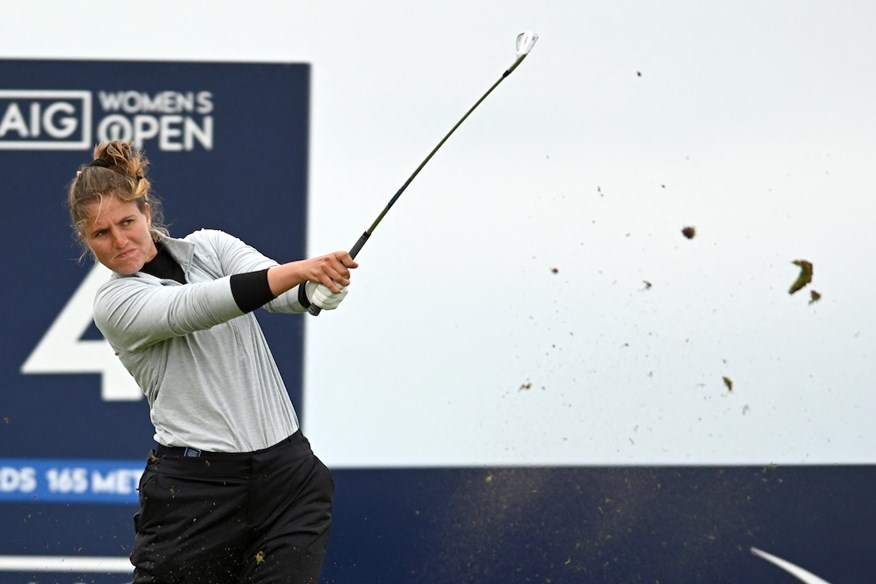
Long before her golf game reached the point of no return, Harm explored the possibility of another career in her youth. A graduate of biochemistry and biophysics at the University of Houston, Harm worked to find a Covid vaccine candidate during her college days Stateside.
But it was in Houston, during the summer of 2016, that Harm was faced with another personal trauma. Weeks before starting her second semester, Harm’s mother, Desiree, died. She had been battling breast cancer for several years.
“At my first semester back my mom’s cancer risk returned and she stuck it out like a trooper,” Harm recalls. “She didn’t really bring it up when I was away. Suddenly you have your whole world falling apart and your closest confidant not being there as you then have to go back to get a degree on the other side of the world.”
Harm finds comfort in the fact she was at home in Germany when her mother passed.
“I would have hated for my mom to having to go through this while I’m away. It was very clear that it was just going to be weeks so I think ultimately in the perspective of this being a really horrific situation, it was good in the way that we could say our proper goodbyes and actually physically be there. Then I went back to college had a semester of trying to grieve. I would give myself like a D-minus for that, I was not passing grade.”
Harm was 18 when she lost her mother and says that, reflecting on it now, she was too harsh on herself as she struggled to process her emotions. She is grateful for the “incredible” support of her college coaches in helping her navigate those isolating first months after her loss. When Harm was set on retirement in 2024, she was considering building on her education and working in cancer research. She still has plans in the future to dedicate herself to that career.
For now, though, Harm says she “will still be chasing a white little golf ball”.
It is only by chance that this perplexing pursuit has remained Harm’s day job. “In 2024, I actually made the decision to quit,” she explains. “I was done and dusted.” Harm planned to give up the game entirely after one final tournament at the notorious DLF Country Club in India.
“It’s the hardest golf course we have on the schedule,” she says. “If you’re not hitting it well, you’re not going to have a good time. I thought that was perfect because I was going to have the most miserable time of my life on the golf course and I’m not going miss it because that’s really the the thing you’re afraid of.”
As it turned out, Harm’s flights were cancelled and she could not make it to New Delhi. A week later though, she caddied for a friend as a favor at a lucrative event in Saudi Arabia. “I just hit a couple balls on the range for probably the last time in my life,” she says. Opportunistically, Scott Edwards, a PGA coach at Riyadh Golf Club, asked if she could take a look at the swing she was convinced was beyond repair. Harm had spent months digging into the dirt, driving herself crazy, trying to find alternate swing patterns.
But with Edwards, she found an almost instant improvement. Edwards made her realize her swing demons could indeed be overcome, and inadvertently reignited her career. There was no overnight fix and the first-tee nerves did not immediately dissipate, but slowly Harm found confidence again.
Almost 18 months after hiring Edwards, Harm added a special chapter to her inspirational story when she won her first Ladies European Tour title at the age of 28.
Instead of fearing the moment of jeopardy in the final round of May’s German Masters, Harm embraced it. She birdied her final two holes at the Green Eagle Course to close out victory by a single stroke. While Harm received $60,000 in prize money, the victory opened doors to the game’s biggest stages – like this week’s $10 million showpiece in Lytham – that for myriad reasons should never have been in reach.
“In the moment it feels like there’s no light at the end of the tunnel,” she says. “There are situations out there where there really isn’t and the situation itself is horrific. For example, I’ll never have my mom back.
“There’s irreversible struggles and traumas but the version of yourself that you’re going to be once you’ve fully navigated through it and emotionally processed everything is not going to be the same version of yourself that you’ve been before you went through all this.
“I can’t wait for the next challenges to come my way because I’m really excited for the character development ahead of me. I’m really excited to meet the version of myself that I’m going to be three, four, five years down the line when I’ve potentially navigated through more struggles which life just throws those our way.
“And I find that quite liberating.”