
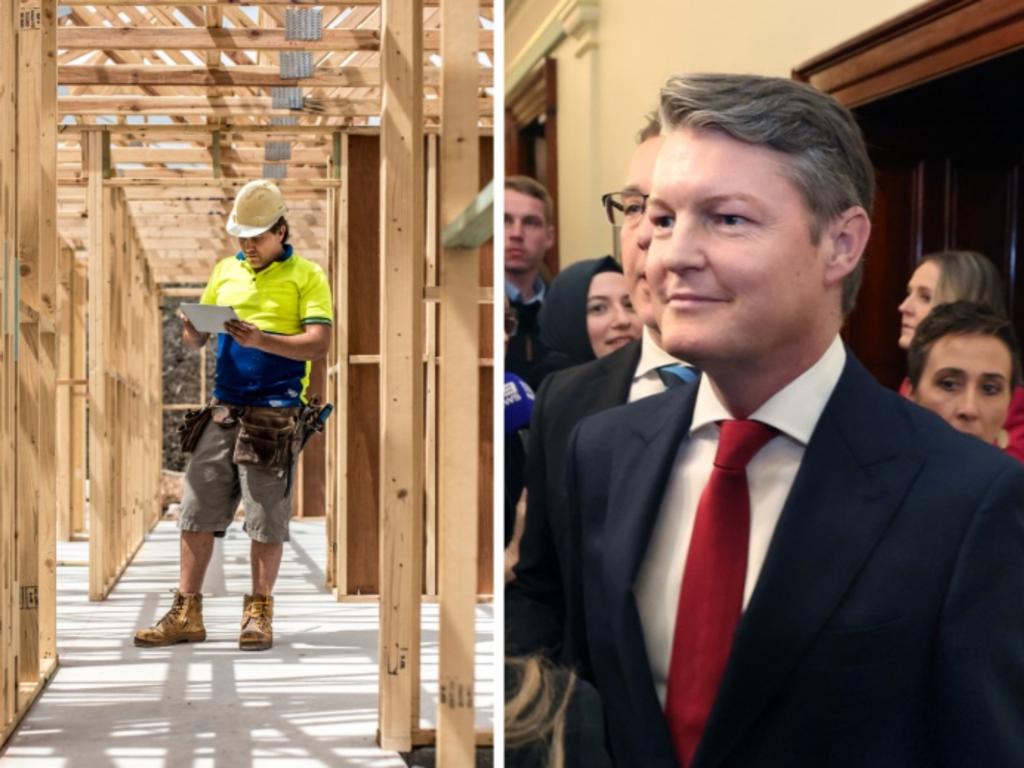

New Victorian premier Ben Carroll has been left with a problematic housing industry, with experts warning changes are needed before the November election.
Jacinta Allan will be remembered with mixed feelings by a property sector repeatedly left reeling by major upheavals during her term.
Her successor Ben Carroll is now facing calls for urgent changes to legacy policies and plans from the Allan government that are yet to come into effect, but could sway voters with changes — and hurt homebuyers, sellers and renters without amendment.
With dozens of policy moves and regulatory reforms across all spectrums of the housing sector (see the base of this article), Ms Allan’s tenure has been polarising with some lauding interventions that have given renters more security and others lamenting that it had “cooked the market”.
RELATED: Vic investors hit with $38m bill for empty homes
Shocking auction day reality for Melb sellers revealed
Victorian landlords face $62,000 fines for asking renters the wrong questions
Real Estate Institute of Victoria chief executive Toby Balazs said she deserved credit for putting the housing crisis “firmly on the political agenda”.
“But the legacy of any government should ultimately be measured by whether it made Victoria a better place to live, work and invest,” Mr Balazs said.
“On that measure, there is unfinished business.”
After more than 150 reforms, he said renters were still facing the same fundamental problems: affordability and availability.
“The answer is not another round of regulation that makes it harder to be a rental provider; the answer is more homes and more investment,” he said.
Property investors have been selling up and leaving Victoria faster than they’re buying into the state, following a raft of Allan-era changes.
Mr Balazs said that Mr Carroll would now need to understand that a strong property market was key to Victoria’s economy, and that investors did not come to the state by accident.
“We need serious consideration of tax reform and incentives that make Victoria an attractive place to invest, rather than continuing to pile on costs and regulation,” he said.
“A government that is prepared to listen when experts tell it that a policy will not deliver the outcome intended.”
He noted that the current Consumer Legislation Bill was one that needed revision and that all future policy should be considering how it will impact investment in the state.
On the home building front, Urban Development Institute of Australia Victorian chief executive Linda Allison said there had been “positive contributions” particularly the Housing Statement’s implementation, as well as sensible reforms to streamline planning.
“At the same time, the taxes and levies it has applied to the development sector have added unnecessary complexity and cost to building homes in Victoria, with costs passed to homebuyers,” she said.
Housing construction needs to remain the focus of the Carroll government, according to industry experts.
“It has also made urban planning policies such as 70-30 difficult to achieve.”
Ms Allison added that going forward, Mr Carroll needed to do more to recognise the importance of greenfield development in adding housing to the state, repealing the Windfall Gains Tax and to ensure infrastructure investment was targeted towards booming communities.
“And we urge new Premier Ben Carroll to make addressing the housing crisis the government’s top priority and to listen to industry’s advice when it comes to solutions,” she said.
Master Builders Victoria chief of public affairs Dr Corrie Williams said they had watched a huge wave of change come through the industry as it was already grappling with surging costs in building, adding to the challenges that global events had put in front of the industry.
Major concerns had emerged as changes to land tax left at least one of their members facing a bill that went from a few thousand a year to more than $200,000 — and no longer having a viable business.
Major changes requiring developers leave a bond for major projects have raised concerns for many builders who are tackling construction. Picture: NCA NewsWire / Andrew Henshaw.
Meanwhile increased consumer protections have led to higher premiums for home builders, while a proposed 12 month extension to the two year hold of a 2 per cent bond that is also being applied to builders was a likely to impact builders’ ability to finance future projects.
Dr Williams said the incoming Carroll government would need to look at contracting practices for builders with a view to creating ones that are fair and commercially realistic, further consultation with industry about any additional “red tape”.
“And regulators, like Victoria Police, must have greater resourcing to investigate and prosecute criminal and unlawful behaviour,” she said.
“It is not the role of a builder to address these behaviours. There also needs to be clearer lines of authority to ensure that unlawful behaviour doesn’t fall through the gaps between regulators.”
Housing Industry Association Victorian executive director Keith Ryan said Mr Carroll’s first goal should be to help builders get on with delivering more homes to the state.
More housing is considered the best solution to Victoria’s housing crisis.
“HIA is seeking an early and clear commitment from Premier Carroll that increasing housing supply will remain a central priority of the Victorian Government.
“We also urge the Premier to minimise changes to Cabinet and portfolio responsibilities. With a state election only months away, there are significant building and contract law reforms due to commence, while critical regulations are still awaiting public consultation.”
Tenants Victoria chief executive Jennifer Beveridge lauded “significant rental reforms” during the Allan government’s time, noting they had “made a real impact on the millions of renters in Victoria”.
“We urge all political parties to commit to dignity for renters by making sure these reforms are locked in for the future, enforced appropriately, and that housing supply and rental affordability are priorities,” Ms Beveridge said.
Property investment experts were less enthused with Ms Allan’s time in the top job.
Property Investment Professionals of Australia chair Cate Bakos said in her speech Ms Allan had noted improved affordability of housing for Millennials as a key achievement — something Ms Bakos disputed.
A reduction in rental homes across the state is believed to be leaving renters with fewer options to move into.
“She has missed the mark there, as a number of Millennials have gotten the short straw,” she said.
While for some this related to Albanese government changes to investor benefits that would-be rentvestors could no longer access, such as negative gearing, poor outcomes in the rental market where the cost of keeping a roof over tenants’ heads was surging, were also a concern for Millennials.
The professional property purchaser added that starting off as Andrews’ deputy, Ms Allan had overseen the implementation of changes to land tax that increased costs for investor and holiday home owners, as well as reducing the threshold at which they kick in.
“And the challenges of owning and renting out rental properties have not slowed down since she took over,” Ms Bakos said.
She noted that some changes, like those around safety for renters, had been worthy — if poorly implemented.
Rental properties have been left empty longer than the otherwise might have been as a result of delays in advertising them caused by a key policy change by the Allan government.
Others had been nonsensical, like preventing landlords from advertising homes while they update them to meet the latest regulatory requirements — leaving them sitting empty for longer.
And some policies would have the opposite impact of their intended goal, such as impending changes to auction reserve disclosure which Ms Bakos said would ultimately lead to fewer auctions being held and buyers getting less transparency when purchasing.
For the next leader of the ALP in Victoria, Ms Bakos said the best thing they could do was to sit down with property industry leaders and talk with them as many had plans and solutions for the major issues facing the sector.
“Better policy could be created with better consultation,” she said.
Ms Bakos added that there were still major concerns about upcoming changes to pre-auction reserve price disclosure, and for the mandatory building and pest inspection election promise, both of which had room for dodgy agents and vendors to wiggle around them.
Melbourne’s auction market could be set for a hit to its sales volumes, leaving buyers with a less transparent market.
“I think underquoting is putrid, but I think this will drive some other behaviours further underground and my biggest concern is agents resorting to expressions of interest and private treaty sales … and the buyer will be flying blind.”
Property Investor Council of Australia chair Ben Kingsley said the only good things he could think of being done by the Allan government were wiping stamp duty for off-the-plan purchases, and additional building protections for new home buyers.
“But they were forced initiatives, because they have completely cooked the market here,” Mr Kingsley said.
He added that the expansion of the Vacant Residential Land Tax without giving the tax an at least less misleading title, as it also covers vacant houses and not just land, was one of the poorest decisions the Allan government had made.
But the biggest mistake had been the changes to land tax and the minimum thresholds for it.
“That has made a lot of investors say it’s not viable,” Mr Kingsley said.
He advised Mr Carroll to get re-engaged with groups like the REIV as a matter of urgency as time was needed to counter industry concerns over the view the Victorian ALP appeared to have formed on property and investment in the state.
New Victorian Premier Ben Carroll has been advised changes are needed to get the property sector on track, and on side again, ahead of the November election. Picture: Jason Edwards.
Mr Kingsley warned that failing to work with industry groups to deliver more balanced policies, and better communicate them, could risk billions in future state funding longer term if we lost more investor activity as a result.
Community Housing Industry Association Victoria chief executive Sarah Toohey said Ms Allan had continued and expanded Andrews-government commitments to social housing that started six years ago and had boosted the number of social homes in the state.
“And it ensured that developers return some of the benefit of fast tracked planning through more affordable homes,” Ms Toohey said.
“These moves give more renters the safety and security of an affordable home.
“Cost of living pressures and a run away housing market means that there are still tens of thousands of people struggling in the private market to keep a roof over their heads.”
She added that the Carroll government could not abandon the space now, however.
“We need to see ongoing investment in social housing to help build our way out of this crisis for low income families.”
Allan government housing reforms and policies:
2023:
– Deputy to Daniel Andrews when the Covid-era debt recovery scheme was announced in the 2023 May budget, with landlords and second property owners including holiday home owners required to pay additional land tax — and the minimum threshold shifted from $300,000 to $50,000 (implemented on January 1, 2024);
– Took on office just after the Victorian Housing Statement was launched in September, with many of her subsequent policy moves linked back to the Andrews-era announcement;
– Homeowners give the right to build a small second home as a granny flat in their backyard without the need for a council planning permit;
– Designated the Minister of Planning as the responsible authority for major residential developments (worth over $50m in Melbourne and $15m in regional Victoria), effectively removing council opportunity to veto them;
– Announced a 7.5 per cent short-stay accommodation levy for owners of homes being leased out on platforms like Airbnb or Stayz;
– Initiated a blueprint to replace ageing public housing sites with rebuilt new housing, intending to replace 44 towers by 2050;
– Formally set a code for a 70-30 urban development split, intending to push the state towards building 70 per cent of its new housing in established suburbs with existing infrastructure;
2024:
– Banning no-fault evictions, forcing landlords to use prescribed reasons to remove a tenant;
– Lease-break costs capped at a maximum of four weeks’ rent;
– Implemented off-the-plan stamp duty concessions for homebuyers and investors for 12 months, which was subsequently extended, without setting a cap on prices;
– Announced 50 train and tram zones, as well as 10 pilot activity centres in key parts of Melbourne, intended to have significantly higher density development of up to 12 storeys, without councils having scope to push back on them;
– Announced Rental Dispute Resolution Victoria as a way to reduce the strain of rental disputes on VCAT, by handling basic tenancy disagreements (RDRV went live in 2025);
– Swapped commercial and industrial property from paying upfront stamp duty to annual land tax payments at 1 per cent;
– Established a tax exemption for owners who lease their properties for social, community or emergency housing services;
2025:
– Converted Domestic Building Insurance to a first resort model, allowing homeowners to access insurance for defective and incomplete work without having to wait for a builder to be formally liquidated;
– Instituted a 2 per cent bond for developers of apartment complexes bigger than three storeys, intended to be held by the Victorian Building Authority for two years to ensure rapid repairs for structural issues and defects;
– Updated planning rules to speed up subdivisions of backyards to 10 days where they complied with necessary guidelines, cutting back from a typical 60 days;
– Shifted approval timelines for houses and duplexes to 10 days, townhouses and complexes up to three storeys to 30 days, with both these categories also no longer needing to give public notice or VCAT appeal rights to neighbours, and anything bigger to be processed for planning in 60 days, with only direct neighbours able to object and interest groups barred;
– Updated list of requirements for ‘comparable’ homes when agents indicate relevant properties for pricing estimates, intended to reduce scope for dodgy valuations that mislead buyers;
– Extended ban on rental bidding to stop landlords accepting higher offers than the advertised price, going beyond prior legislation that had just banned the solicitation of such offers;
– Extended eviction notice period, and notice of rent increases, from 60 days to 90 days (announced in 2024);
– Implemented a requirement for landlords to have homes fully compliant with all rental standards and regulations prior to advertising the home for rent;
– Blocked landlords from demanding more than a month’s rent upfront, unless the rental exceeded $900 a week;
– Made it mandatory for landlords to check smoke alarms are working in their properties;
– 30-year regional blueprint effectively barred regional councils from outward housing expansion unless they could guarantee immediate connections for water, transport, sewerage, etc …
– Announced minimum standards for rental energy efficiency, touching on insulation, draught proofing, hot-water systems, efficient heating and cooling as well as low-flow showerheads and slated for implementation from March 1, 2027;
2026:
– Established Portable Rental Bond scheme to allow tenants to transfer bonds between homes, rather than temporarily be out of pocket for two;
– Established a standard rental form as mandatory for the state and put in place penalties for landlords who ask questions that go beyond this;
– Banned rental application and payment processing fees from third-party apps;
– Gave VCAT expanded powers to evaluate if rental increases are excessive;
– Announced an $860m boost to the Social Housing Growth Fund intended to help not-for-profit community housing groups build and operate an extra 7000 homes in the next 10 years;
– A $16m pilot program of rent-to-buy for First Nations Victorians to access and ultimately own their home;
– Tenancy Plus scheme announced $6.1m designated to help keep social housing tenants from becoming homeless;
– Vacant Residential Land Tax expanded to every municipality in Victoria, rather than the 16 initially affected by the policy implemented by Daniel Andrews;
Upcoming:
– Underquoting auction ban to force home sellers to disclose their auction reserve seven days before auction from October 1 this year;
– From January 1 next year developers will pay a flat infrastructure levy as part of the Developer Contribution Scheme, replacing council collection schemes;
– Home sellers to be forced to disclose their sale price to commence from October 1 this year, though a time frame for how long vendors have after their sale to indicate the sale price publicly is not yet known;
– Requirement for sales contracts to be available for 14 days prior to the sale of homes being allowed;
– Repeal of Section 27, which allows for early deposit releases including to agents, but will now only be allowed if it is expressly in the contract – and even then only to owners;
2026 election promise:
– Requirement for home sellers to obtain a building and pest inspection for their residence to be provided to buyers, then reimbursed by the successful purchaser, to be legislated early in 2027 pending an ALP victory at the polls in November this year;
Sign up to the Herald Sun Weekly Real Estate Update. Click here to get the latest Victorian property market news delivered direct to your inbox.
MORE: Victorian government hit with grim election warning on housing crisis
Metricon builds China-made Melbourne homes in just 20 days
Melbourne housing market worst in a decade: 93% of suburbs fall