
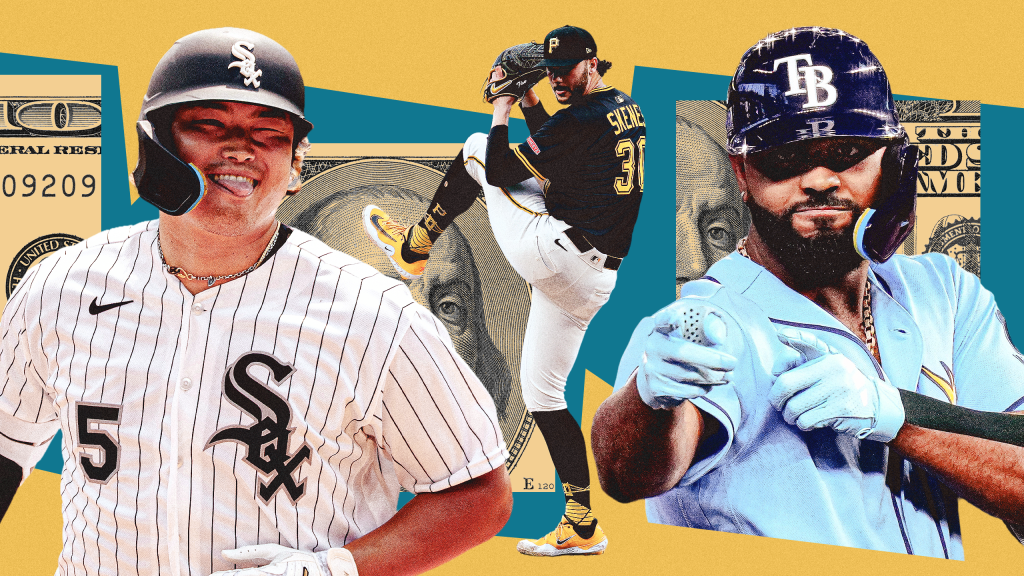
The Tampa Bay Rays are providing an inconvenient counterweight to MLB owners’ framing of modern baseball.
Owners have long held up the financial disparities in the sport, and their subsequent impact on competitive balance, as a reason to overhaul its cost structure and implement a salary cap. Yet the low-spending Rays have the best record in the American League, at 62-44, and a 1.5-game lead over the New York Yankees in the AL East division.
Tampa Bay is doing this with a payroll of roughly $114 million, the third-lowest mark across the league, according to real-time Spotrac data. And it’s not the only club balling on a budget four months before MLB’s collective bargaining agreement expires on Dec. 1.
Among the bottom half of spenders in MLB this season, four are currently in line for one of baseball’s 12 playoff spots, with another six on the bubble. The Milwaukee Brewers lead the NL Central and are tied with the Los Angeles Dodgers for the best record in baseball. The resurgent Chicago White Sox sit atop the AL Central with a team of largely young and cheap talent. The Cleveland Guardians occupy the final AL wild card spot. The Pittsburgh Pirates, Washington Nationals, St. Louis Cardinals, Miami Marlins, Minnesota Twins and Seattle Mariners are all within three games of qualifying for the postseason.
Meanwhile, despite MLB not having a salary cap or salary floor, three of the 10 teams with the largest payrolls find themselves in baseball purgatory. The Toronto Blue Jays are 10 games under .500 following their run to the World Series, the San Francisco Giants have a near-zero chance to reach the postseason and the New York Mets—and their roughly $358 million payroll—are threatening to go down as the biggest waste of money in the sport’s history.
It’s a rarity for tight-wallet teams to win the World Series—only one of the last 15 champions had a payroll in the lower half of the league—but quite common for them to play in October. Since 2011, the furthest back that Spotrac’s data goes, around 36% of clubs with a bottom-15 spend have made the playoffs. Even though bigger budgets undoubtedly create an advantage, the presence of those high spenders doesn’t rule out any franchise’s chance to compete, so long as it builds its roster efficiently and catches an occasional break.
“I think over the broader scope, you can say it’s not abnormal for a low-spending team in Major League Baseball to make it into the playoffs,” Martin Conway, a professor at the Georgetown University Sports Management Institute, said. “And then I think what happens is that because of the nature of a short series, the prospect for those high-spending teams getting eliminated is maybe a little bit higher than say in the NFL or someplace like that.”
The Major League Baseball Players Association additionally believes that the lowest spenders are actively choosing not to spend as much as they are able. “Every team in baseball can afford to compete, many are choosing not to,” MLBPA interim executive director Bruce Meyer said, according to USA Today.
But MLB and its owners are steadfast in their belief that the league needs major changes. Commissioner Rob Manfred has referenced the dominance of the Dodgers to make the case a salary cap is needed to maintain parity, increase fan engagement and protect the future of the sport.
Last year, the Dodgers had the No. 1 payroll at $515 million, inclusive of luxury tax payments, while the Marlins ranked last at $69 million, according to MLB.com. Los Angeles went on to win its second straight World Series, while Miami finished 79-83.
Los Angeles also earned a reported $334 million from its regional broadcast deal; compare that to a team like the Minnesota Twins, which sold about $5 million worth of streaming subscriptions after their cable deal with the formerly named Diamond Sports Group went bust in the company’s bankruptcy saga.
The Dodgers continue to be elite in 2026, but many of their deep-pocketed peers have failed to join them.
The strong performance of baseball’s low-spending teams this season “undercuts [MLB’s] argument,” Tony Torain, a partner and the lead of the traditional labor practice at McDermott Will & Schulte LLP, said, even if “the longer time horizon proves the league’s point” that spending money correlates with winning. But the impact of a potential salary cap would go far beyond just leveling the sport’s playing field.
“There is an element of this that has to do with competition and attracting the best talent,” Torain said. “But I also think an element of it is cost certainty with the correlation between the valuation of these teams, especially as compared to other leagues. So I think that probably is the driver.”
Among the four major North American men’s sports leagues, MLB is the only one without a salary cap, and the appreciation of its franchises has lagged in comparison to the others. Over the past five years, the growth of MLB’s “get-in price”—the valuation of its lowest-ranked franchise—severely lags the NHL (up 217%), NBA (up 199%) and NFL (up 159%), with the No. 30 Miami Marlins having only increased in value by 29% since 2021. While baseball isn’t alone in dealing with the collapse of the regional sports network model, it’s felt the brunt of the impact.
Baseball does have the benefit of booming attendance, TV viewership and engagement from younger fans. It also attained a record sale price for one of its franchises when a competitive bidding process for the San Diego Padres led to private equity billionaire José E. Feliciano and his wife Kwanza Jones agreeing to purchase the club for $3.9 billion in April.
That momentum, though, is threatened by the ongoing labor fight, including fears that a potential work stoppage could shorten or even cancel the 2027 season. No matter who wins the Fall Classic this year, the salary cap debate isn’t going anywhere.
“We’ve gone over a hundred years without the salary cap. The momentum of baseball at this point is going on such a positive trajectory, is it really worth it to give it up for the owners?” Torain said. “And it may be, but that’s a question I think that needs to be considered.”