

“We devised a model for consideration by our playing conditions advisory committee that allowed for injury substitutes in first class cricket,” a Cricket Australia spokesperson told this masthead.
“Our initial advice was that this model would not comply with the parameters set for such trials by the ICC. More recent advice suggests this could now be possible, and it is something we are investigating ahead of the coming season.”
The trial is intended to introduce a way to cover the impact of serious injuries on an affected team, while reducing the chance of the system being exploited to disadvantage teams that have 11 fit players.
A mandatory post-game stand-down period for the substituted player is one of the ways that rorting the system might be avoided.
There is also debate about when would be the most appropriate time for a trial: immediately after the Big Bash League when players are adjusting back to long-form cricket and injuries become more likely, or during the block of games before the Ashes when Australia’s Test players make rare domestic appearances.
“If the game is serious about considering this, it needs to go through a process with all stakeholders and get players’ views and other views and work through all the scenarios to see whether it actually makes sense,” Australian Cricketers Association chief executive Paul Marsh said. “You’ve got to keep an open mind to things, but this needs to be considered from all angles.”
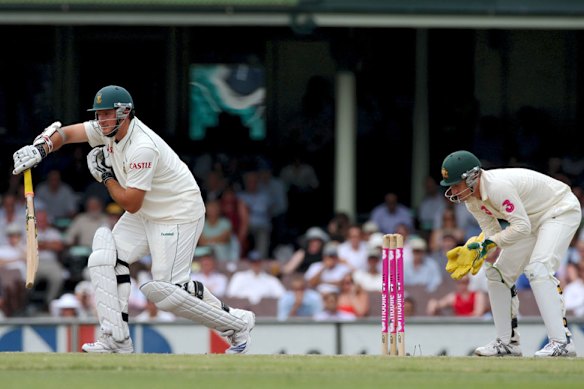
In the 2009 Test between South Africa and Australia, Graeme Smith took to the crease with a broken finger.
Some of the most ardent advocates for injury substitutes have long resided in Australia. Among them is CA’s long-serving chief medical officer, Dr John Orchard, who had this to say in 2012, when looking at how players were increasingly required to play Twenty20 games in proximity to the very different requirements of Tests.
“No one is going to limit T20 cricket when it is getting bigger crowds and it’s bringing in more money than the traditional forms of the game,” Orchard said. “You’re never going to stop players playing in tournaments that earn more money than their Test cricket.
“Bringing subs in is a radical solution, but it is one that has to be debated more and more. It is really a matter of how long we’re prepared to sit back and watch injuries have a greater and greater impact on cricket matches, before people get sick of outcomes of Test matches being decided by who happens to have the least injuries rather than who has the better side.”
Loading
On the flipside, seasoned Test cricketers have always been extremely wary of the rule, as outlined by Smith during his time as a venerated skipper of South Africa.
“I don’t think there’s a sport out there that really tests you for as long mentally, emotionally and skill-wise other than Test cricket, and I think maybe rules like that might soften the blow a bit,” he said. “That’s why people who look back over time can be proud of what they’ve achieved, that they’ve been able to handle what this game is all about.”
Fast forward to 2025, and it was Stokes who offered the most strident opposition to the idea, based on the realities of how battered a fast bowler’s body can get towards the end of a long series.
“I think it’s absolutely ridiculous that there’s a conversation around an injury replacement,” Stokes said. “I think that there would just be too many loopholes for teams to be able to go through. You pick your XI for a game; injuries are part of the game.
“I completely understand the concussion replacement – player welfare, player safety. But I think the conversation should just honestly stop around injury replacements because if you stick me in an MRI scanner, I could get someone else in straightaway.
“If you stick anyone else with an MRI scanner, a bowler is going to show, ‘oh yeah, you’ve got a bit of inflammation around your knee; oh sweet, we can get another fresh bowler in’. I just think that conversation should be shut down and stopped.”
News, results and expert analysis from the weekend of sport sent every Monday. Sign up for our Sport newsletter.