
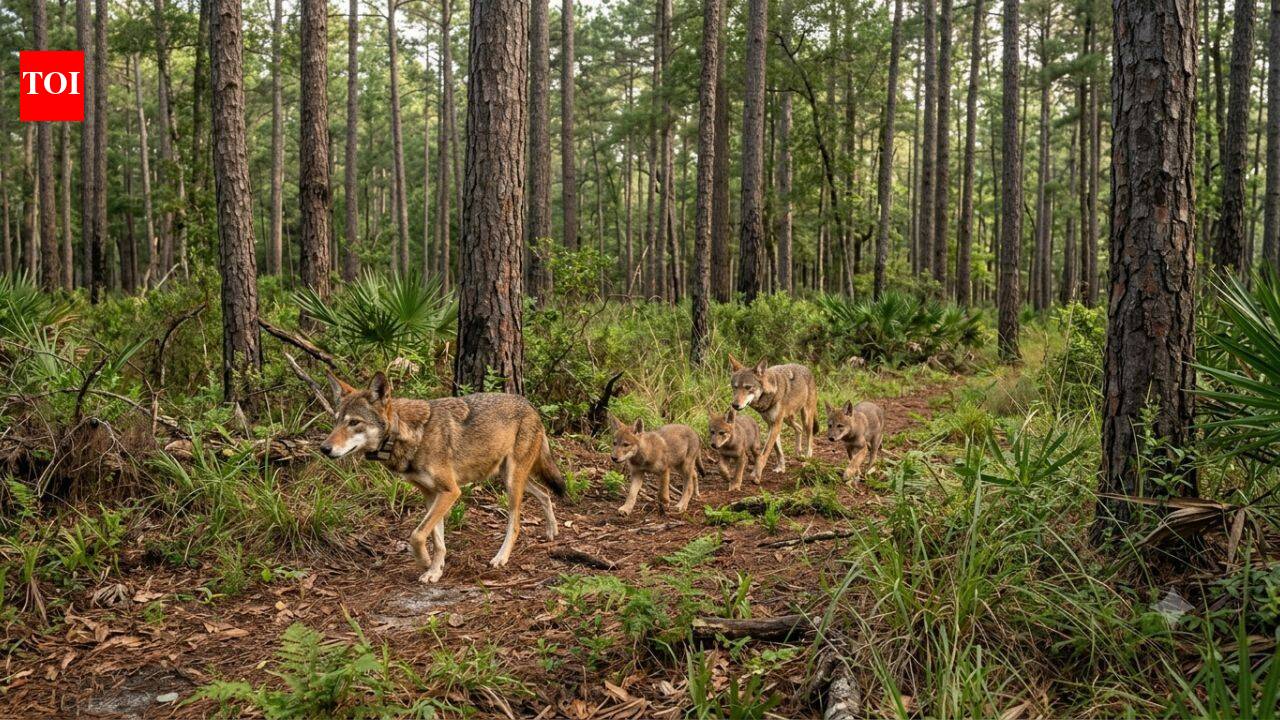
 There are places in eastern North Carolina where hearing a red wolf remains an unusual event. The species has spent decades balancing on the edge of extinction, surviving through an effort that has stretched across generations of wildlife biologists, conservationists and local landowners. This spring brought an encouraging sign. Several litters of pups were born in the wild, adding new life to a population that still numbers only a few dozen animals. The births do not remove the many risks the species faces, yet they offer a reminder that recovery is sometimes measured in small, hard-earned steps rather than dramatic leaps. For the red wolf, every successful breeding season carries unusual weight.
How the red wolf nearly disappeared
The red wolf once ranged across large parts of the southeastern United States. It occupied forests, wetlands and coastal plains, living alongside a changing landscape long before widespread settlement altered its habitat.By the middle of the twentieth century, that range had collapsed. Intensive hunting, organised predator control programmes and the steady loss of suitable habitat pushed the species towards extinction. As numbers fell, another challenge emerged. Red wolves increasingly bred with expanding populations of coyotes, making it harder to preserve genetically distinct animals in the wild.Wildlife officials eventually accepted that the remaining population could not survive without direct intervention.
The race to save the last remaining wolves
During the 1970s, conservation teams searched the Gulf Coast in an effort to locate surviving pure red wolves before they vanished entirely. The task became increasingly difficult because so few animals remained.Only 14 wolves were ultimately selected to establish a captive breeding programme. That small group became the genetic foundation for every red wolf alive today. Without those animals, the species would almost certainly have disappeared from the planet.Captive breeding was never viewed as the final goal. The larger ambition was to return red wolves to landscapes where they could once again live independently.
North Carolina becomes the centre of recovery
The first reintroductions began in eastern North Carolina during the late 1980s, making the area home to the world’s only wild population of red wolves.For a period, the programme appeared to be making steady progress. Packs formed, pups survived and numbers gradually increased. At its strongest point, the wild population exceeded one hundred animals.That progress proved difficult to maintain. Vehicle collisions, illegal shootings, habitat pressures and continued hybridisation with coyotes slowed recovery. Population estimates dropped sharply over the following years, leaving conservationists concerned that decades of work could be undone.
Red wolf pups mark a rare conservation success
This year’s breeding season has provided one of the most encouraging developments in recent memory. Nearly two dozen pups were born in the wild across several litters in eastern North Carolina, offering a valuable increase to the existing population.Young wolves face many hazards before reaching adulthood, so not every pup will survive. Even so, successful reproduction across multiple packs suggests that breeding pairs remain established and capable of raising young under natural conditions.Conservation organisations described the births as an encouraging sign for a species that has repeatedly faced setbacks throughout its recovery.
A population that remains extremely small
Despite the arrival of new pups, the red wolf remains among the rarest wild canids anywhere in the world.As reported by International Wolf Center, current estimates place the number of adult wild red wolves at roughly 22 to 24 individuals during 2026. That figure highlights how limited the recovery still is. A disease outbreak, several road fatalities or the loss of breeding adults could quickly affect such a small population.Captive breeding programmes continue to play an essential role by maintaining genetic diversity and supplying animals that may support future releases when suitable conditions exist.
Community support plays a key role in saving red wolves
Protecting red wolves extends beyond managing wildlife alone. Much of the recovery area includes private land, making cooperation with local communities an important part of long-term conservation.Biologists monitor wolf packs, track breeding success and work to reduce conflicts with coyotes. Public education has also become part of the recovery effort, helping residents distinguish red wolves from other canids and understand the legal protections surrounding the species.Recovery depends as much on consistent management as it does on successful breeding seasons.