
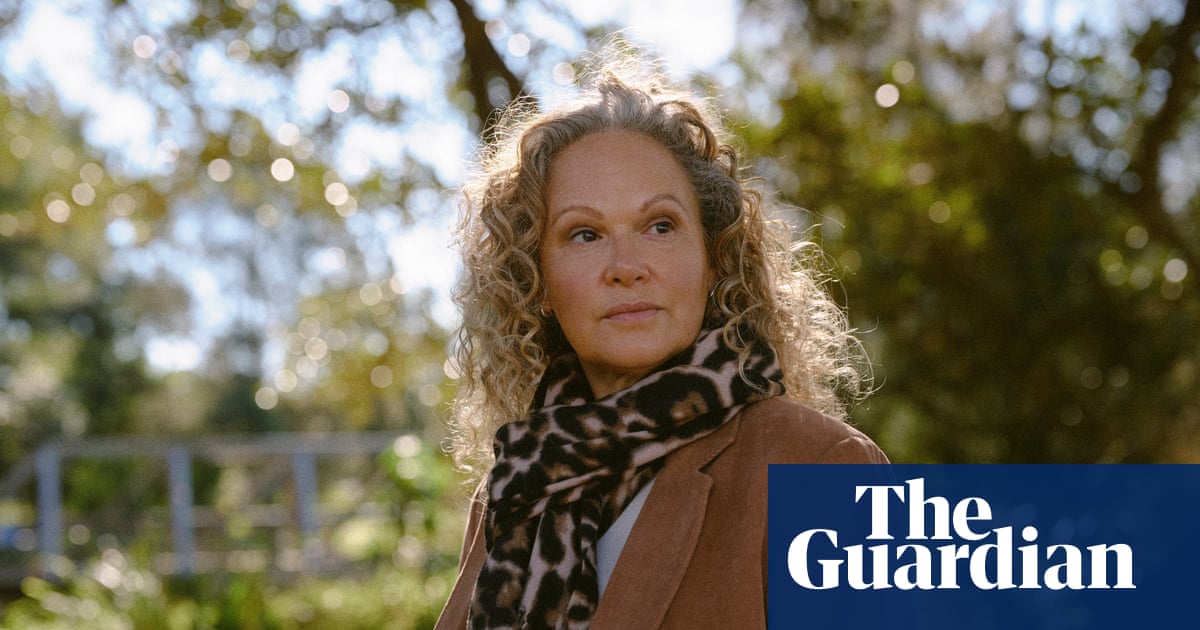
It’s a gloriously sunny midwinter’s day in Sydney. The sky is blue and cloudless, the air is crisp and Blackwattle Bay glimmers in the light.
It’s the middle of the school holidays and Jubilee Park is busy. Kids on push-bikes, toddlers in the playground, old folks out with their dogs. Trams shuttle past. A family of ducks cruises along the canal. Distant traffic moves endlessly across the Anzac Bridge.
This is Leah Purcell’s favourite place for a quiet afternoon walk with her dog, a Sydney silky terrier called Odie.
“I like it when there’s no one around,” she says.
Purcell has had an incredible career since I first interviewed her in 1997, when she appeared on the theatre scene with the semi-autobiographical one-woman play, Box the Pony. Co-written with Scott Rankin, Box the Pony was based on Purcell’s life, growing up in central Queensland, a harrowing and at turns darkly hilarious story of survival, trauma and the fierce love between a mother and daughter.
The play went on to win several literary awards and launched her reputation as a versatile actor, scoring key roles in landmark Australian films like Lantana, The Proposition and Jindabyne, as well as stints in network television and prestige dramas alike. Not bad for a Murri girl from Murgon who, as the accolades, experience and confidence have grown, has never forgotten where she comes from.
Purcell in Sydney’s Jubilee Park: ‘I like it when there’s no one around.’ Photograph: Joel Pratley/The Guardian
Purcell is a bright spark on this cool day, fizzing with warmth and good humour. She throws herself “completely into” each new project, she says, and her newest one – an opera version of The Drover’s Wife – is a leap into the unknown, rarefied world of opera.
Purcell’s adaptation of the 1892 short story by Henry Lawson has been through many iterations. Her version of The Drover’s Wife began in 2016 as an award-winning stage play, a bestselling book in 2019, and then a feature film (for which Purcell won an Aacta for best actress in 2023).
In Lawson’s original story, set in the high country of the Snowy River, the Drover is away and his heavily pregnant wife is left to defend herself and her four young children against a snake entering their hut.
Purcell – a Goa, Gunggari and Wakka Wakka woman – says she grew up hearing the Lawson tale. Her mother read her the story when she was a child, and in it she could see her mother’s own fight to keep her family safe.
‘We’ve got spirit, we’ve got Aboriginal dancers, language, Aboriginal storytelling coming through so it’s very unique,’ says Purcell of the opera. Photograph: Joel Pratley/The Guardian
In her Indigenous feminist retelling, Purcell gave The Wife a name: Molly Johnson. Molly is the fierce, gun-toting protector of her children, the snake is a totem, and dramatic tension escalates with the arrival of Yadaka, an Aboriginal man. Yadaka is on the run from colonial violence and is seeking safety. He also knows the true story of Molly’s family history. The character is based on Purcell’s great-grandfather, she says, “So it’s our family story that I’ve woven through the Henry Lawson story.”
Purcell’s version centres the Aboriginal characters, giving them voice and agency – and along the way tells the harder truths of the impact of frontier violence, racism, gender violence and colonisation. The scale and drama of opera, then, is a fitting new forum for the tale.
“We want to be a part of mainstream and the wider culture and share culture. This is Aboriginal storytelling up against a European opera. We’re a little bit older by a couple of thousand years, but we’ve got two ancient forms coming together, and it works,” she says.
“What I love about the opera is it allows me to dream bigger because it’s an epic world. With the scale and the scope that opera allows, I could dream up the spirit world. So we’ve got spirit, we’ve got Aboriginal dancers, language, Aboriginal storytelling coming through so it’s very unique,” she says.
“Every creative wants to do the wacky, wonderful big thing, and this is it for me.”
For Opera Australia Purcell is directing and collaborating with composer George Palmer, known for his operatic adaptation of Tim Winton’s Cloudstreet.
“He’d write something, I’d write something, and it was really cool,” she says, as we dodge a chatty gang of little boys on push-bikes. We reach the eastern edge of the park, and a big gust of wind turns us around on the path, back the way we came along the waterfront.
Purcell is a singer, too. Early in her career, her song Run Daisy Run became an anthem for the Stolen Generations, based on the life story of her maternal grandmother, Daisy Walker, who was forcibly taken as a child. The song, sung from her parents’ perspective, exhorts Daisy to run to the highland, through the scrub, away from the white man coming to take her away. Daisy was five, and never returned home. Purcells’ musicianship has helped to imagine the way voice can help tell the inner story of the characters, as well as how the music can incorporate Aboriginal song and story. The idea of opera was a bit intimidating at first, she says. But she realised she had already done many intimidating things in her career.
“I said, look, I’ve been in a band, but I don’t read music. After four workshops, though, I knew my score. I sat down and I went, I can follow this, everybody. Look out, boys! Look out!” she laughs.
Palmer’s score is accompanied by Purcell’s libretto, which Palmer also contributed to, and it is sung in English with Indigenous language and music woven throughout.
“George kept saying, “What’s the Aboriginal music? And I’d say: “Mate, it’s our vocals and body.’ The didgeridoo doesn’t belong to us. That’s from up north. Yes, it was gifted and it came throughout the land later, but I want to be truthful. No disrespect to that instrument or the people but you don’t want to be stereotypical. For us, it’s about our voice. Clapsticks are big. The rattle of the boomerang. And women would drum on possum skin. You’d have your possum hides to keep you warm, then when you had ceremony, you lay it across your lap and drum. It was a bit hard to compete against the big orchestral drums but the women gave the gesture,” she says.
“George knew how it would all fit together. He’s a genius. I don’t know if a lot of people know, but George is deaf. He’s got hearing aids. It was pretty magic to sit there and listen to it all, and I said to George, ‘It’s beautiful.’ He broke my heart when he said, ‘I’ll never know.’”
Purcell’s next project is a screenplay about revered Aboriginal leader Aunty Ruth Hegarty, who grew up in the notoriously harsh mission dormitory at Cherbourg in Queensland. Photograph: Joel Pratley/The Guardian
“This is a good yarn,” she says. “In opera, you’ve got deaths, you’ve got people fighting governments, you’ve got people hurting others, you’ve got people falling in love. It’s all the same. I’ve just sprinkled my black pepper through it, and it just happens to have our Indigenous content.”
With Molly Johnson now embedded in the Australian stage and film canon, Purcell says she is turning to other stories. She has just finished the first draft of a new screenplay, about revered Aboriginal leader Aunty Ruth Hegarty. Aunty Ruth grew up in the notoriously harsh mission dormitory at Cherbourg before being sent out to work as a domestic servant during the so-called Protection Era. The screenplay, in true Purcell style, is about that unrelenting harshness, but it is especially about the resilience, humour and strength of Ruthie and all the “dormitory girls”. Another story born out of Purcell’s fierce love for the women of her family.
The sun has dropped behind a bank of clouds and Purcell has to get back to rehearsals. I wish her luck for the opening.
“Toi toi toi,” she says.
Um, what?
“It’s the opera thing to say,” she explains. “To wish you good luck.”
The Drover’s Wife, produced by Opera Australia in association with the Queensland Performing Arts Centre and Oombarra Productions, plays at the Sydney Opera House from 7–15 August