
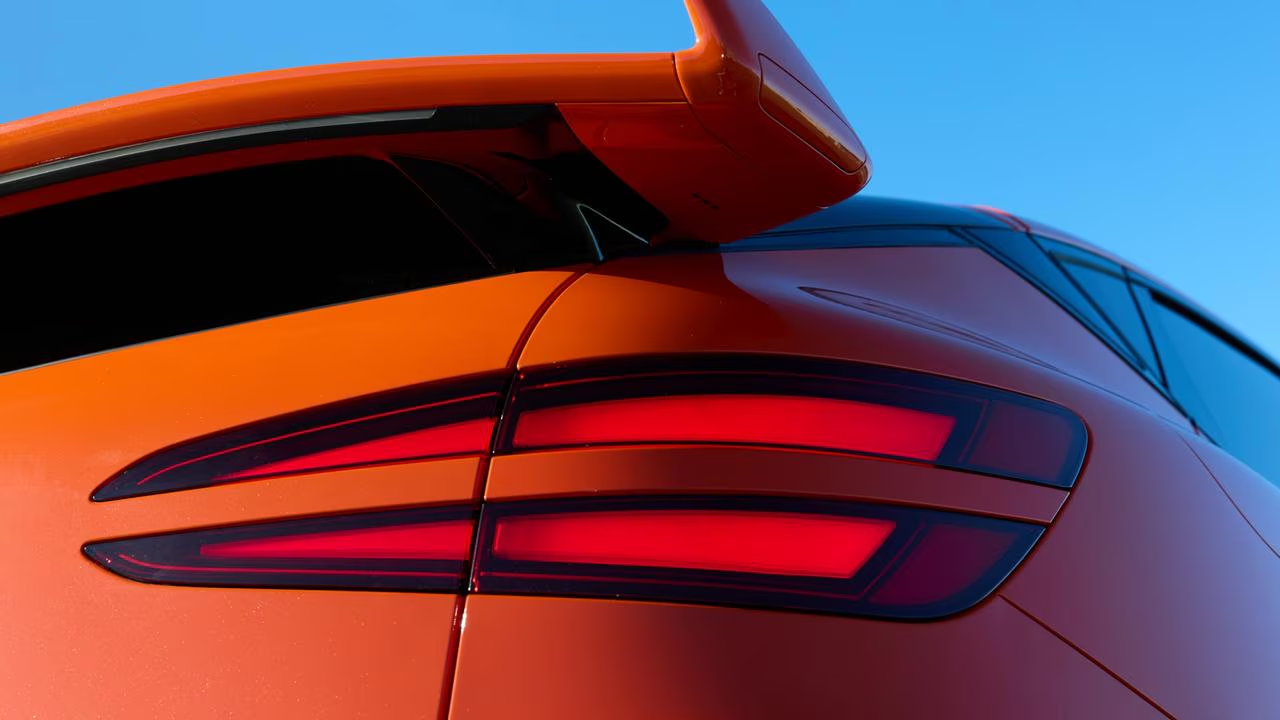
Does Australia really need another performance car, especially one with both a “Boost Mode” and a “Drift Mode”? Of course it does.
Genesis, the Hyundai-owned luxury brand, has never done things conventionally.
It arrived in Australia in 2019 with a pair of sedans, the G70 and G80, at a time when the sedan market was in steep decline. It didn’t open conventional showrooms, instead it created ‘Studios’ in the Sydney and Melbourne CBDs.
MORE: How Genesis plans to take on the world
And it was originally planning to skip hybrids and evolve straight from petrol and diesel power to being an all-electric brand.
But none of that really worked as planned.
With pressure mounting as more and more new luxury brands hit the Australian market, Genesis has had to revert to one of the most conventional ways to attract local buyers – performance cars.

Even so, it is putting its unconventional twist on things, launching a performance sub-brand called Magma (rather than just picking a letter or acronym) and introducing its first production car in the form of an all-electric small SUV.
Hardly the kind of car to worry the Porsche 911 – but Genesis has a plan for that …
The GV60 Magma may be a small, electric SUV but make no mistake, it still has serious performance credentials. In part thanks to Hyundai, because the GV60 Magma uses the Hyundai Ioniq 5 N and 6 N as its starting point.
MORE: Car giants probed over privacy credentials
These are arguably Hyundai’s most advanced, and certainly fastest, cars ever offered so it makes sense to leverage the connection to fast-track the first production Magma model. Despite the similarities between the three cars, Genesis’ designers and engineers have worked hard to ensure that there is enough difference between the GV60 Magma and the Hyundai pair to justify its premium position and higher price tag ($130,000 compared to $115,000 for the Hyundais).

The key shared componentry is what powers the GV60 Magma, a dual-motor, all-wheel drive electric powertrain that makes 448kW of power and 740Nm of torque. Or at least it does until you hit the ‘Boost’ button on the steering wheel and it gives you a burst of 478kW and 790Nm, which is more grunt than a Ferrari Amalfi or a Porsche 911 GTS.
But this is where the GV60 Magma gets really interesting, because building a powerful and fast car is the easy bit. Crafting a car that is enjoyable to drive, one that engages the driver in the same way something like a Ferrari or a Porsche does, is much, much harder. And the challenge is only multiplied when the car in question is electric, as elements like noise, revs and changing gears is a major part of engaging a driver.
MORE: Riding shotgun in the Genesis GV60 Magma
This is where Genesis was once again able to lean on Hyundai’s knowledge with the Ioniq N duo. Those cars featured a game-changing virtual gearbox and artificial sound, with clever technology allowing the driver to feel more in control. It is a concept since copied by other brands, including Ferrari most recently with its simulated manual transmission.
The net result is a car that is a genuine joy to drive, even if it is electric.
At the press of a button a simulated V6 engine barks into life and you can use the F1-style, steering wheel-mounted paddle shifters to shuffle through eight virtual gears.
If you do find this all too technical or too contrived you can simply leave it off and drive in near-silence.
However, whether in silence or with the fake engine noise pumping through the car’s speakers, you will be going very, very quickly. Small SUVs like the GV60 don’t usually accelerate with the ferocity of a Porsche or Ferrari, but the GV60 Magma takes just 3.4 seconds to go from standstill to 100km/h and in 10.9 seconds you’ll be doing 200km/h (assuming you find somewhere legal to do such a speed, of course).
All this talk of Ferrari and Porsche may sound a bit far-fetched for a brand still yet to really establish itself in Australia, or even around the world, but that is clearly Genesis’ goal. It’s why the brand is spending tens of millions of dollars racing in the World Endurance Championship against the likes of Ferrari, Aston Martin, Cadillac and BMW.
It’s also why Genesis is making no secret of its ambition to compete against the likes of the Ferrari 296 and Porsche 911 on both the road and track with its recently unveiled Magma GT, a proper two-door, mid-engined sports car.
It’s planned to hit production by the end of the decade and will spawn a GT3 racing version (which could race in the Bathurst 12-hour), such is Genesis’ commitment to making Magma a serious performance brand.
The GV60 Magma may be an unconventional place to start, but Genesis has big plans for its performance future.