

Business networking site LinkedIn looks set to be dragged into the federal government’s ongoing fight to force big tech companies to pay for Australian news.
Labor is set to tweak its proposed News Bargaining Incentive to better support small and regional publishers while also adjusting how major platforms will be charged if they don’t make deals with local publishers.

Business networking site LinkedIn looks set to be dragged into the federal government’s ongoing fight to force big tech companies to pay for Australian news. Supplied
Under the draft NBI, set to be considered in parliament in spring, digital platforms including Meta, Google and Tiktok owner ByteDance will incur fees that can be reduced by setting up commercial deals with Australian media companies.
If the digital platform chooses not to set up a commercial agreement, they will pay the charge, which is calculated as a proportion of the company’s revenue, in full.
The latest tweaks to the draft legislation include increasing the charge from 2.25 per cent to 2.5 per cent, while narrowing the scope to apply to just digital advertising revenue from its Australian operations, rather than all Australian income.
The weighting towards deals for small publishers will also be increased, addressing criticism that the old News Media Bargaining Code too heavily favoured large companies such as Nine – the publisher of this site – and News Corp.
“Journalism is the lifeblood of a robust democracy, which is why the Albanese Government is backing a strong and sustainable media sector,” Communications Minister Anika Wells said.
“An important change is the doubling of the distribution scheme loading for smaller and regional publishers.

Under the draft NBI, set to be considered in parliament in spring, digital platforms including Meta, Google and Tiktok owner ByteDance will incur fees that can be reduced by setting up commercial deals with Australian media companies. AP
“This acknowledges both the challenges smaller outlets face, but also the incredible contribution they make to the communities they serve.”
But Microsoft is unlikely to be happy with one of the changes, dropping a carve out for “professional networking services”.
That’s understood to be based on feedback about some news services being significantly reliant on the platform and that it features an increasing volume of news.
Financial Services Minister Daniel Mulino said Australian journalism was “important to a well-functioning democracy” and the government wanted it to be sustainable.
“While we are making some changes to the News Bargaining Incentive, they do not alter the intent of the legislation and remain true to the policy rationale,” he said.
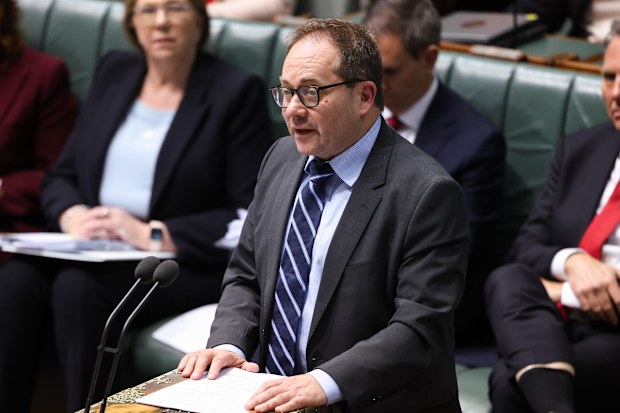
Financial Services Minister Daniel Mulino said Australian journalism was “important to a well-functioning democracy”. Alex Ellinghausen
“We want digital platforms to do deals with a diverse range of media organisations and have shown good faith with both the platforms and media companies during the consultation process.”
Nothing appears to have been done to address criticism that the legislation doesn’t cover artificial intelligence, which appears to be having a major negative impact on web traffic for news sites around the world.
Meta, which after initially doing deals under the old code simply pulled all news from Facebook, has slammed the new incentive as “grossly unfair”.
“It is discriminatory, economically incoherent, and will not deliver the sustainable news sector that Australian journalists and audiences deserve,” the company said in May.
“This is not a plan to save journalism. It is a tax on innovation dressed up as media policy.”
Major media companies across the country, including Nine, the publisher of this website, called the draft legislation a “critical step toward securing the future of Australian news” in a joint statement released in April.
Former Australian Competition and Consumer Commission Rod Sims is bullish that the NBI could achieve its goals but warned the new approach brought complexity and potential inequality between publishers.
“That said, the government is to be congratulated for pushing on with the noble cause of protecting journalism,” he wrote for The Conversation.
“Consultation is occurring on the News Bargaining Incentive, and it may well be legislated by mid-year.
“Australia is again leading the world by taking such action. Let us hope some amendments are made and that the incentive works well.”