
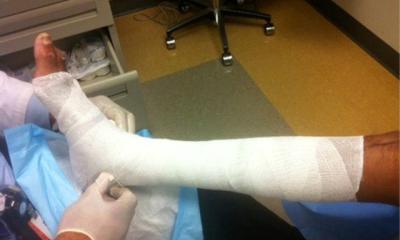
Venous leg ulcers can have a major impact people’s quality of life and place a significant burden on healthcare services, so it is important that health professionals have robust evidence to guide treatment decisions
Jo Dumville
Wraps have become increasingly popular because they can be adjusted and, in some cases, self-applied by people with leg ulcers or those around them. However, there has been limited high-quality evidence comparing compression wraps with other commonly used strong compression treatments.
The researchers carried out a large randomised controlled trial involving 637 adults receiving care at 33 mainly community sites across the UK. Participants were assigned to be offered either compression wraps, two-layer compression bandages, or established evidence-based compression treatments (four-layer bandages or two-layer compression stockings).
The researchers found that ulcers healed more slowly in patients offered compression wraps than in those offered established evidence-based compression treatments. Patients receiving compression wraps also appeared to heal more slowly than those treated with two-layer compression bandages, although this difference was not statistically significant. The study found that two-layer compression bandages performed similarly to established evidence-based compression treatments. The findings provide some of the strongest evidence to date comparing commonly used compression therapies for venous leg ulcers.
A separate companion process evaluation published in Trials found patients liked compression wraps because they were comfortable, easy to adjust, and could be removed for showering, However, these same features may also mean that people are more likely to loosen or remove the wraps, potentially reducing the amount of therapeutic compression delivered and helping explain the slower healing observed in the trial.
Together, the studies suggest compression wraps should not routinely be the first choice for most people with venous leg ulcers. However, they may still be appropriate for some patients where comfort, independence or self-management are particularly important, provided patients receive clear advice on maintaining effective compression.
Jo Dumville, Professor of Applied Health Research from the University of Manchester said: “Venous leg ulcers can have a major impact people’s quality of life and place a significant burden on healthcare services, so it is important that health professionals have robust evidence to guide treatment decisions. Our study compared three commonly used strong compression approaches in a real-world NHS setting and suggested that that compression wraps do not improve healing times when compared with established evidence-based treatments.”
Catherine Arundel, Senior Research Fellow at the University of York said: “While some uncertainty remains, these findings suggest that compression wraps are unlikely to offer a healing advantage as a first-line treatment. The results will help clinicians, patients and healthcare providers make informed decisions about the most appropriate therapies for managing venous leg ulcers.”
Source: University of Manchester