
On a sunny winter afternoon on Sydney’s bustling George Street, you’d be forgiven for thinking the cost of living crisis is all smoke and mirrors.
Shoppers pack the street carrying bags of goods, while youngsters sip on overpriced iced matchas looking for their next purchase as the sound of buskers fills the air.
It’s a scene that traditionally means good news for retail giants like Myer, as shoppers wander from store to store, looking for discounts on products at the end of the winter season.
However last week, the department store revealed it was in a deep slump, with sustained cost of living pressures driving consumer sentiment to its lowest levels in years.
And a leading consumer expert has warned the slump facing department stores is now so bad that they face becoming “archaic museums” in the face of a retail revolution.

Myer’s sales drop
While Myer’s sales surged in May, they lagged heavily in June and July as the inflationary effects of increased fuel prices triggered by the Iran war, three interest rate hikes, slower household income growth and a weaker housing market made consumers think twice before parting with their cash.
Its share price dropped a massive 17.31 per cent last week as it also lamented a warmer than average start to winter that hit clothing sales.
Even steep discounting and promotions were not enough to lure in more shoppers. Monday’s trading update showed a 5.5 per cent sales dive in June, followed by a 4 per cent slide in July.
And the game is becoming even tougher for Myer, as one of its biggest earners and most famous offerings, beauty, was also a weak category over the last two months, driven mostly by the recent departure of popular makeup brand Mecca from its stores after almost 20 years.
It’s a blow for the department store, as the fast-growing beauty category has traditionally provided a vital buffer during volatile economic conditions.
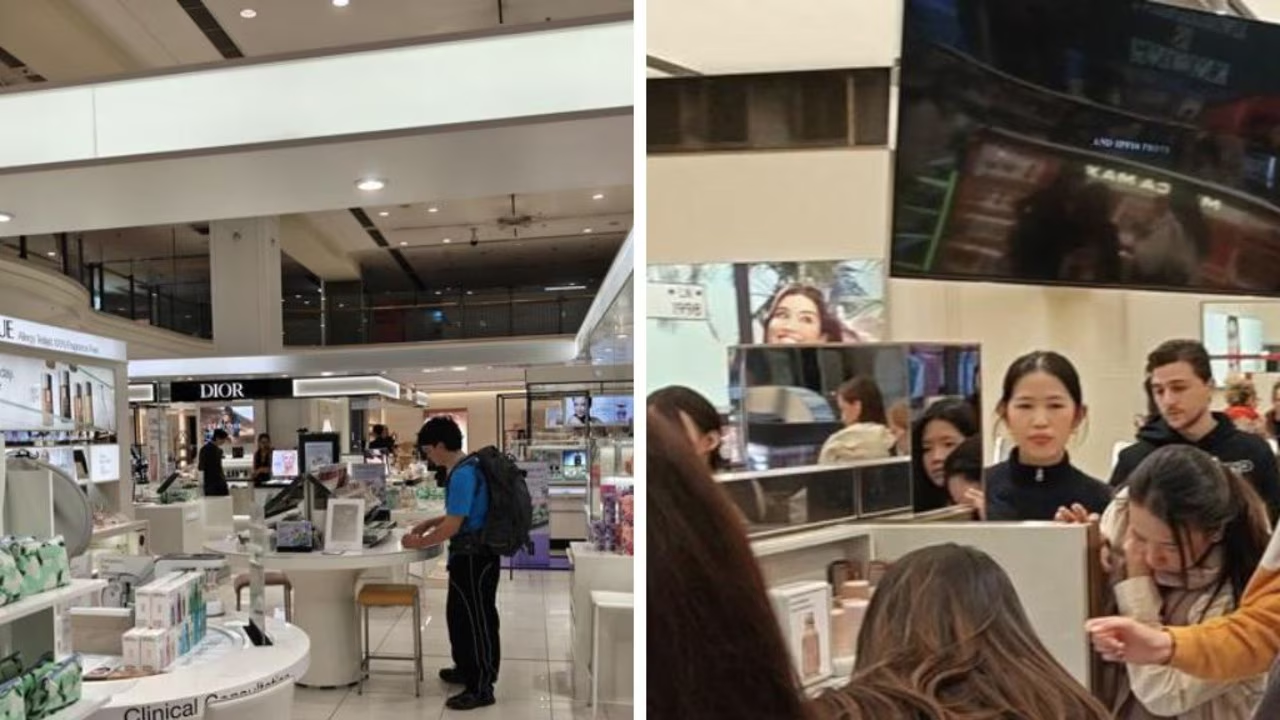
As news.com.au wandered down George Street one afternoon last week, the effect of this break-up between Myer and Mecca was plain to see.
Mecca has opened up its own shop directly across the road from Myer’s famous store in the CBD.
The shop, with vibrant lighting and trendy music, was crowded with Gen Z women trying products and stuffing them into their bags. It was hard to move in there as crowds of shoppers continued to drift into the multi-level store.
It’s a scene that has prompted a multi-million dollar overhaul from Myer – a massive area of the Sydney store is currently under renovation, creating a new beauty mega-destination to compete with the likes of Mecca and Sephora.
“Works are underway on the multimillion-dollar redevelopment of the Myer Sydney Beauty Hall and when completed later this year, it will be one of the biggest beauty destinations in Australia spanning almost 4500 square metres across two levels,” a Myer spokesman said.
It’s a bold vision from Myer that will give it a boost in the midst of a challenging outlook for department stores around the world.
The squeezed margins hitting Myer reflect a wider industry struggle, with luxury competitor David Jones facing its own uphill battle in Australia.
DJs recently posted a massive $95.5 million pre-tax loss following heavy store refurbishment costs and sluggish sales, though it has since pointed to early signs of recovery following cost-cutting measures and modernised digital investments.
In the United States, the traditional department store model is undergoing a painful, structural downsizing. Retail giant Macy’s is in the middle of closing roughly 150 underperforming stores to focus purely on its top-tier flagships, while legacy chains like Nordstrom and Kohl’s continue to trim their footprints as foot traffic drops across regional shopping malls.
Across the Atlantic, Britain’s high streets tell a similar story of aggressive consolidation. Famed department store House of Fraser has dwindled to a shadow of its former self through continuous store closures, while market leader John Lewis has been forced to slash in-store services, scale back operations, and lean heavily on digital integration just to protect its bottom line in a tough consumer environment.
Department stores becoming ‘museums’
Jana Bowden, professor of marketing and consumer behaviour at Macquarie University Business School, said that while Myer pointed to larger economic factors causing its slump, the decline of department stores has been 25 years in the making.
She said Aussies have historically loved department stores, but changing times mean they have lost their sense of wonder.
“They were a place of wonder and excitement — a family outing in themselves,” she said. “But those days are long gone. What we’re left with is just a memory of what the department store used to be.
“The younger Gen Z market is looking for an immersive, interactive, digital, and AI-led experience. Look at Mecca or Sephora — they are idolised by Gen Z because they offer cool brands, abundant staff trained to deliver tailored service, and real excitement. You contrast that with department stores: you walk in and you’re met with zero wow factor.”
It’s an issue Myer is more than aware of, and planning to combat with its latest redevelopment.
“We know our customers want more than a transaction – they want to discover, to be inspired, and to indulge in an in-store experience that feels truly special,” a spokesman said.
“With over 200 expert services to be offered alongside a curation of world-class brands, we’re creating a destination that puts the customer at the centre of everything. Sydney is just the beginning, with this approach paving the way for the future of beauty at Myer.
“We’re grateful for our customers for their patience while we deliver the new Myer Sydney Beauty Hall.”
Hybrid shopping hurting department stores
Prof Bowden said that hybrid shopping between online and physical stores had presented another challenge to department stores.
“Gen Z consumers are hybrid shoppers. Statistics show around 78 per cent of Australian buyers research online before visiting a physical store, while 57 per cent browse items in-person and complete the purchase online,” she said.
“The question is: how is Myer leveraging this shift to connect the digital and physical experience?”
Myer’s troubling results
Last week, Myer executive chairwoman Olivia Wirth painted a challenging picture of what the company faces.
Ms Wirth told investors the second half of the financial year had been characterised by a volatile and significantly more challenging macroeconomic and retail environment than the first half, as well as the previous financial year.
While the retailer’s performance in the second half was “mixed”, it “observed a material downturn in consumer sentiment”.
“This was particularly evident in June and July, resulting in a subdued consumer and weak discretionary spending,” Ms Wirth said.
“While we remain cautious on the near-term consumer outlook, we are confident that the strategic actions we are taking today are strengthening the group’s competitive position, resilience and supporting the creation of long-term shareholder value.”
Since taking over as CEO in 2024, Ms Wirth has been overhauling Myer’s offerings, particularly in clothing and beauty, after admitting it needed to broaden its appeal to young shoppers.
Last year, it bought Just Jeans, Portmans, Dotti, Jay Jays and Jacqui E — collectively known as Apparel Brands — from billionaire Solomon Lew’s Premier Investments in a near-$1 billion deal.
Ms Wirth said the month-by-month breakdown of sales remained highly volatile across Myer and the apparel brands it had recently bought.
In an interview with The Australian, she said the company had been hit by “many factors” that had led to a compounding effect. Not even deep discounting and promotions were enough to tempt customers into opening their wallets.
“You have got the (interest) rate rises, cost of living pressures which is real,” she said.
“Fuel has obviously added to that. You have got (a) weakening housing market, low auction rate clearance and then on top of that you also had the perception of the federal budget.
“So the combination of all those factors has meant the customer is feeling it, and that obviously impacts on discretionary spend.”
Myer’s trading update this week revealed total preliminary sales for the 12 months to July 25 of $4.089 billion, which is a rise of 11.3 per cent on an actual basis.
Pro forma sales (which includes a full year of sales from its apparel brands acquisition) were up 0.3 per cent. This was by strong growth in home, womenswear and kids’ categories as well as Just Jeans and strong growth in the Myer online marketplace and concession sales.
Mecca break-up hits hard
The positives in Myer’s update were offset by lower sales in beauty, driven by the loss of Mecca, and Portmans.
In recent weeks, Mecca officially completed its exit from Myer stores across the country, drawing to a close the iconic beauty juggernaut’s 17-year partnership with the department store chain. The final rollout wraps up a transition that began earlier this year.
A spokesperson for Mecca confirmed the milestone.
“Mecca and Myer have had a very successful partnership for the past 17 years, and we’re grateful for all the beautiful moments we’ve shared along the way,” they said in a statement.
“As both businesses continue to grow and focus on the future, we’ve decided the time is right to conclude our partnership.
“This is a natural next step as Mecca continues to invest in our larger-format stand-alone stores, where we can offer our full brand line-up, immersive services like Beauty Labs, and new experiences all under one roof.
“As part of this evolution, we gradually started closing our Mecca Myer locations in late 2025 and finished the process in June 2026.”
A Myer spokesperson said the company remains proud of the role it played in Mecca’s growth journey.
“As we both pursue distinct and ambitious growth plans, we have parted ways with shared appreciation for what we’ve achieved together and thank Mecca and their team members for the service provided to our business and customers,” they said.
“Looking ahead, our focus remains on delivering a curated, premium, and trend-driven beauty experience, in-store and online, that aligns with our customers’ evolving needs and supports the strategic priorities of our business.”
Not all doom and gloom
Despite the headline margin squeeze, Myer’s underlying sales engine continues to fire, with group revenue breaching the $4 billion mark for the first time.
Last week, it announced that sales were up year on year for the group and solid growth in Home, Womenswear, Kids and Just Jeans.
Its loyalty program MYER one added an extra 600,000 members in FY26 and now has a record 5.3 million active members.
Myer online sales grew by 5.8 per cent also in the first half of FY26. Myer will release its full-year results in September.
Read related topics:Sydney