
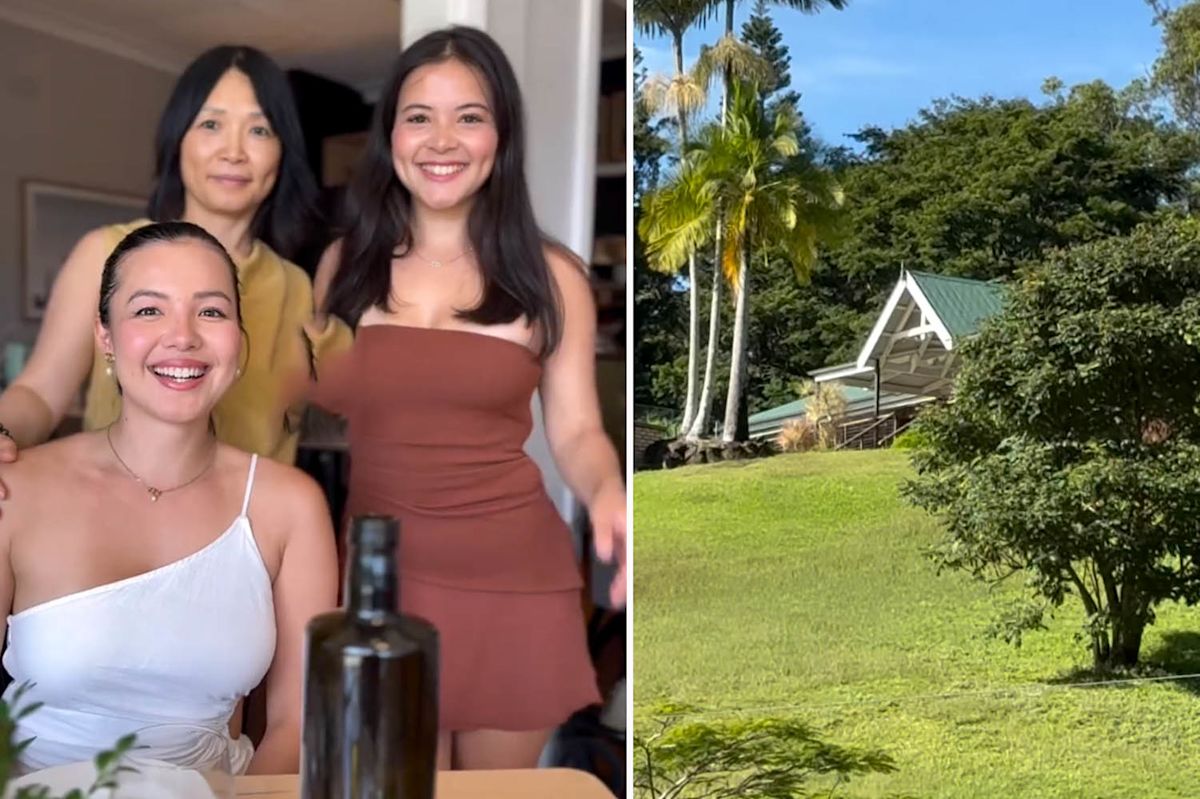
For Katie Wilkinson, trading a cramped Melbourne apartment for a 7.5-acre property on the Gold Coast was not just a tree-change — but a chance to embrace multi-generational living.
The 27-year-old and her partner ditched city living for a “slower-paced life” in the hinterland, along with her younger sister and their mum, to create the ultimate family compound.
While it’s not for everyone, for Katie, it “just made sense”.
“Building a family compound often is cheaper than living separately when you factor in everybody’s costs, including bills and groceries”, she told Yahoo News.
“And it’s like we have our own built-in village”.
“Nowadays, people buy their village through things like daycare, a housekeeper, or a nanny,” she continued.
“That’s one big reason why we wanted to live in a family compound, so we can share the load.”
Often, she said, you get “much more land” living this way than multiple family members each buying an affordable property of their own.
Do you have a story about multi-generational living? Contact newsroomau@yahoonews.com

Katie, 27, now enjoys a calmer life away from the city on the Gold Coast property
(Katie Wilkinson)What is multi-generational living?
Multi-generational, or inter-generational, living is a trend growing across Australia, heavily driven by the rising cost of living and dwindling housing affordability.
According to the Australian Bureau of Statistics (ABS), households containing at least three generations rose by 21.8 per cent between the 2016 and 2021 censuses, with these figures set to rise even further.
Katie believes this type of living should be “the future” for many Aussies.
RELATED:
While her family compound cost them “a few million”, she said the concept is “more accessible than people think”.
“You don’t have to be really rich or really wealthy to make this work. I’ve actually seen people do it for a couple of hundred thousand,” she said.
It doesn’t have to be acreage, it could be a set of townhouses or a duplex with a shared backyard, she said.
For some, it’s adding a granny flat to a lot, while for others, it’s building a home with separate living spaces.

They ditched city life in Melbourne for a slower-paced lifestyle.
(Katie Wilkinson)
Katie’s Gold Coast property already had three separate dwellings — a six-bedroom house, which they’ll split in two, a cottage, and a tiny house they’ll rent out.
Currently, only Katie and her partner live on the property, with plans for her mum and sister to move from Melbourne when they’re ready.
“I would never want to move back to Melbourne. It’s a different lifestyle, but that’s what suits us,” she said.
Why are more Aussies choosing to live with family?
Katie noted that the “Australian way” is typically to move out of home as early as possible. Now, however, it’s becoming too expensive.
She said Western society is often quite “individualistic,” meaning family members tend to forge lives of their own without the support of “a village”, noting her Chinese heritage.
“If you already have the stepping stone of your parents being able to build that together, you’re already ahead from the get-go,” Katie said.
McCrindle Research this year found that 70 per cent of Australians were still at home at age 19, compared to 60 per cent in 2006.
According to the research, three in five Australians, or 57 per cent, said they were “open to or would welcome living in a multi-generational home with their family”.
Chris Thornton, CEO of G.J. Gardner Homes says they’ve seen a steady increase in demand for multigenerational homes in recent years.
“Multigenerational living can help distribute the financial burden of housing expenses by sharing the costs of living, such as mortgage payments, utilities, and groceries,” he told realestate.com.au.
Multigenerational living future-proofing young Aussies
Looking ahead, intergenerational living also allows the sisters to have help with their future children, and currently, Katie always has a dog-sitter and someone to manage the property if they’re away.
As their mother ages, she will be looked after without relying on aged care services, which is pretty typical in non-Western cultures, Katie said,
“We’d rather support each other than outsource it and pay for other people for these services when we can all provide them between ourselves,” she said.
You can also follow us on Facebook, Instagram, TikTok, X and YouTube.