
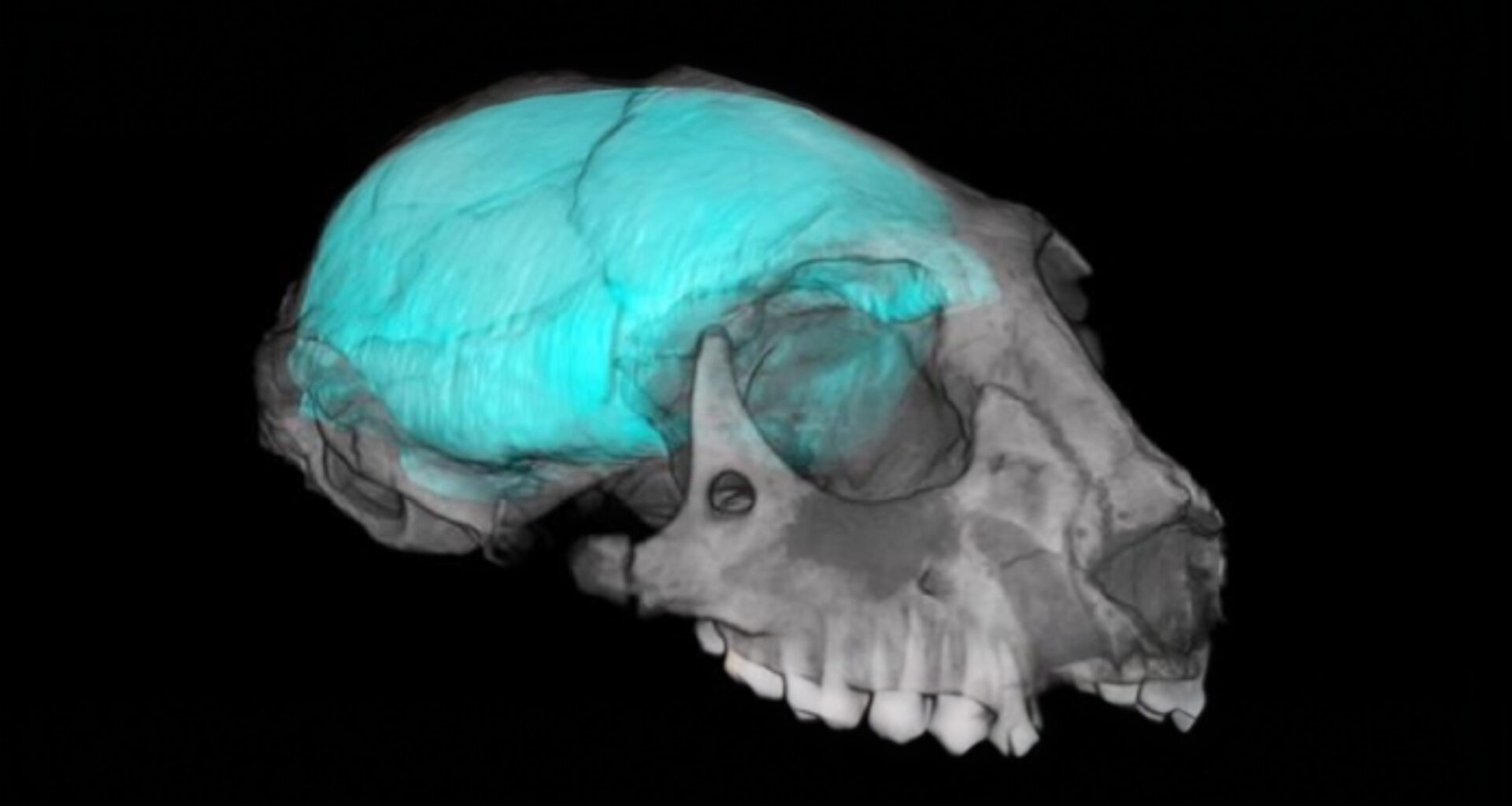
Brains rot within days. The bony case that held them can last 33 million years, which is why primate brain evolution has been so hard to read from fossils.
A new study led by scientists at Duke University filled those empty braincases digitally, then measured them. What came out was vision, not raw intelligence.

Our own outsized brain, on this account, traces back to ancestors that got more out of what they could see. The “thinking” frontal lobe never swelled on its own.
Brains do not fossilize
The neocortex – the outer, folded layer that handles sensory perception and complex thought – is greatly enlarged in primates compared with other mammals.
Exactly how it grew so large over the past 56 million years has been hard to pin down. Brain tissue does not fossilize, so the thing that changed left no direct record.
The team worked around that with skulls, many of them from the Duke Lemur Center Museum of Natural History.
High resolution micro-CT scans at the Shared Materials Instrumentation Facility captured the empty space inside each braincase. The models were then rebuilt digitally in 3D.
Those virtual casts, called endocasts, stand in for the brain itself. Researchers can measure their volume and surface area much as they would a living brain.
Comparing them let the researchers track how parts of the neocortex changed across living and extinct primates, from lemurs to monkeys to us.
Frontal lobe kept pace
The frontal lobe is the region popular accounts tie to reasoning and planning. It has long been assumed to have ballooned on its own, over and over, in separate primate lineages.
The endocasts say otherwise. Frontal lobe size grew gradually and predictably as overall brain size rose.
One scaling pattern held across every major primate group. There was no sign of the dramatic, independent expansions earlier studies had proposed from the look of a fossil.
The study was led by Richard F. Kay, a professor of evolutionary anthropology at Duke.
“Everything from humans down to tree shrews, they all fall on the same line: Relative to the size of the brain, the proportion of the frontal lobe is a constant,” noted Professor Kay.
Vision shaped primate brain evolution
The real change sat behind the frontal lobe. The occipital, parietal and temporal regions carry most of the work of seeing, and they expanded fast and out of proportion.
That growth shows up in tarsiers and in anthropoids, the group that holds monkeys, apes and humans. It marks the branches where visual processing took over the neocortex.
Those same branches are where the optic nerve grew larger. More visual information was flowing into the brain.
“Fossil brains have been frustratingly silent on this question for a long time,” said Professor Kay.
“When we let the fossils speak quantitatively rather than relying on impressions of their shape, the enlarged brains of monkeys, apes and humans turn out to be tied to vision much more than to the frontal lobe, which simply kept pace with overall brain size.”
Optic nerve as a clue
Nerves do not fossilize either. The team used the optic foramen – the bony opening the optic nerve passes through – as a stand-in for how much visual traffic a skull once carried.
Tarsiers and anthropoids have the largest and most vision-dominated neocortices of any primates. They also had the largest optic foramina.
The visual regions of the brain appear to have grown even faster than the nerve feeding them. Small increases in visual input were magnified into large expansions of brain tissue.
That is a different picture of primate evolution than the familiar one, in which a lineage gets smarter and the brain follows.
“Typically, the story of primate (and human) evolution places emphasis on increased relative size of the frontal regions of the neocortex compared with other parts of the neocortex and brain size,” Professor Kay told Earth.com.
“The received ‘story’ is that frontal lobe increases are associated with improvements in ‘executive functions.’ Our study suggests that any proportional increases in the size of the frontal lobe are a shared feature of increased brain size in all primates, not a novel feature of the human brain as distinct from the brains of other primates.”
Why sharper eyes mattered
Why primates evolved to process so much more visual information remains an open question.
“What are those visual signals for? One idea is the increased complexity of social communication. Another possibility is that their driving force is related to how efficiently these animals can forage for food,” noted Professor Kay.
“Each of those, I would imagine, could have a very strong impact on natural selection and primate evolution.”
Either pressure would reward eyes that resolve fine detail. Anthropoids carry a retinal fovea, the pit of densely packed receptors behind sharp central vision.
They also carry a bony partition that shields the eye. Both features point to a lineage invested in high-acuity sight.
The pattern is old, too. Anthropoid brains have looked like this for at least 33 million years, long before anything resembling an ape.
Limitations of the study
An endocast records the outside of a brain, not its wiring. Boundaries between regions are read from impressions left on bone, and the soft tissue detail is long gone.
The optic foramen is a proxy as well. It tracks the room the nerve needed, not the number of fibers that ran through it.
“Here is a caveat: As paleontologists, we have only the surfaces and shapes of fossil brains to work with. So many other changes in brain wiring must have occurred that fossil brain shape and size cannot capture,” Professor Kay told Earth.com.
“All our inferences are contingent on what is known about the brains of living primates and their close relatives.”
The two possible drivers, social life and foraging, remain hypotheses. Fossil skulls cannot reveal which pressure drove the change, or whether both played a role.
What the fossils do settle is where to look. Across 56 million years of primate history, the brain grew mostly by seeing more.
The lobe we credit for thinking simply grew at the rate the rest of the brain set.
The study is published in the journal Science.
Image Credit: Kay et al./MorphoSource
—–
Like what you read? Subscribe to our newsletter for engaging articles, exclusive content, and the latest updates.
Check us out on EarthSnap, a free app brought to you by Eric Ralls and Earth.com.
—–