
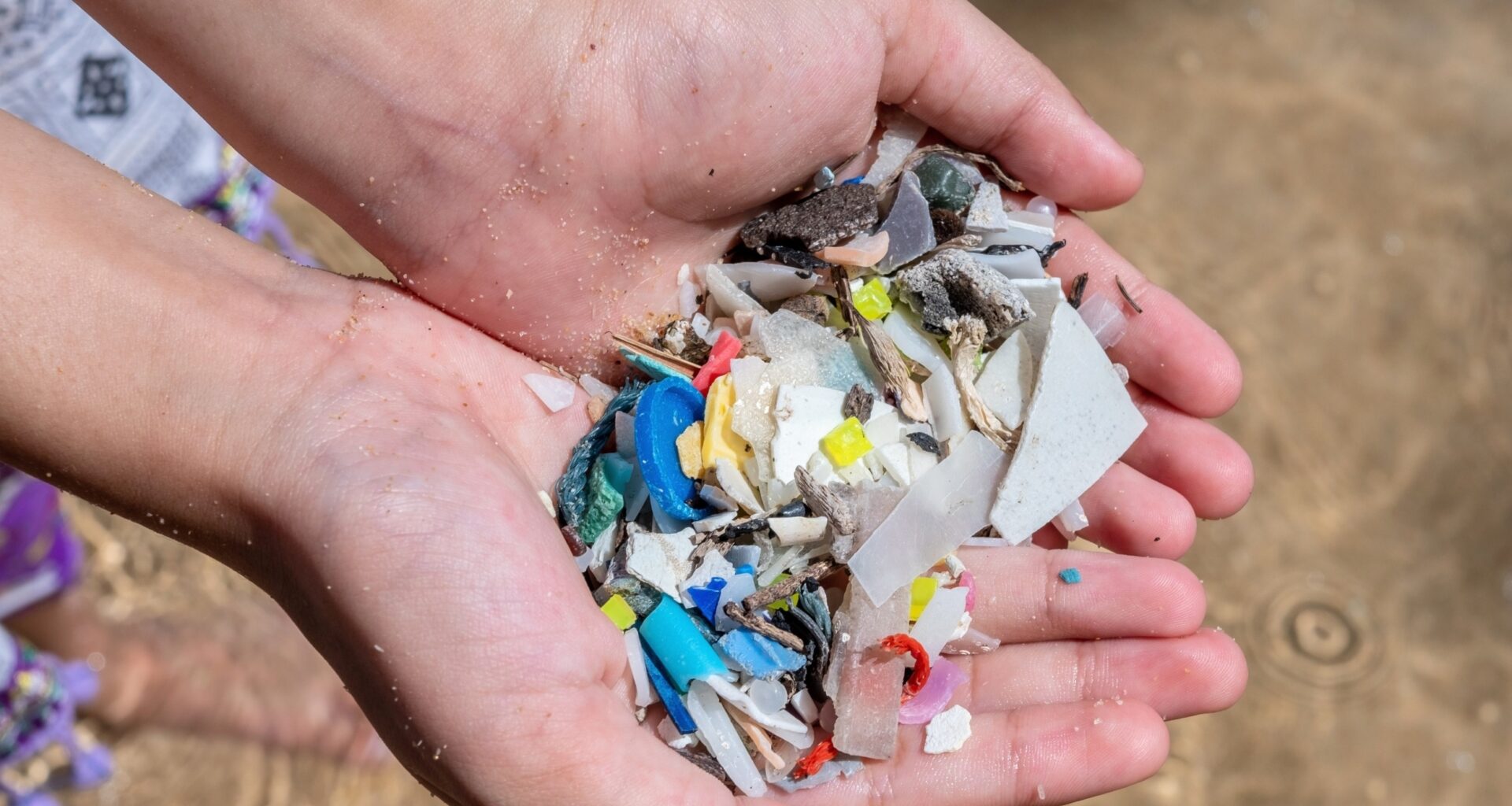
Balls of dead seagrass wash up on beaches with plastic tangled inside them. Researchers have now recreated that natural trap using seaweed and shellfish shells to pull plastic from water.
The trap works across a huge range of sizes, from specks too small to see to fragments the size of a fingernail.
Microplastic filters face a tradeoff. A mesh wide enough to let water flow quickly can miss particles only a few hundred nanometers across. Make the openings small enough to catch them, and the filter can clog.
Haeleen Hong and colleagues at NC State designed a single material to capture particles at both ends of that size range.
“Our goal here was to develop a multiscale structure that allows us to capture the full range of plastic microparticles,” said Orlin Velev, a professor of chemical and biomolecular engineering who led the work.
Seagrass balls are natural filters
Mediterranean seagrass drops its leaves every autumn. The fibrous remains roll together on the seabed into balls, and plastic gets caught in the tangle. Those balls sink or wash ashore, and the plastic goes with them.
Floating rafts of Sargassum seaweed do the same at the surface.
Three features make the natural version work. Branches snag fragments, sticky surfaces hold them, and slack water lets particles settle into the folds.
“We wanted to create structures that mimicked what the tangled seaweed is already doing,” said Velev.
Anything smaller than 0.2 inches (5 millimeters) counts as a microplastic, and these particles now reach every ocean depth anyone has sampled.
Even protected marine reserves are not clean, and sea caves lock plastic into hardened tar.
Ice crystals squeezed the fibers
Velev’s group started with two cheap raw materials. Alginate comes out of brown algae. Chitosan comes from the shells of crabs and shrimp.
The team injected each one into a liquid spinning at 20,000 revolutions per minute. The shear tore it into particles that branch over and over, ending in a crown of fibers too small to see.
A gecko’s foot works the same way. Splitting one flat contact into thousands of tiny ones multiplies the faint attraction between two surfaces until it holds a weight.
To turn loose particles into a solid net, the team froze the material at -4°F (-20°C) and thawed it, three times over.
Growing ice crystals squeezed the branched particles into dense walls, leaving a honeycomb of pores under 100 micrometers wide. After a fourth cycle, the gel turned brittle.
A bath of washing soda then stripped the smooth skin back off, and a second coat of branched chitosan went on top. That is the fluffy part.
Salt water didn’t weaken performance
Most plastic in natural water carries a negative charge. The chitosan coat carries a positive one, so the two pull toward each other.
The mesh removed 98.5% of bare latex beads about a micrometer wide, and 93% of beads coated to carry a stronger negative charge.
Beads deliberately given a positive charge, which the mesh should push away, still came out at 33.5 percent.
Size barely mattered. From 300 nanometers up to 100 micrometers, roughly the width of a human hair, the mesh took more than 90% of the beads by weight. The largest of them came out at 95.7 percent.
Salt in the water screens electrical charge, which should have weakened the pull. It hardly did. At 3.5% sodium chloride, about the strength of seawater, the mesh still held the beads, and it held them above that.
Polyethylene, polypropylene and PET – the plastics in grocery bags, bottle caps and drink bottles – came out slightly worse than polystyrene.
The lighter ones float at the top instead of mixing through, so they meet the mesh less often.
Plastic from a Hawaii beach
Model beads are clean and round. Currents carry the real thing to Kamilo Beach, on the southern tip of Hawaii Island, and Plastic Ocean Project sent the team a sample from there.
The floating fragments ran from about 100 micrometers to more than 0.2 inches across. Most of the suspended pieces too small to see measured 200 to 300 nanometers.
A piece of mesh weighing 5 milligrams went into 6 milliliters of that slurry. Millimeter-scale fragments stuck to it within 10 minutes. The smallest pieces took closer to 24 hours.
The mesh finished holding 11 milligrams of plastic, more than twice its own weight and 92% of what was in the vessel.
“What you end up with looks like a fluffy net,” said Velev.
Limitations of the study
Nothing here happened in open water. Every test used plastic concentrations far above the levels in real lakes and seas, so the capture rates are an upper limit rather than a prediction.
No one has measured what natural organic matter does to the mesh once it coats the fibers.
Bacteria growing there are a second unknown. Plastic already at sea would take more than 100 years to clear on its own, and it interferes with how the ocean absorbs carbon.
There is also the problem of getting mesh and plastic into the same place. All of it happened in a swirled dish. In a bay, something has to move one toward the other.
The future of microplastic removal
Velev’s group already has a possible next step. Last year, the team developed self-dispersing cleaners that move through water on their own and float back to the surface carrying captured particles.
Combining that system with the new mesh could make cleanup easier, but the researchers have not yet tested the two together.
What happens to a full net is another open question. One idea is to use microbes to digest the captured plastic along with the mesh, then turn that material into new biopolymers for another batch of nets.
That recycling loop remains a proposal rather than a demonstrated process.
“We’ve demonstrated that this design works,” said Velev. “And the materials we used are of natural origin and relatively inexpensive. So, it may present a viable path forward.”
“Can it be used on a large scale? That depends on the extent to which we want to invest in scaling up such cleanup approaches.”
The full study was published in the journal Science Advances.
—–
Like what you read? Subscribe to our newsletter for engaging articles, exclusive content, and the latest updates.
Check us out on EarthSnap, a free app brought to you by Eric Ralls and Earth.com.
—–