
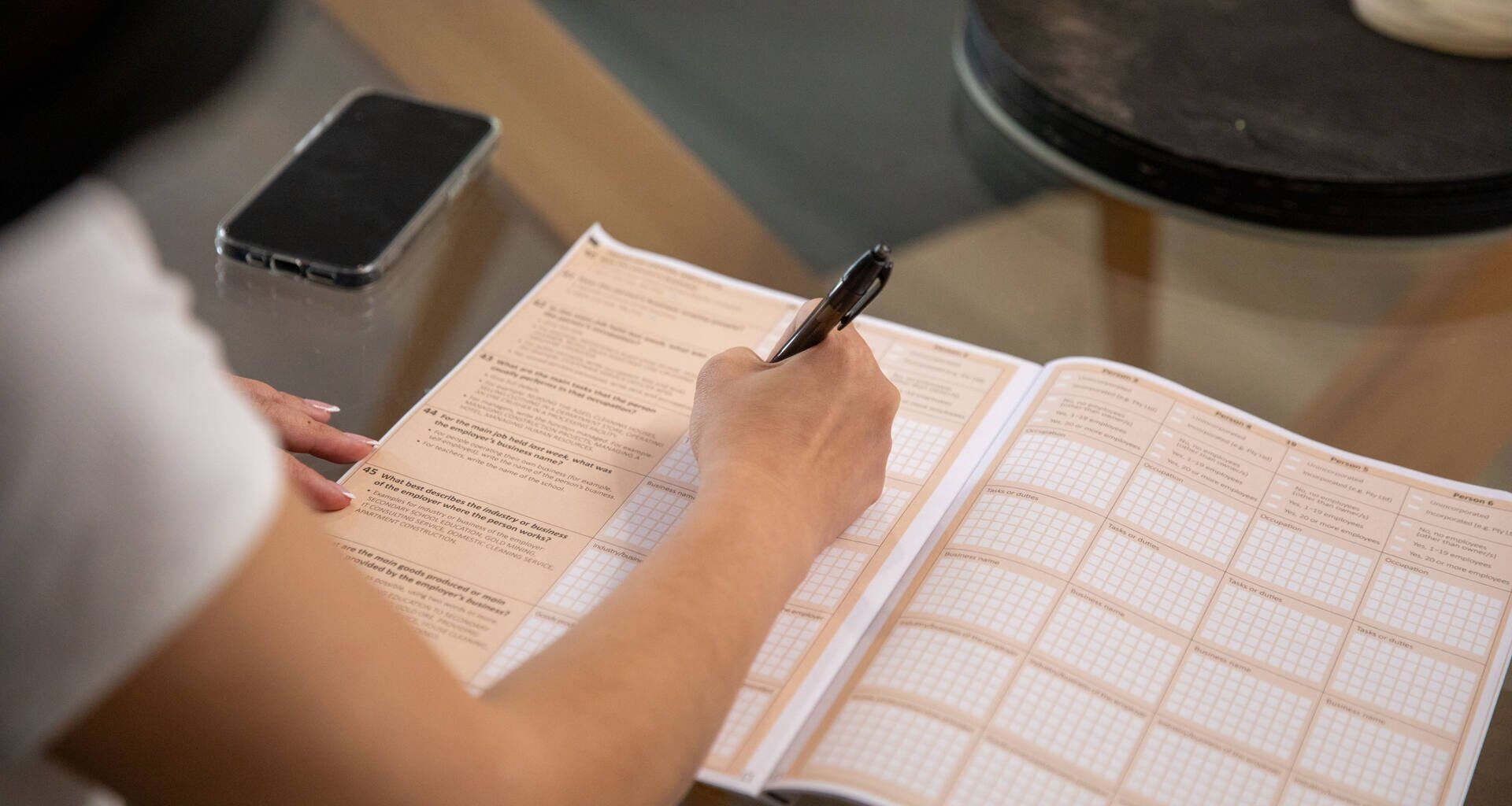
How many answers can there be to the seemingly simple question: Where do you come from?
For a growing number of Australians, one — or even two — may no longer be enough.
Just days before Census night on Tuesday 11 August, Google search data offers an intriguing glimpse into the way Australians are thinking about ancestry, family history and the approaching national count.
Google Trends* data for Australia over the past 12 months shows that searches for “Ancestry” remained consistently stronger than related terms including “Family tree”, “Genealogy”, “DNA test” and “Ancestry DNA”.
But the more revealing finding sits beneath the headline numbers.
Of the 19 rising queries Google Trends associates with searches for “Ancestry” over the same period, eight explicitly relate to the Census.
Both “census 2026” and “census abs” were classified as “Breakout” searches — Google’s designation for queries that have grown by more than 5,000 per cent compared with the previous equivalent period.
Other fast-rising queries included “census ancestry question”, up 3,000 per cent; “census form”, up 1,550 per cent; and “census 2026 australia”, up 1,500 per cent.
The figures do not prove that Australians have suddenly become more interested in their family origins, nor do they establish that the Census itself caused increased interest in ancestry.
They do, however, show that the two subjects are increasingly meeting in Australians’ online searches at a particularly timely moment.
[INSERT GOOGLE TRENDS GRAPHIC 1 HERE — INTEREST OVER TIME]
Google Trends search interest in Australia for “Ancestry”, “Family tree”, “Genealogy”, “DNA test” and “Ancestry DNA” over the past 12 months. Google Trends scores represent relative, not absolute, search volumes. Source: Google Trends.
FOUR ANCESTRIES INSTEAD OF TWO
This year, the question itself is changing.
For the first time, the 2026 Census will allow people to report up to four ancestries, doubling the two responses permitted in 2021.
The Australian Bureau of Statistics says the change is designed to better reflect Australia’s cultural diversity and the increasingly varied backgrounds of its population.
The question remains straightforward: “What is the person’s ancestry?”
But the possible answer has become broader.
Those with more than four ancestries are asked to provide the four with which they most closely identify. For people unsure how to respond, the ABS suggests considering the ethnic or cultural origins of their parents and grandparents as a guide.
The 2026 form provides tick-box options for a number of ancestries, while other backgrounds — including Greek — can be entered in the free-text “Other ancestry” fields.
It is a relatively small change to a form, but potentially a significant one for communities shaped by several generations of migration.
A child may have a Greek-born grandparent on one side, an Italian grandparent on another, parents born in Australia and a family identity that comfortably carries all three stories.
Until now, the Census required some of those threads to be left out.
In 2026, there is more room for them.
WHAT IT MEANS FOR GREEK AUSTRALIA
For the Greek Australian community, the change is particularly relevant.
In the 2021 Census, 424,744 people across Australia reported Greek ancestry, representing 1.7 per cent of the national population. Significantly, 315,118 of them were Australian-born.
The numbers underline just how far the community has travelled from the post-war migration story with which Greek Australia is so often associated.
Greek ancestry in Australia today is not confined to people who themselves migrated from Greece. It also belongs to their children, grandchildren and, increasingly, great-grandchildren — generations whose family histories are often more layered than those of their parents.
Victoria remains at the centre of that story.
The 2021 Census recorded 181,184 Victorians with Greek ancestry, equivalent to 2.8 per cent of the state’s population.
In Greater Melbourne alone, 171,480 people reported Greek ancestry, representing 3.5 per cent of the population.
For many younger Greek Australians, “Greek” may remain a powerful part of their identity without necessarily being the only answer to the ancestry question.
The expansion from two responses to four gives the Census greater scope to record precisely that complexity.
WHAT AUSTRALIANS ARE SEARCHING FOR
Google Trends does not provide raw numbers of searches. Instead, it uses a scale from 0 to 100 to show the relative popularity of a search term within a selected time and location.
That distinction matters, particularly when interpreting a subject as personal — and as difficult to quantify — as identity.
There is another important point to keep in mind.
The term “Ancestry” is also strongly associated with the commercial genealogy and DNA service of the same name, something reflected in top related searches including “dna ancestry”, “ancestry login” and “ancestry test”.
The data therefore cannot tell us why somebody typed “Ancestry” into Google, and it would be misleading to read it as evidence of a sudden nationwide surge in Australians exploring their family origins.
What the rising related searches can show, however, is where new search interest is emerging.
And in the lead-up to Census 2026, the Census itself is impossible to miss.
Eight of the 19 rising related queries associated with “Ancestry” explicitly reference the national count, ranging from the broader “census 2026” to the much more specific “census ancestry question”.
Rising related queries associated with “Ancestry” in Australia over the past 12 months. Census-related searches feature prominently among the fastest-growing queries. Source: Google Trends.
A MORE COMPLICATED ANSWER TO A SIMPLE QUESTION
Census night falls on Tuesday 11 August 2026, when the ABS will once again undertake the country’s largest statistical collection, capturing a snapshot of Australia’s people and households.
Its data will help inform decisions ranging from health care and schools to transport, infrastructure and community services.
But buried among those practical questions is something considerably more personal.
What is your ancestry?
For Australia’s older migrant generations, the answer may once have seemed obvious.
For their descendants, it can be a map drawn across countries, languages, marriages and generations.
The 2026 Census will not resolve what identity means to any individual. Nor can a Google search measure the strength of someone’s connection to a place their grandparents left decades ago.
What both reveal, in different ways, is that ancestry remains part of the conversation.
And this year, Australians have a little more space in which to tell the story.
*This content is part of a paid partnership with Google to promote Google Trends