
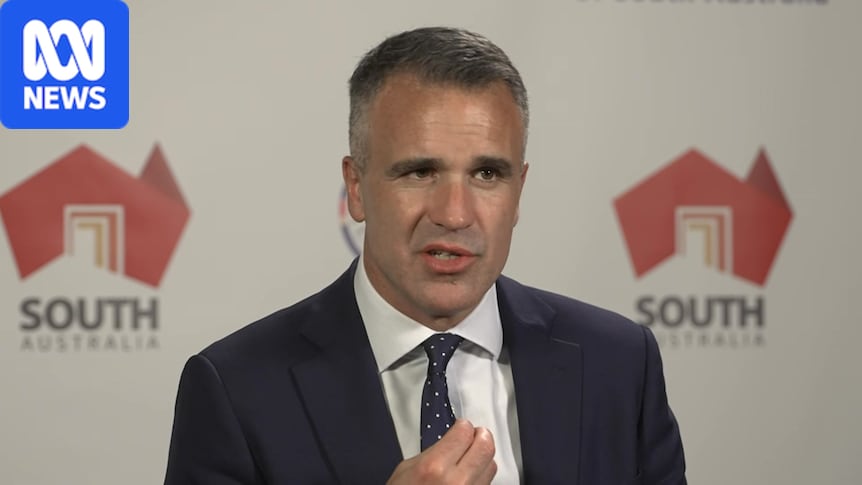
South Australia will hold a royal commission into artificial intelligence and the policy around it, with the state government warning of the technology’s potentially destructive impacts as well as acknowledging its upsides.
Premier Peter Malinauskas said AI, if unchecked, presented a “material risk to the way society operates”.
He said the inquiry was intended to maximise the benefits and minimise unwanted impacts from the growth of AI.
The royal commission is expected to begin on October 1 and deliver a report to the government no later than July 1 next year.
“The use of artificial intelligence is an exciting opportunity to advance the cause of humanity but it is also true that unchecked artificial intelligence does represent a material risk to the way our society operates and a risk to the future of work if not thought through carefully,” Mr Malinauskas said.
“We are at a really important fork in the road.
“We can choose to allow this industry to come to our country and evolve in a way that is unregulated and unchecked … or we can choose to set the agenda. We can choose to set the guard rails and the policy frameworks to ensure that we use AI in a way that puts people first.”
The announcement followed Mr Malinauskas’s recent trip to the United States where he met with representatives from AI heavyweights OpenAI, Anthropic and Apple.
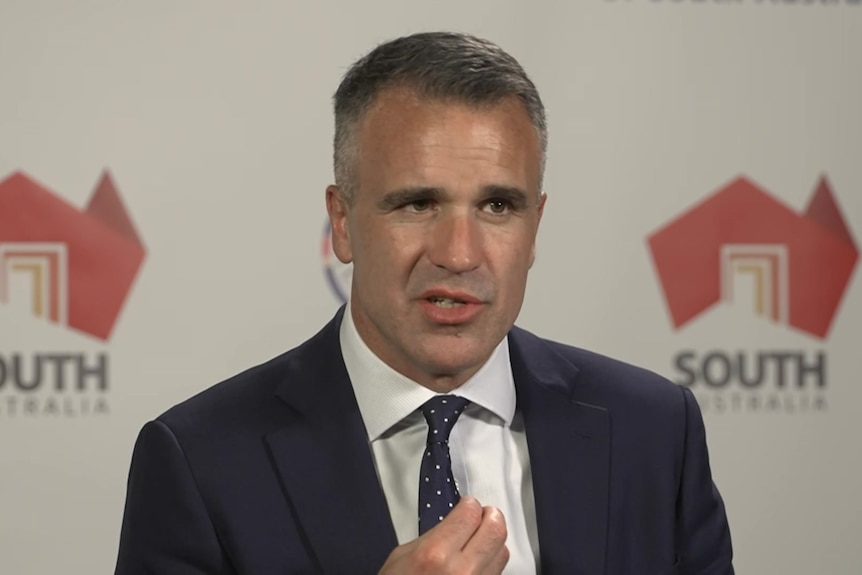
SA Premier Peter Malinauskas says, when it comes to artificial intelligence, society is at a fork in the road. (ABC News)
The premier said he wanted AI companies to participate in the inquiry, which would shape future approaches to the technology and potential restrictions on its use.
“We’ve seen different approaches in different states — in some states in Australia there have been flat-out bans on ChatGPT, whereas we haven’t gone down that path in South Australia,” he said.
“In a regulated way, we want to teach kids how to use AI but I don’t think we’ve done as much work as we potentially can or should.
“A sign of success might be that a royal commission makes a bunch of recommendations that are well thought through, able to be adopted by state governments and that others may follow.”
The inquiry’s terms of reference will be announced in the next four to six weeks.
Three royal commissioners will also be appointed in that time, following an “international search”.
But Mr Malinauskas conceded data centres — which the government wants to lure to the state for financial reasons, but are controversial because of their water and energy use — would not be part of the royal commission.
“This royal commission isn’t looking at the infrastructure that underpins AI; it looks at the use of AI,” he said.
“We don’t want a situation where we get caught up arguing about data centres and whether or not they’ve done well, when the main game is what the data centres are actually being used for.”
‘No precedent for this’
The royal commission has been welcomed by UNSW AI Institute chief scientist Toby Walsh, who said it would complement the federal government’s recently announced AI framework.
“If this is a way of getting the [federal] government to move faster, I welcome the idea that South Australia can again help us get to a good place,” Professor Walsh said.
“There’s a lot of things the commission can examine. I suspect it’s going to have to work very fast.”
Mr Malinauskas said he expected the cost of the royal commission to be around $3 million.
‘AI factory’ proposed at River Murray town
“The cost of the royal commission is really chicken feed in comparison to the cost of society if we don’t think through the complex questions that are going to be asked of us with the deployment of this technology,” he said.
“If we don’t do this properly, we could see very significant changes in the way that people work … [and] a more rapid destruction of demand in some areas of the labour market.”
The royal commission was expected to hear from businesses, unions, industry bodies, technology companies and academics.
The government said it would examine the impacts of AI on education, skills, work, public services including health, and on infrastructure such as the electricity grid.
“Whether it be the implications AI represents for the creative industries, whether it be the way AI is used in our schools, whether it be the way that AI is deployed in the delivery of public services where we know there are advances to be gained — these things need to be thought through,” he said.
“Only governments, only parliaments have the tools and the resources to ensure that people are at the centre of the advancement and the rollout of AI-related technologies and industries.
“There is no precedent for this — there is no precedent in humankind for a new form of intelligence that is able to match, and soon exceed, the capabilities of human beings.”
Mr Malinauskas said while no-one had yet been chosen, he already had potential royal commissioners in mind.