
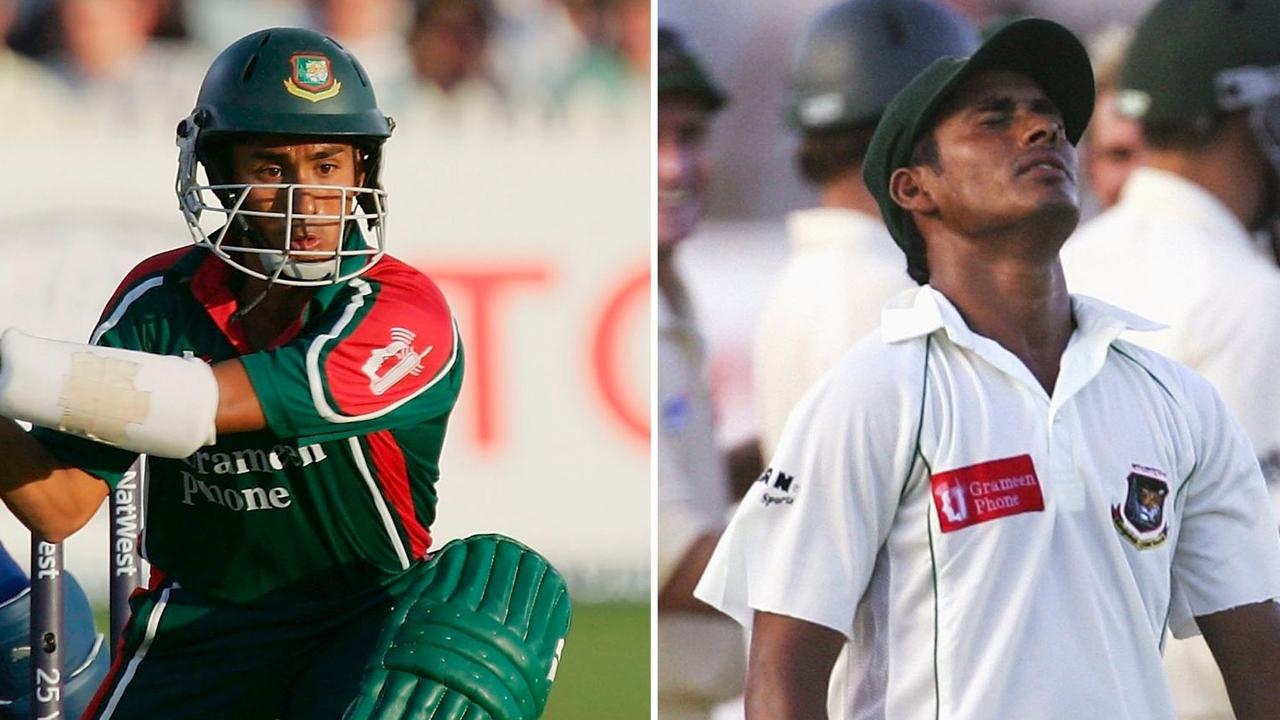
Sport is littered with ‘what if’ stories and tragic tales of players who looked destined for greatness before circumstances, injuries or poor decisions dramatically altered the course of their career.
For Bangladesh, that player is Mohammad Ashraful.
Watch every ball of Australia vs Bangladesh Test Series live and ad-break free during play with Fox Cricket on Kayo | New to Kayo? Join now and get your first month for just $1.

Long before Shakib Al Hasan became one of the world’s premier all-rounders, before Tamim Iqbal rewrote the record books and before Mushfiqur Rahim established himself as one of the nation’s greatest ever batters, Ashraful was the player carrying Bangladesh’s hopes.
He wasn’t simply viewed as a talented youngster.
Ashraful was entrusted with leading Bangladesh before his 25th birthday.Source: FOX SPORTS
He was expected to become the cricketer who would define Bangladesh’s first generation as a Test nation.
Instead, while his career produced unforgettable moments that changed Bangladesh cricket forever, it ultimately became one of the sport’s most heartbreaking cautionary tales.
THE BOY WHO MADE BANGLADESH BELIEVE
Bangladesh’s elevation to Test status in 2000 was one of the biggest moments in the country’s sporting history, but it also came with enormous challenges.
Competing against established powers including Australia, India, Pakistan and Sri Lanka, Bangladesh struggled through its early years in Test cricket as heavy defeats became commonplace.
Critics questioned whether the nation had been promoted too early, while supporters simply searched for reasons to believe the future would be brighter.
That belief arrived in the form of a fearless 17-year-old.
Marsh bashes 50 for Leeds in the hundred | 01:43
Making his Test debut against Sri Lanka in September 2001, Ashraful produced one of the most memorable innings in Bangladesh cricket history, scoring 114 to become the youngest player ever to score a Test century at the time.
It wasn’t just another hundred.
It was the innings that convinced Bangladesh it finally had a player capable of standing alongside the world’s best.
Almost overnight, Ashraful became the face of Bangladesh cricket.
READ MORE
FULL CRICKET SCHEDULE: 21-Test frenzy headlines blockbuster 12 months
AUSTRALIA V BANGLADESH: Waugh’s secret classy gesture to cricket minnows thrown to the wolves
‘PRETTY GOOD ONE’: Head’s hilarious endorsement of returning veteran as surprise claim explained
THE TALENT THAT STUNNED THE WORLD
Ashraful’s greatest strength was also what made him so captivating.
He wasn’t a batter who accumulated runs through patience and discipline.
Instead, he played with freedom.
His elegant strokeplay, fearless approach and willingness to attack the world’s best bowlers made him one of the most naturally gifted players of his generation, even if that style also led to frustrating inconsistency.
No innings better demonstrated his extraordinary ability than Cardiff in 2005.
Australia arrived at the NatWest Series as the undisputed kings of world cricket, boasting a side featuring the likes of Ricky Ponting, Adam Gilchrist, Matthew Hayden and Glenn McGrath. Bangladesh, meanwhile, had never beaten Australia in a one-day international and were given virtually no chance of causing an upset.
Ashraful had other ideas.
His stunning century helped guide Bangladesh to one of the biggest upsets in ODI history, proving they could compete with, and beat, the world’s best.
The teenager who gave Bangladesh belief.Source: FOX SPORTS
Speaking to Cricinfo after the historic victory, Bangladesh coach Dav Whatmore believed the performance showed it wasn’t simply a case of Australia having an off day.
“Australia didn’t play that badly,” Whatmore said.
“It’s just that the Bangladesh team – on that particular day – played better cricket.”
More importantly, Whatmore believed beating the world’s No.1 team would force those who had dismissed Bangladesh as cricketing minnows to reconsider.
“We’ve beaten the No. 1 team in the world, and that will make a lot of people think twice,” he said.
But Cardiff wasn’t an isolated flash of brilliance.
Ashraful followed his century with a breathtaking 94 from just 52 balls against England at Trent Bridge before smashing 58 of Bangladesh’s 139 runs in another meeting with Australia at Old Trafford.
Suddenly, the 20-year-old was becoming one of the most entertaining batters in world cricket.
Even Australian captain Ricky Ponting was taking notice.
Ashraful’s famous century helped stun Ricky Ponting’s Australia in Cardiff.Source: FOX SPORTS
After watching Ashraful unleash his extraordinary array of shots throughout the series, Ponting described his innings against England as “an unbelievable knock”, but also offered a warning about whether such an audacious approach could survive at international level.
“I think he’s riding his luck a lot at the moment to tell the truth,” Ponting said.
“The longer you stay in international cricket you work out that that just doesn’t work for you, you have to be a bit more selective than that.”
It was a challenge even those closest to Ashraful recognised.
Bangladesh captain Habibul Bashar admitted at the time that attempts to temper the young star’s attacking instincts had proven difficult.
“He’s capable of playing all the shots,” Bashar said.
“I’m trying to stop him, but he’s been playing well so there’s no point telling him not to play those shots as long as he becomes successful.”
Those comments would prove remarkably telling.
Ashraful celebrates after inspiring one of ODI cricket’s greatest upsetsSource: FOX SPORTS
The fearlessness that made Ashraful capable of producing unforgettable innings against the world’s best would also make consistency difficult to find throughout his career.
But in 2005, Bangladesh had something it had desperately been searching for: a young star capable of making the cricketing world stop and take notice.
For many supporters, Cardiff remains the defining innings of Ashraful’s career.
It wasn’t simply about the runs he scored, but what they represented.
On a day when Bangladesh needed someone to prove they belonged on the same field as cricket’s dominant force, it was their young prodigy who delivered.
Bangladesh no longer viewed itself as just another emerging cricket nation. For the first time, it truly believed it belonged among the world’s best.
THE EXPECTATION OF AN ENTIRE NATION
As Bangladesh continued to improve, Ashraful became the player expected to lead the country’s rise.
Selectors handed him the captaincy before he had turned 25, believing the teenager who had inspired a generation could now guide the national team into a new era.
Yet despite all the natural talent, one problem continued to follow him throughout his career.
Consistency.
Ashraful would produce breathtaking centuries against the world’s best before disappearing for weeks at a time. Every remarkable innings was followed by another lean stretch, leaving supporters asking the same question over and over again.
When was he finally going to fulfil his enormous potential?
His final international numbers never truly reflected the player many believed he could become.
Travis Head wins Allan Border medal | 02:38
He averaged just over 24 in Test cricket and a little over 22 in one-day internationals – modest returns for someone capable of producing innings that few others in world cricket could match.
Looking back on his career in a 2014 interview with The Cricket Monthly, Ashraful admitted he wished Bangladesh’s coaches and administrators had handled his development differently.
“I played at every level – A team, U-19, national team,” Ashraful said.
“But I hardly got a chance to sit back and understand what my mistakes were. They thought maybe I will learn by playing more, but now I feel it was the other way that could have helped me.”
Ashraful believed his development had focused heavily on technique rather than teaching him how to consistently construct innings and accumulate runs.
“I never learned how to score runs, which the likes of Shakib [Al Hasan] and Nasir [Hossain] did from the nets,” he said.
“They have better game sense, picking the gaps. They do that simulation in the nets and have been doing it since their early days.
At just 17, Ashraful became the youngest Test centurion in history.Source: FOX SPORTS
“When I trained, it was about technique, not finding gaps and scoring runs. I could score big hundreds but I never had the training to score runs every day.”
It was perhaps the perfect explanation for the contradiction that defined Ashraful’s international career.
At his best, he could produce innings very few Bangladesh cricketers of his generation were capable of. But turning those flashes of brilliance into sustained success proved far more difficult.
Statistics, however, never truly told Ashraful’s story.
His averages may have fallen short of expectations, but they did little to capture the moments that made him one of the most exciting and influential cricketers Bangladesh had ever produced.
THE DECISION THAT CHANGED EVERYTHING
In 2013, those moments were suddenly overshadowed.
The Bangladesh Premier League was rocked by corruption allegations, with anti-corruption investigators uncovering a widespread spot-fixing scandal involving several players and officials.
Among those caught up in the investigation was Ashraful.
Unlike others, he admitted his involvement.
The former captain publicly apologised after confessing to his role in the scandal, accepting responsibility for his actions and asking supporters for forgiveness.
The Bangladesh Cricket Board initially imposed an eight-year ban before later reducing the punishment after Ashraful cooperated with investigators.
Regardless of the reduced suspension, Ashraful’s international career was effectively over.
Years later, Ashraful revealed just how deeply that period had affected him, describing it during an appearance on sports journalist Noman Mohammad’s Not Out Noman as the “worst time” of his life.
The career that never reached its extraordinary potential.Source: FOX SPORTS
“That was the worst time of my life when I accepted my fault of being involved in the match-fixing scandal,” Ashraful said.
“I can still remember how devastated and upset I was. By then everyone came to know that I am an offender, everyone came to know that I have done something that was not expected from me.
“After this incident, everyone, who was close to me, started to go away. I was left alone and stranded.”
Ashraful admitted the fallout left him struggling to see a way forward, saying he was “clueless about how to live the next part of life” and deeply anxious about whether he could ever repair the damage he had caused.
The burden eventually became so overwhelming that Ashraful revealed he contemplated taking his own life.
It was at that point he decided to perform Hajj, a decision he said helped him regain a sense of calm and begin confronting the mistakes that had changed the course of his life.
For many supporters, the scandal represented far more than the loss of one player. It was the end of the dream that Bangladesh’s first cricketing prodigy would become the superstar everyone believed he was destined to be.
THE COMEBACK THAT NEVER ARRIVED
Ashraful eventually returned to domestic cricket following his suspension and continued chasing one final opportunity to represent Bangladesh again.
That opportunity never came.
By then, Bangladesh had entered its golden era.
Refreshed Marnus ready for Test | 02:06
Shakib Al Hasan had become one of the world’s best all-rounders. Tamim Iqbal was rewriting batting records, while Mushfiqur Rahim and Mahmudullah had become the experienced core of a side now capable of consistently competing on the world stage.
Ironically, Bangladesh had become the cricket nation everyone once hoped it could be.
It had simply reached that point without the player many believed would lead the journey.
THE GREATEST ‘WHAT IF?’
Mohammad Ashraful will always be remembered as one of Bangladesh cricket’s most gifted players, but also one of its greatest missed opportunities.
His talent was undeniable, yet inconsistency and the match-fixing scandal that ended his international career ensured he never fulfilled the extraordinary promise he showed as a teenager.
One of cricket’s greatest “what if?” stories.Source: FOX SPORTS
His legacy, however, extends beyond the statistics. Ashraful’s debut century gave Bangladesh belief, while his famous hundred against Australia showed the cricket world the nation could no longer be underestimated.
For that reason, his story isn’t simply one of a career cut short—it’s the story of the player many believed would become Bangladesh’s first true cricketing icon, and the greatest “what if?” the country has ever produced.