
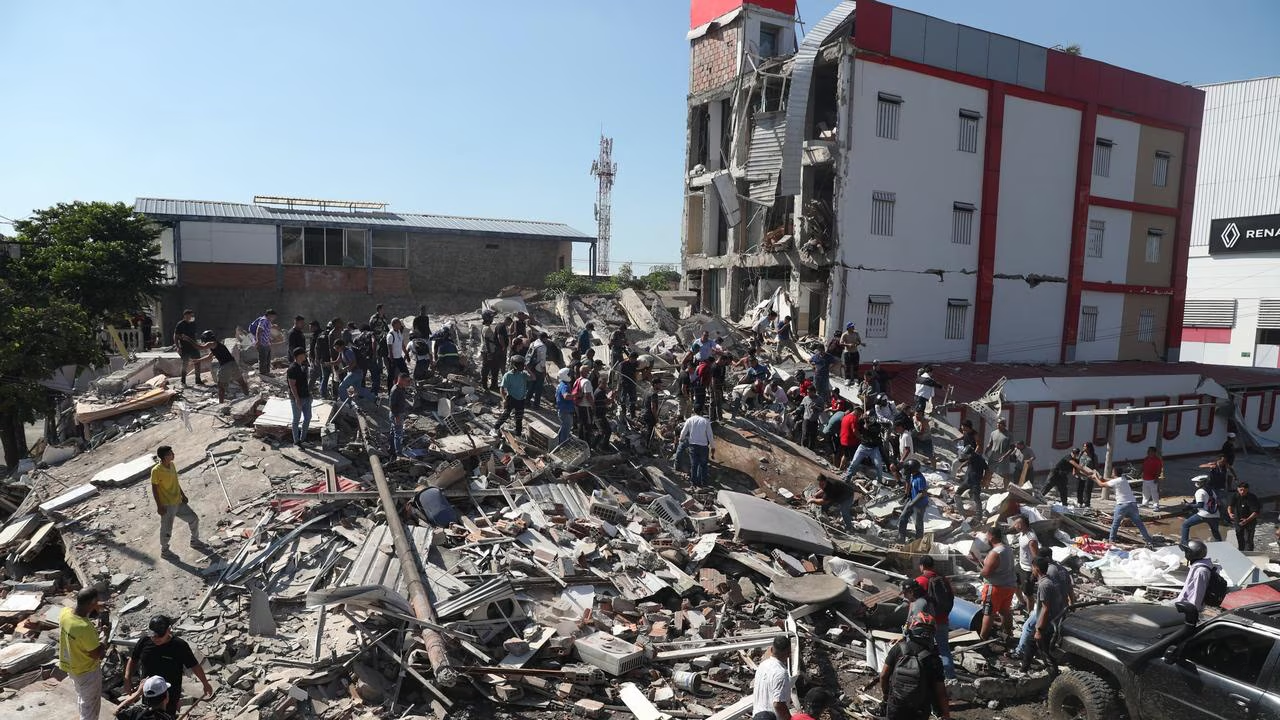
The death toll from Colombia’s devastating earthquake has climbed to at least 169, with thousands of people reported missing as rescuers and volunteers clear rubble with their bare hands to search for survivors.
The preliminary toll from the Colombian Association of Capital Cities stood at 169 dead and hundreds more injured early on Tuesday morning, local time. Authorities warned the figures were still changing as damage assessments continued.
More than 2700 people had been reported missing by Monday night, according to AP, although that number includes reports lodged by families on citizen-run missing-person websites and is likely to fluctuate dramatically as communications are restored. About 165 buildings have collapsed and about 1600 buildings have been reported damaged.
The magnitude-7.4 earthquake struck western Colombia at 7.34am local time on Monday, with the US Geological Survey placing it about 107km underground. Colombia’s Geological Service described it as the strongest earthquake recorded in the country this century.

President Abelardo de la Espriella, who was sworn into office just three days before the disaster, declared a national state of emergency.
“The national government has all of its capabilities deployed to protect lives, assist affected communities and deliver aid wherever it is needed,” he said.
“The first priority is rescuing the people trapped under the rubble.”
Hospitals in five Colombian cities were put on red alert Monday and a night-time curfew was declared in Cali, according to local authorities.
At least six local airports suspended operations, the civil aeronautics agency said.
‘The city fell down around us’
Australian Lisa Richards, who has lived in Cali for almost a decade, said the force of the shaking made it difficult to stand.
“The wall was bending, it was hard to walk actually because you felt very disorientated. It was really strong,” she told the ABC.
“And then I could hear people like my neighbours were screaming, car alarms were going off.”
With parts of the city without power and water, Ms Richards said residents were using social media to call for gloves, masks and water for the rescue effort.“Everyone’s hands [are] on deck.”
Pereira business owner Mónica Sánchez told AP she and 12 workers escaped her factory moments before part of it came down.“It was shocking — the city fell down around us.”
Cali resident Saul Paz said the destruction could have been even worse.
“I think if it had lasted five seconds more there would be nothing left,” he told Reuters.

Desperate search through the night
Thousands of civilians have joined emergency crews, forming human chains and removing huge pieces of concrete by hand as searches continue across western Colombia.
Rescuers wearing headlamps worked into the night in Cali while cranes were brought into Pereira, where emergency workers were in contact with a young boy trapped beneath a bakery.
Extraordinary footage broadcast by Caracol Television showed rescuers pulling a six-month-old baby covered in dust from the rubble of a five-storey building in Cali. Her mother was also rescued alive.
Elsewhere, rescuers were seen rappelling people from the windows of a damaged hospital.
Firefighter Mauricio Andrade said his team had already pulled two women and two children alive from one collapsed building.
“They are alive,” he said, as crews prepared to go back in.
Cali volunteer Carmen Yasmin Garcia said rescuers had freed seven people from another building, but others remained underneath.
“A moment ago there was scratching but now we can’t hear anything,” she said.
Civilian rescuer Andres Felipe Mejia told AFP volunteers had arrived carrying food and supplies.
“We are trying to get everyone out alive,” he said.
“One of the rescuers asked anyone trapped to whistle, and someone whistled back.”


President declared state of emergency
“The national government is maintaining all its capacities deployed to protect lives, assist affected communities and deliver aid to every area that needs it,” President Abelardo de la Espriella stated from Bogota.
The quake’s epicentre was in Colombia’s coastal Choco region at a depth of 100 kilometres.
Experts at the US Geological Survey said the quake was likely caused by movement along a deep fault within the Nazca tectonic plate.
The quake crumpled a tower of a beloved cathedral in the city of Manizales, an AFP journalist observed.
“A great many buildings” in the city sustained damage, said administrative worker Jaime Zuluaga “Traffic is paralysed, and people don’t want to go back to their homes for fear of an aftershock.”

Aussie travellers in Colombia warned
Smartraveller has issued an urgent update for Australians in Colombia following the earthquake.
In its latest advisory, Smartraveller states: “There are reports of damage in the cities of Cali, Manizales, Pereira and Quibdo, among others. Be aware of aftershocks and follow the advice of local authorities.”
Australians requiring urgent consular assistance have been directed to contact the Australian Embassy in Bogotá on +57 601 657 8030, or the Consular Emergency Centre in Australia on +61 2 6261 3305 from overseas, or 1300 555 135 within Australia.
The earthquake has also disrupted air travel across several major hub cities.
According to Smartraveller: “Air operations in Cali, Armenia, Buenaventura, Cartago, Manizales, Medellin, Pereira and Quibdo are reportedly suspended.”
Travellers have been urged to contact their airline or travel agent directly for the latest updates on flight availability.
In a separate but related development, Smartraveller has flagged heightened volcanic activity at the Puracé Volcano, situated within a designated “Do Not Travel” zone between the departments of Cauca and Huila.
“The Puracé Volcano … has been experiencing increased seismic activity. The Colombian Geological Service has raised the alert level,” the advisory notes.
Australians in or planning travel to the region have been strongly advised to follow the instructions of local authorities, including any directives to avoid the area altogether.
‘Missing people’
At least 20 buildings crumbled in Colombia’s third-largest city, Cali, trapping people beneath the debris, Mayor Alejandro Eder said.
Choco’s governor warned of serious damage in the provincial capital Quibdo, where videos showed more buildings reduced to rubble.
“We are all devastated,” Quibdo community leader Luis Gregorio Moreno told AFP.
“At this moment there are reported deaths, dozens of wounded, but what there are most of are missing people,” he said.
Ecuador, Panama and Venezuela also felt the early-morning quake, which prompted building evacuations in the Colombian capital, Bogota.
Still wearing their pyjamas, crowds of people rushed out into the street upon feeling the tremor, AFP reporters saw.
“The quake was very, very strong,” said content creator Valeria Polo, 29, in the capital, where only minimal damage was recorded.
Six small airports in western Colombia suspended operations, the civil aeronautics agency said, and the soccer governing body postponed upcoming football matches.
Washington is “closely monitoring the large earthquake that struck Colombia and stands ready to support the people of Colombia,” US Secretary of State Marco Rubio wrote on X.
European Union chief Ursula von der Leyen said the EU was “ready to provide more support” to the South American country.
“We have already mobilised Copernicus, our satellite service, to help with rescue operations,” she wrote on social media.
Israel, Mexico, Ecuador and France also offered assistance.
Latin America is already reeling from two disastrous quakes that struck Venezuela in June, killing more than 6,000 people and causing widespread destruction.