
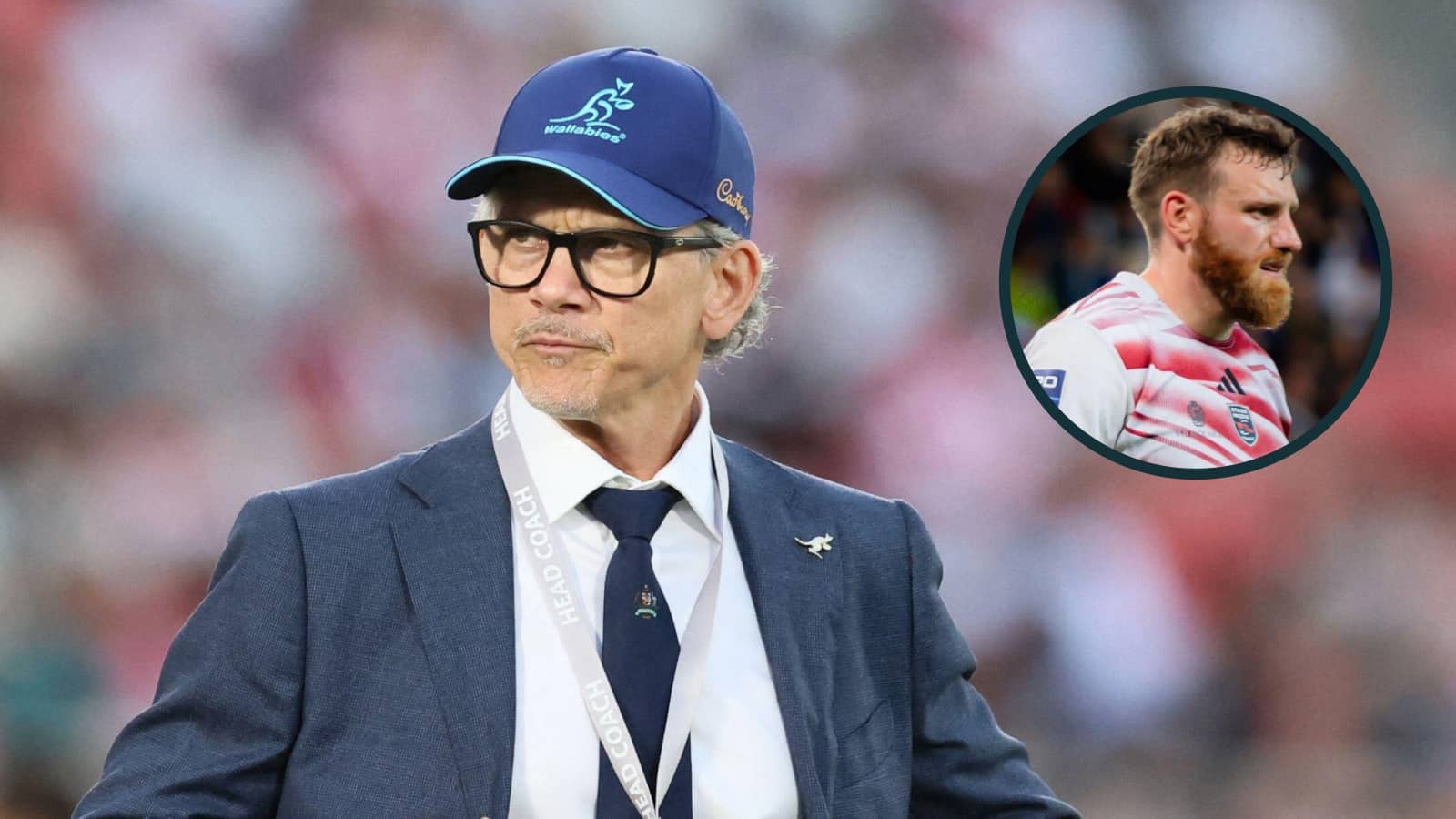
This week we will mostly be concerning ourselves with Nice’s complicated rise to the Pro D2 and Australia’s crisis one year out from the World Cup…
Nice back from the brink
The name of Jean-Baptiste Aldigé has cropped up in this column before. His battle with Biarritz mayor Maider Arostoguy lasted almost an entire World Cup cycle, comprising several rounds of accusations and counter-accusations, encompassing the city of Biarritz cutting the club off from its utilities and threats by Aldigé to relocate the club to San Sebastian, and culminating in Aldigé selling the club for €1 in disgust in the spring of 2024.
Faults were clear on both sides, with Aldigé’s impatience and naked ambition clashing forcefully with civic pragmatism. Aldigé may only have got a euro for the sale of the club, but the club still pays for a pair of Land Rovers for Mr. Aldigé to drive around – and rack up his fair share of traffic fines, not to mention a conviction – later quashed – for an assault on a Toulouse restaurateur.
Since August of 2024, he’s largely been driving the cars around in Nice, where once again his ambition and willingness to disrupt have been evident. After a disastrous season in the ProD2 which saw Nice relegated on the back of a 15-game losing streak, Aldigé kicked properly into action.
In the wake of that relegation, he oversaw 27 player departures, but replaced them with 20 new players, including Fiji captain Waisea Nayacelevu, Wales international Owen Williams, South Africa’s Uzair Cassiem and France international Vincent Rattez. So far, so good. But then he started ringing the bell of the municipality for help, and managed to extract the promise of a gleaming new 12,000-seater stadium for the club from former mayor Christian Estrosi, along with the construction of a 1,400-capacity temporary grandstand to bring in a few early bucks during the stadium construction. Then the team did its bit and got promoted. All light and happiness.
But the new mayor, Eric Ciotti, was in a less generous mood, immediately cancelling the plans for the temporary stand because of a fairly understandable desire not to spend €8m on something that would only last three years. However, he did commit to compensating the club for the lost potential revenue and talked about building a permanent new stand, although it was never clarified what effect that would have on the new ground; one slightly oblique communique suggested it would tide the club over until it reached the Top 14.
Mr. Aldigé, perhaps burned a little already by the saga in Biarritz, quickly opted to resign in dismay, notionally taking his funding source for the club with him. Which is where Nice’s troubles really started. The impasse between the two warring tribes caused a shortfall in Nice’s budget of €4.6m, something the French sporting financial watchdog noticed predictably quickly, and promptly booted Nice out of the ProD2, potentially even down to the bottom of the club pyramid.
Eventually, between the verdict and the appeal, Mr. Aldigé’s investment vehicle Sport Inside Europe (SIE) found the wherewithal to pony up the dough, and the relegation was overturned on appeal, which the club handed a suspended two-point deduction for budget irregularities. Meanwhile, the city committed to building a permanent 4,000-seat facility as the initial phase of the 12,000-seat project, with the other 8,000 seats to be conditional on an ascent to the Top 14.
So all’s well that ends well. In fact, it’s a better outcome for all than their initial bargaining positions. It remains to be seen whether the damage done to morale will impact on Nice’s season in the Pro D2 – which can’t go a lot worse than the last one.
It also remains to be seen whether Mr. Aldigé will resume duties at the club, but there are plenty of indications he will do so now that the matter has been resolved. Should he do so, he will be President of the club’s first game on Thursday week: a trip back to Biarritz. Some endings are just too happy.
No conductor for the players
14 months out from their own World Cup, Australia look to be no closer to solving that most ghastly of conundrums for an international team: the glaring lack of a first-choice fly-half.
Carter Gordon is the most obvious contender when he is fully fit, but that seems to happen in periods measured in minutes rather than matches.
As for the rest, nobody has convinced, and more pertinently, nobody has been given a lot of time to convince. Thirteen players have now worn the jersey for Australia since the World Cup Final in 2015
“There’s a decade of Australian No.10s that have been chewed up and spat out,” Morgan Turinui said on Stan Sport last year.
Want more from Planet Rugby? Add us as a preferred source on Google to your favourites list for world-class coverage you can trust.
“It’s hard to expect a Wallabies fan to be patient, and let guys make mistakes at Test level and learn at Test level because you’re supposed to be ready for Test level. But that’s just where we’re at.”
Les Kiss clearly has a lot of work to do at Australia in general, but settling on a pivot for the next 14 months must be absolutely top of the list.
Declan Meredith made some painful errors on Saturday but it ought not to be lost on viewers that his kicking game was pretty useful.
Bernard Foley remains in the background as a potential mentor and finisher – if Deon Fourie can crack it at 39, Foley can surely close out a game at 36. But until Kiss settles on a starter and gets him properly settled in, Australia will continue to stutter.
READ MORE: Ex-Wallabies and Ireland back Brian Smith passes away aged 59