
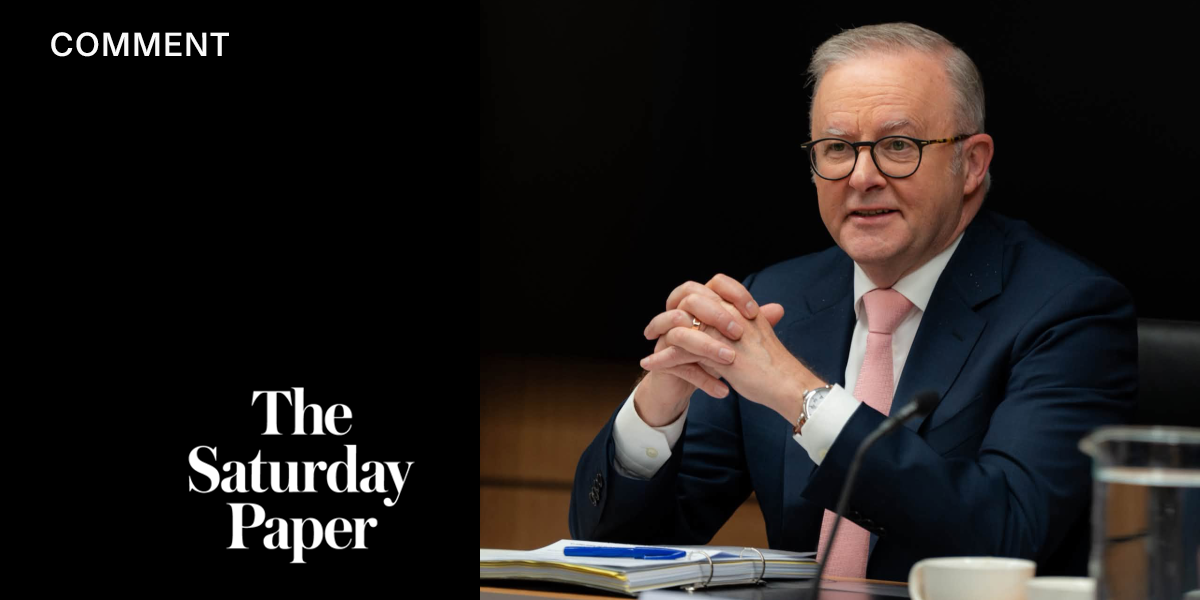
A senior minister describes the controversial “melongate” like this: “It’s a noise no one wants to keep running.”
Included among the no ones is Prime Minister Anthony Albanese, whose performance on the sexually charged Bush Deep podcast last month proves a recurring embarrassment for the government.
The latest flare-up was prompted by an opinion piece published on Monday by the former Japanese ambassador to Australia, Shingo Yamagami, accusing the prime minister of mocking his Japanese counterpart and denigrating her gift of two Shizuoka crown melons. “It is,” he wrote, “appalling to note the ignorance about what this gift means.”
Yamagami was a controversial ambassador who had his term cut short when his superiors in Tokyo realised his antipathy to the Albanese government wasn’t helpful to the relationship.
“He’s a mate of Tony Abbott’s,” was a dismissive comment from a government insider. Unfortunately for Albanese, this does nothing to erase the impression most who have viewed the podcast got from the prime minister’s hand gestures and the perceived double entendre about melons and Sanae Takaichi’s breasts.
Albanese insists this is a misinterpretation and he has nothing to apologise for. In that, he has been strongly supported by the most senior women in the cabinet: Penny Wong, Katy Gallagher and Tanya Plibersek, as well as other female ministers.
Earlier, the podcast generated controversy when Albanese was forced to “unequivocally apologise” for his participation in a “shag, marry, date” game where he chose Kylie Minogue for all three categories.
The “melons” remark and gesture were excluded from this contrition. Indeed, it was barely noticed before the former ambassador called for an apology and for more respect for Takaichi in her efforts to breathe new life into the security Quad arrangement between the United States, India, Australia and Japan.
On Tuesday, Yamagami did a live cross from Tokyo to News24, in which he said his remarks were neither partisan nor political.
“Simply, this is a matter of decorum, diplomatic propriety and mutual respect,” he said. “In Australia or in Japan or anywhere else for that matter, you don’t make a mockery of gifts from your friends, which are meticulously prepared and kindly presented.”
Yamagami suggested Albanese should make an official return visit to Japan, something the prime minister has not done this term.
The embattled opposition quickly turned the melons controversy into an attack … The lesson for Albanese has to be, surely, that despite the media strategy of doing podcasts with a wide spectrum of audiences and demographics, he is still the prime minister and not some smutty schoolboy.
The opinion piece’s publication in The Australian coincided with the latest Newspoll in the paper, in which Labor and One Nation both dropped a point to a primary vote of 29 each and the Coalition dropped a point to a disastrous 18 per cent.
The embattled opposition quickly turned the melons controversy into an attack on Albanese’s character.
There is a view, bolstered by the Newspoll, that the prime minister is particularly vulnerable. Satisfaction with his performance is in the negative by 22 points, compared with Angus Taylor on minus 12 and Pauline Hanson on minus three.
Taylor twice attempted to suspend standing orders to debate the issue, calling for the House to condemn Albanese for his disrespectful remarks, refusal to apologise and for potentially breaking the law for releasing classified intergovernmental communications.
In a display of hollow bravado, the opposition leader even gave Albanese a 1.30pm deadline on Wednesday to make a statement to the House. The government’s overwhelming numbers killed off this performative protest.
The Liberals’ Mary Aldred began the Question Time attacks, accusing the prime minister of making “a series of foul-mouthed, classless comments about women” and asking Albanese to apologise.
He rejected “the assertion” in the question and said Australia and Japan “have never been closer or more strategically aligned”. In light of recent agreements and defence purchases, he added, his government “has taken our special strategic partnership to new heights”.
Nevertheless, correspondence between the Japanese and Australian governments over the July Kumamoto earthquake, released to Seven News and The Australian to rebut claims the podcast remarks were taken as an insult, do reveal Tokyo had noticed them and not all that kindly.
According to The Australian, the Japanese government “noted sensationalised reporting” in the media but said it would take “no action”, so the media could move on. It noted there was no “ill intention” in Albanese’s remarks.
Seven’s report made no mention of the Japanese embassy taking no action to smooth over matters and, according to a government source, this was a more reliable angle.
Both media outlets reported Prime Minister Takaichi “expressing heartfelt gratitude for Australia’s profound friendship following the recent earthquake”.
A reporter from one of Japan’s biggest newspapers, The Asahi Shimbun, was in the press gallery as the opposition pursued Albanese. He filed a report on the debate and says there is speculation in Tokyo that the former ambassador, Yamagami, had the support of the Takaichi government in expressing his disappointment with Albanese.
The lesson for Albanese has to be, surely, that despite the media strategy of doing podcasts with a wide spectrum of audiences and demographics, he is still the prime minister and not some smutty schoolboy.
Analysis in what one senior staffer calls the “hostile media” compared Labor’s 29 per cent primary vote with the grim days of Julia Gillard 15 years ago. Indeed, if the same precepts applied today, Albanese and the government would be in dire straits.
When Gillard was in power, the loss of support for Labor mostly flowed to the Coalition. The Liberals and the Nationals are a long way from the 48 per cent primary vote they were achieving in Newspoll in September 2011.
The times have changed dramatically.
At the last election Labor won 62.7 per cent of the seats with 34.6 per cent of the primary vote. That 94-seat result is the highest number of seats ever won by a single party since Federation.
The other polls this week broadly confirm Newspoll’s results and show we have a new three-way contest with the Liberals trailing One Nation.
This appears to be a structural shift, which for the time being shields Albanese from the sort of internal stirrings predecessors who recorded similar poor results would have faced.
That is not happening because, as one seasoned Labor campaigner says: “Albanese has been bitten on the bum by a rainbow.” He is not all that flash, but he is lucky his opponents are much worse.
The Liberals are counting on Taylor developing policies and having a program ready to sell when voters start paying attention closer to the next election. This is the plan the Liberals’ new federal director, Lincoln Folo, outlined as their best chance at a briefing to MPs during the week.
No one, least of all Albanese and the government, can get away from Bill Clinton’s campaign truism: “It’s the economy, stupid.”
Treasurer Jim Chalmers breathed a sigh of relief when the Reserve Bank’s Monetary Policy Board kept interest rates on hold at 4.35 per cent this week. The treasurer pointed out inflation had come in substantially lower than the Reserve Bank or the Treasury had forecast. This was the second meeting of the board since the budget, and rates on both occasions were held steady.
To refute the narrative that the government is tanking the economy and the housing market, the treasurer pointed out that Australia is one of only nine countries “with a AAA sovereign credit rating” from all three major ratings agencies.
He also said we’ve “got lower gross debt than every major advanced economy”.
The elephant in the room, however, is United States President Donald Trump and his inability to end the conflict engulfing the Middle East.
Chalmers said that “from an economic point of view, a proper enduring end to this war cannot come soon enough”.
The other key marker for the government is undoubtedly housing affordability.
Albanese raised eyebrows when he quoted, apparently with approval, investment commentator Scott Pape, who wrote in the Herald Sun: “Average house prices have increased by more than 400 per cent since 2000, partly on the back of taxpayer-funded landlord welfare.” He said house prices have grown faster than workers’ wages, creating “the pickle we are in”.
Somewhere along the way, Albanese went on, we treated houses like a share price. “We forgot what they are actually for: a house is for living in.”
In his answer to Angus Taylor, Albanese explained the budget’s tax changes as a way to address this. The media characterised this as Albanese welcoming the fall in house prices and acknowledging his reforms were at least partly responsible.
The next day Albanese sounded as if he had cold feet when the opposition pointed out that he and other ministers had benefited from negative gearing. He confused the House by saying the views he was quoting were Scott Pape’s and not his.
It sounded like an each-way bet or, as Paul Keating would say, running for the hills at the first whiff of grapeshot.
Reserve Bank governor Michele Bullock somewhat spoilt the party by warning she would not hesitate to raise interest rates again if it were necessary to rein in inflation.
That wouldn’t do much to help Albanese’s poll ratings.