
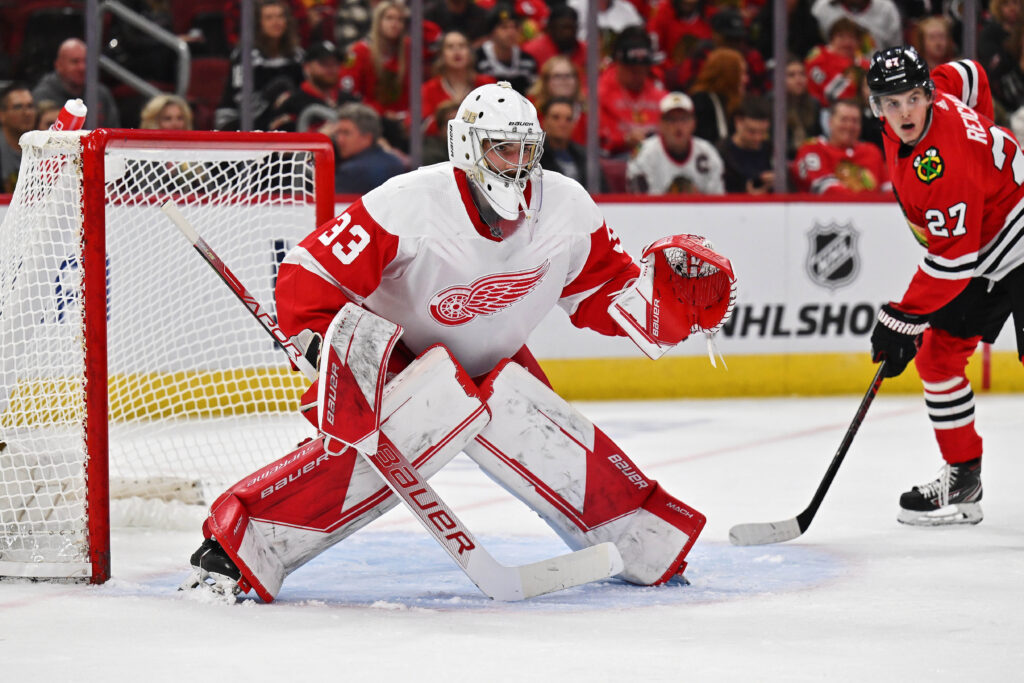
A trip through the minor leagues has dragged on for goaltender Sebastian Cossa. Once a top-15 draft pick, Cossa has failed to earn as much as an extended NHL opportunity – despite strong performances in the AHL. With a logjam forming in front of him, the Detroit Red Wings opted to trade Cossa to the Utah Mammoth in exchange for the 23rd-overall pick in the 2026 NHL Draft. Detroit used that pick to select Red Wings-fan J.P. Hurlbert, while Utah added a goaltender with a realistic chance to become the franchise’s first long-term answer in net.
Karel Vejmelka has stabilized the Mammoth crease through their early years. He secured the starter’s role with a .904 save percentage and 26-22-8 record in 58 games during the 2024-25 season. That earned him a fuller workload in 2025-26, when he recorded a .897 save percentage and 38-20-3 record. The pair of seasons stand out as steady work in a goaltending room that otherwise lacked a clear #1. They were also important years for Vejmelka, who briefly lost his starting role in 2023-24 despite handling 50-game workloads with average results in 2021-22 and 2022-23.
Vejmelka’s play has been reliable, but it has not separated him from the league’s middle tier. His save percentage has landed near league average in each of his seasons as a starter, and he has stopped just 0.05 goals-above-expected (GSAx) per 60 minutes throughout his career, per HockeyStats. That has been enough to keep Utah competitive while young stars like Logan Cooley and Dylan Guenther begin to carry more of the load for the playoff-hopeful Mammoth. Still, Utah will need to add another step in net if it wants to become a true Western Conference standout.
Cossa could provide that. He has been a steady performer behind the perennially-strong Grand Rapids Griffins since 2023. After working his way out of the ECHL in his first pro season, Cossa posted save percentages of .913, .911, and .915 while handling Grand Rapids’ starting role. He has also combined for a 70-33-19 record and a 2.46 goals-against average in 123 AHL games. Those are commendable numbers, even with the support of Grand Rapids’ veteran blue line.
Cossa’s strengths shined as clearly as his weaknesses during his time in the Griffins’ crease. He remains a nimble athlete with a strong connection between his eyes and his glove. Cossa is difficult to beat from distance, though his tracking and handling of net-front scrambles have left room for growth. Those drawbacks flared at the end of the 2025-26 season, when Cossa relinquished the starting job to Michal Postava after allowing 36 goals on 297 shots (.878 save percentage) through his final 11 games.
The Red Wings responded to those signs of trouble by flipping Cossa for another first-round pick. The return gave Steve Yzerman a modest win in his final move as Detroit’s general manager, but it also gave Utah a shrewd chance at upside. Despite year-over-year consistency at every level, Cossa has received just one appearance at the NHL level. He relieved Ville Husso in a 2024 matchup against the Buffalo Sabres after Husso allowed three goals on the first seven shots of the game. With 45 minutes of ice time, Cossa secured the win while allowing two goals on 14 shots.
Cossa allowed 0.37 goals above expected, per HockeyStats, making the underlying results a negative mark in his first taste of NHL ice. But those numbers do not include Cossa’s silencing of Buffalo in the three-round shootout that lifted Detroit to the victory. Even in a surprise debut, Cossa showed an ability to keep his team in the game. That acumen could support his success at the top level as he becomes more comfortable against NHL competition.
That will be the test Utah presents to Cossa next season. He is in line to play through his rookie NHL season while operating as Vejmelka’s backup. That spot should offer enough exposure for Utah to evaluate the former first-round pick without forcing him into a starter’s workload too quickly. Positive showings in a new lineup, and behind a better defense, could help Cossa push for split minutes before the second half of the season. If he finds the same .910-save-percentage consistency that he showed in the WHL and AHL, Cossa may even secure the starter’s role before the end of the year.
Utah won’t have to force that outcome. Vejmelka’s ability to perform as an average NHL starter should give the Mammoth enough stability to challenge for the postseason behind an improved lineup featuring Anders Lee, Vincent Trocheck, and Andrew Peeke. Cossa will have room to settle in as a backup before pushing for a larger role. That runway may be exactly what he needs, giving Utah a real chance to answer whether Cossa can be a long-term NHL starter.