
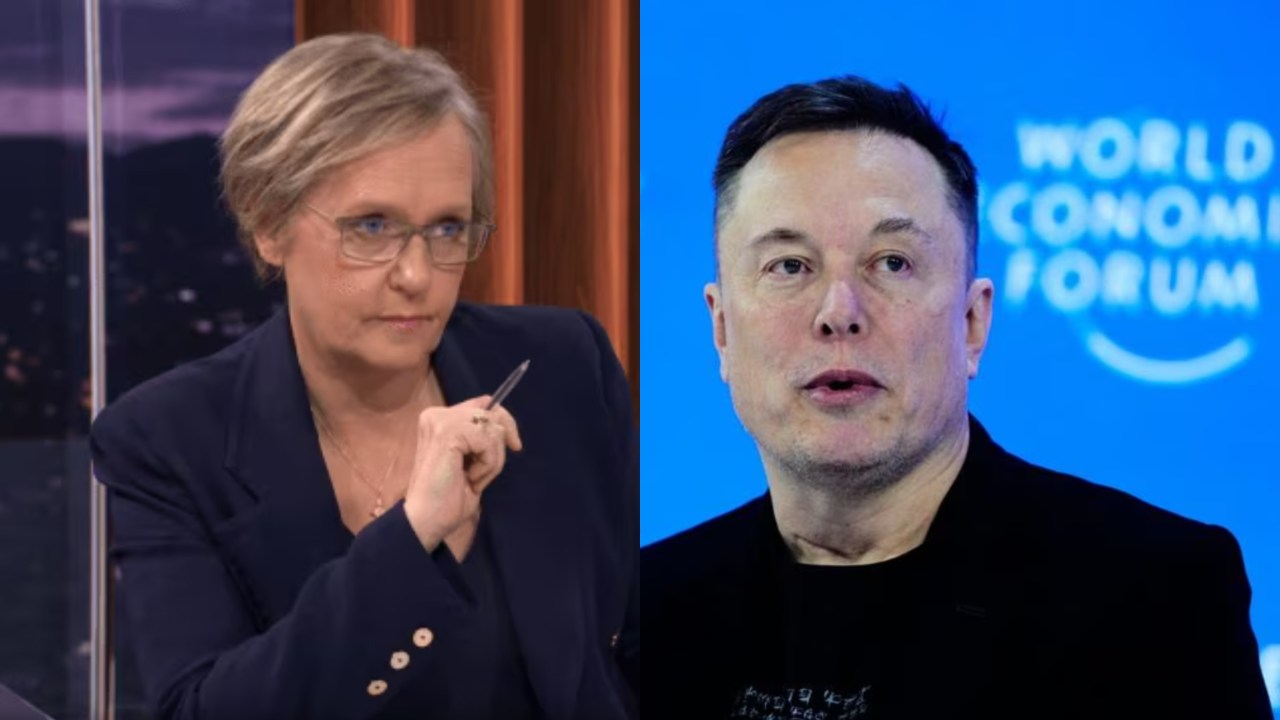
ABC presenter Sarah Ferguson has joked about keeping Elon Musk against his will during a bizarre exchange at the Logies, just one night before it was rocked by a new Mahmood Fazal scandal.
Ferguson was asked by interview Steve Molk who she would choose as her first guest in a hypothetical podcast.
The ABC presenter answered Musk before the interviewer joked about paying $20 to make sure Musk never left the studio.
“I’m going to start with Sarah Ferguson podcast. Who would be your first guest?” Molk asked.
“Elon Musk,” Ferguson replied.
“Can I slip in a 20 to just to make sure he doesn’t leave the studio,” Molk said.
“Consider it done,” Ferguson replied.
“This conversation never happened!” Molk then declared, facing the camera.
The exchange prompted News24 host Chris Kenny to question whether the ABC considers such a joke acceptable from one of its senior presenters.
“Okay, so ABC host Ferguson wants to interview Musk, but jokes about ensuring, for a price, that he never leaves. What is it with these people?” Kenny said.
News24.com.au sent questions to Molk and the ABC about what was meant by the remark.
Molk said the comment was “nothing more than a joke in poor taste”.
Asked whether it was a joke about killing Musk, Molk replied: “No.”
He said the intended meaning was that “by isolating/insulating his influence some things might be better”.
“I can see now you raise it how it might be inferred as something other,” Molk said.
Asked what was in poor taste about the remark, Molk said: “Holding someone against their will is the poor taste view. With all the conflict in the world nobody should be held in such a fashion.”
The ABC did not respond to News24.com.au’s questions.
Elsewhere in their conversation, Ferguson defended the role of the ABC and its place in Australian broadcasting.
Molk asked why Australians continued to turn to the national broadcaster during major events and periods of uncertainty.
Ferguson said the ABC had earned that trust through its role in public broadcasting.
“Because we’ve always done the right thing. We’ve always understood that’s what our role is. We really know what we’re about,” she said.
“Incredibly important in all forms of broadcasting, to know what you’re for. And we always have.”
She said audiences were increasingly concerned about whether information was reliable.
“And right now, people are so afraid of what’s real, what’s not real, what’s reliable, and the world is scary. So this is something you can trust. It’s worth a million.”
The comments came just one night before the ABC became embroiled in a deepening scandal over using fake sources to create fictional journalism.
On Monday, News24.com.au revealed the ABC was rocked by another anonymous sources scandal linked to disgraced ex-bikie Mahmood Fazal, who has left a trail of editorial carnage behind him at the national broadcaster.
Mr Fazal ceased employment with the ABC in May 2026 following an investigation into his paid role in a podcast titled Word on the Street in 2025.
The ABC was later forced to remove two Four Corners stories by Mr Fazal – Cocaine Nation and Meth Highway – over concerns about fake anonymous sources.
However, the ABC has since identified three more stories of concern: Four Corners episode Silent Orders, Background Briefing episode Meet the Teens, and a segment in Post Code Wars.
In a statement on Monday, the ABC admitted its verification procedures had not been properly followed.
The ABC has stressed its commitment to editorial standards and journalistic integrity as the review process continues.
The scale of the Fazal controversy has raised questions about how one of Australia’s most prominent news organisations verified sources used in high-profile investigative programs.
It is not without precedent internationally.
One of the most notorious examples came in the United States with former New York Times reporter Jayson Blair, whose career collapsed in 2003 after an investigation uncovered fabrication and plagiarism across dozens of stories.
The Times found that Blair had invented material, used other reporters’ work and falsely claimed to have reported from locations he had never visited.
The scandal led to the resignation of senior newsroom executives.
Another notorious case involved The New Republic journalist Stephen Glass, who fabricated people, organisations, quotations and even supporting documents to make invented stories appear genuine.
The Fazal scandal is the latest in a series to have rocked the ABC.
Earlier this month, and 25 days after the episode aired, the broadcaster apologised, following a national backlash, for an offensive film it aired that depicted a fictional attack on Gina Rinehart.
The short clip featured remarks about a “revolution” before describing an attack on the billionaire businesswoman in explicit terms.
Titled “A Very Relaxing Video”, the four-minute film was created by Race Around the World contestant Kate McGuinness while filming in Scotland.
The segment included a sexually violent reference to Australia’s richest woman.
The ABC Ombudsman found the controversial film did not breach editorial policies, but had fallen short of community expectations.
Last week, News24.com.au revealed that the ABC has embarrassingly took down a second piece concerning Mrs Rinehart in as many weeks, with the broadcaster admitting that broadcasting a claim that the Australian billionaire is pushing for Australians to “work for $2 a day” was “inaccurate.”
In the interview, she said One Nation’s surge in the polls was “a result of the massive amounts of funding from billionaires like Gina Rinehart who are pushing for Australian workers to work for $2 a day”.
Host Jeremy Lee failed to challenge the claim or push Mrs Sheppard to substantiate it.
Mrs Rinehart last month awarded more than $1.2 million to successful Aussie swimmers at the Commonwealth Games, and is known for frequently handing out random cash bonuses worth hundreds of thousands of dollars to her staff.
A statement posted to the ABC website admitted the mistake.
Despite the online and on-air corrections being issued, it stopped short of apologising to Mrs Rinehart for the comments.
The ABC has also faced a significant legal setback over its reporting on former Australian commando Heston Russell.
Mr Russell successfully sued the ABC for defamation after it aired a report that accused him of committing war crimes.
The former soldier was awarded $390,000 in damages, but only after the ABC spent more than $3 million to defend its reporting.
In a different report also concerning members of Mr Russell’s regiment and platoon, additional gunshots were added to footage claiming to show an Australian soldier firing at unarmed civilians from a helicopter in Afghanistan.
An internal investigation later found the additional gunshots had been “inadvertently” added, but there was “no evidence of any intent to mislead”.
Ferguson herself has also previously been at the centre of an ACMA finding involving her work.
In 2022, the media watchdog found that the Four Corners documentary Fox and the Big Lie, which Ferguson presented, breached aspects of the ABC’s editorial code relating to accuracy and fair dealing. ACMA did not find a breach of the impartiality standard.
ACMA identified three breaches in the program, while rejecting the overwhelming majority of issues raised by Fox News.
The ABC strongly defended Ferguson’s reporting and said the documentary remained an important public-interest investigation.
Read related topics:ABC Backlash