
Are Chinese robots on the cusp of killing off a popular occupation?
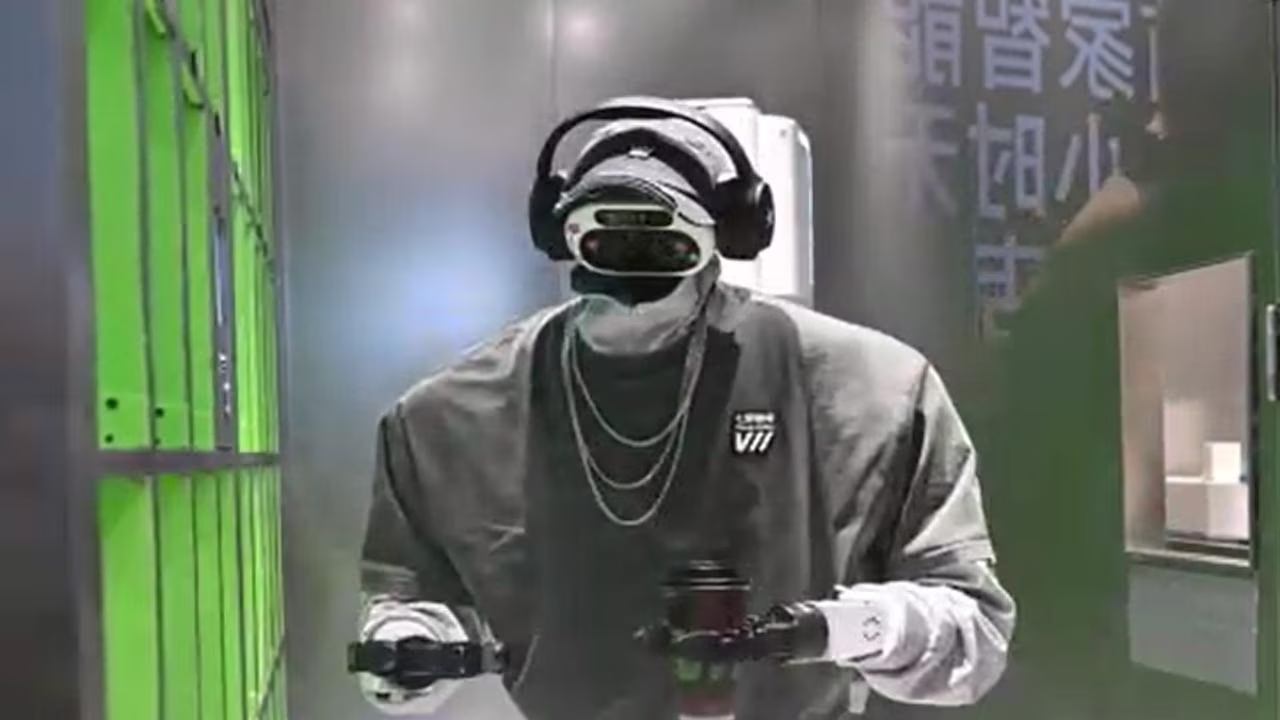
On Sunday, a 24-hour coffee shop entirely run by a humanoid robot opened in Beijing and offered freshly brewed coffee with an average wait time of less than 30 seconds per cup.

On its opening day, the shop set a Guinness World Record for the most cups of coffee served by a robot-operated store in one hour, with 202 cups prepared and served.
Inside the store, a single robot handles the entire process from grinding, brewing, and mixing to serving. Customers can place orders through a self-service system and customise sweetness and coffee intensity.
Crazy footage shows the slickly-clad robot dolling up coffee and teas and placing them in pigeon holes for customers to collect.
Customers lined up outside hoping to get in.
One customer said the coffee was “pretty well-balanced” while her partner it took no time at all to get his cuppa.
“When I first saw the place, I thought it would take a while to get a cup. But I walked in and got it almost right away.”
Crazy footage shows the slickly-clad robot dolling up coffee and teas and placing them in pigeon holes for customers to collect.
‘They’re taking our jobs’
Dr Leonora Risse from the Queensland University of Technology said humanoid bots and AI were well suited for routine, repetitive tasks and offered productivity gains but were less suited to tasks that involve variety or unpredictability.
“AI can’t replace the human dimension, which is what many customers are looking for when they order a coffee or go out to a restaurant. These purchases are not solely about functionality, but also about the customer experience,” Dr Risse told news.com.au.
She said data from Jobs and Skills Australia found jobs like waiters, baristas and bar attendants being replaced by AI was not as high as people expected.
“This shows how the essence of hospitality jobs is about human interactions,” the academic said.
“The jobs at highest risk of being replaced by AI are clerical and administrative jobs, as these involve routine processes, which can increasingly be done by digital tools. Telemarketers and call centre workers are top on the list, but clerks, bookkeepers, secretaries, receptionists and personal assistants are also in this mix.
“This places women more at risk of losing their job to AI, given that most of these are mostly female-concentrated occupations.”
Clerical and administrative jobs made up more than 7 0per cent of women and provide almost one in five jobs for all women in the Australian workforce, Dr Risse and the ANU’s Elise Stephenson wrote in a recent article.
Dr Risse said we need to be ready to assist these displaced workers to transfer their skills to other roles.
“I expect that AI will make the ‘human’ side of our jobs even more important and valuable. “These skills that make us human – like empathy, care and emotional intelligence – are the skills we don’t want to outsource to robots and automation.
“Critical Judgement is also a skill that we’ll need to focus on more strongly. AI can perform the mechanics of a task. But how will it navigate complex decision-making processes where there is not a clear answer? This is where human ethics, morals and experience matter.
“As for the record-breaking coffee-serving robot, Australians love their coffee shops. There might be some novel exceptions, but I can’t see a huge wave of robots replacing Aussie baristas.”
In the US, Morgan Stanley predicted 62.7m US jobs could be replaced with humanoid robots by 2050. The bank stressed this was not a forecast of mass joblessness.
In July, humanoid robots performed keyhole surgery on live patients for the very first time.
A team of engineers and surgeons from the University of California, San Diego (UCSD) teamed up to test just how useful these two-legged humanoid robots could be in a high-stakes clinical environment. As part of the landmark preclinical trial, two humanoid robots carried out keyhole procedures on live, anaesthetised pigs while being remotely operated by human surgeons.
In one operation, a robot worked side-by-side with a human surgeon to successfully remove a pig’s gallbladder.