
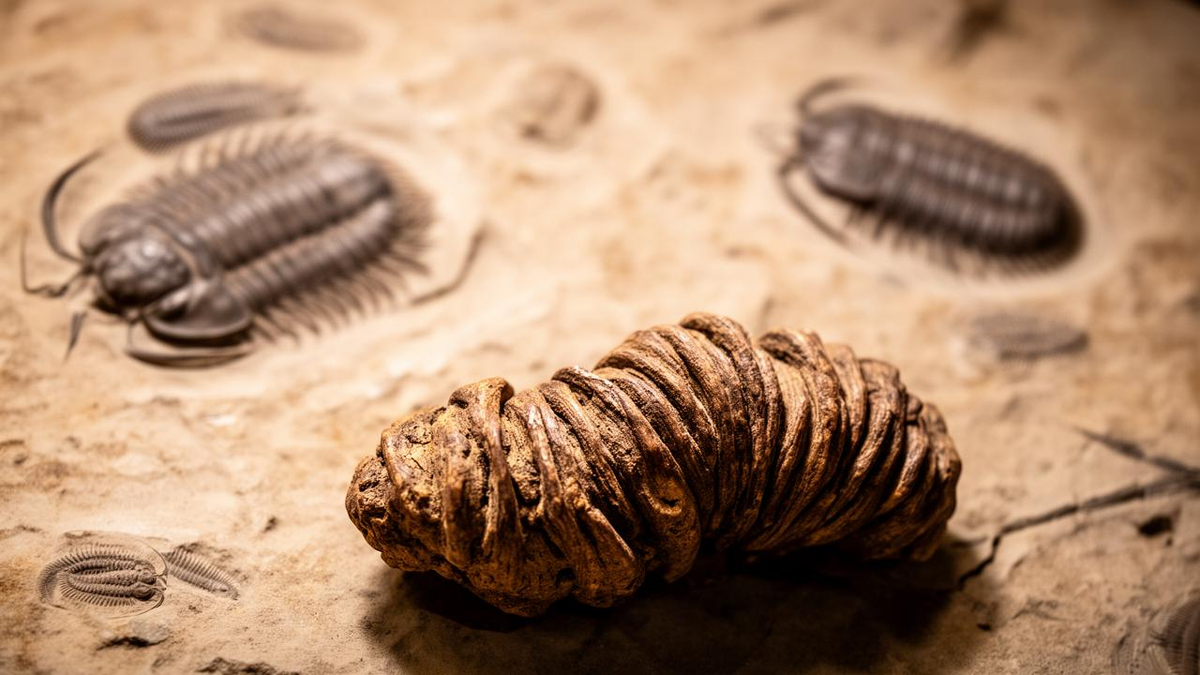
Fossilized feces from primitive marine animals have been identified as a potential trigger for the Cambrian explosion—the dramatic proliferation of animal species that occurred approximately 540 million years ago. The argument: as animal digestive systems became more complex and feces grew larger and more nutrient-rich, organic matter flooded the oceans, acting as an ecological fertilizer that drove animal diversity upward.
Russell Bicknell, a professor at Australia’s Flinders University, and Julien Kimmig, a curator at Germany’s State Museum of Natural History Karlsruhe, published their findings in the international journal Trends in Ecology & Evolution. “We found evidence in sedimentary deposits around the world that both digestive tracts and coprolites increased in size and complexity during the Cambrian,” they wrote.
The Cambrian period, beginning roughly 540 million years ago, spanned about 20 million years and saw the emergence of most major animal groups on Earth. Trilobites are the iconic representatives, and the period also marked a revolutionary increase in anatomical complexity—eyes, claws, teeth, antennae, fins, and tails all appeared. Scientists have previously proposed causes including a surge in marine oxygen levels, climate stabilization, and resource competition, but the precise mechanism has remained elusive.
The researchers drew inspiration from the fact that modern deep-sea organisms depend on feces sinking from the surface. They examined coprolites—fossilized animal excrement that has hardened into rock—recovered from Cambrian strata. Coprolites allow scientists to infer the degree of digestive system development in ancient animals.
The investigation revealed that across more than 35 sedimentary deposits worldwide, the size and complexity of digestive tracts and coprolites increased in tandem. “Coprolites ranged from grains smaller than 1 millimeter to centimeter-sized specimens containing shell fragments or pieces of other animals,” Bicknell explained. “The digestive systems of early arthropods also became more complex, with guts and digestive glands evolving to process a wider variety of food.”
Animals first appeared during the Ediacaran period around 600 million years ago, but complex digestive systems and coprolite fossils only became widespread from the early Cambrian onward. As digestive systems developed, animals could consume a more diverse range of prey, and their feces became richer in organic matter. “The fossil record makes it clear that the evolution of feeding strategies was intimately linked to the production and distribution of organic matter and nutrients, creating an environment analogous to how we use fertilizer in food production today,” Bicknell said.
That said, this remains a hypothesis. Critics note the difficulty of establishing causality—did feces increase first, or did animal diversity? Nevertheless, given what we know about the impact of animal waste on modern marine ecosystems, researchers consider it a highly plausible scenario.
The Ecological Value of Feces, Confirmed in Modern Oceans
The fertilizing effect of animal feces on marine ecosystems is well documented in today’s oceans. In 2010, researchers from the University of Vermont and Harvard University published a study in the international journal PLoS ONE showing that whales act as pumps, drawing nutrients from the deep ocean to the surface.
Whales feed on krill—crustaceans at the base of the food chain—near the ocean floor, then rise to the surface to defecate. Iron from the krill’s bodies spreads across the surface through whale feces, where phytoplankton absorb it and proliferate rapidly. Krill and small fish feed on the plankton and grow, becoming prey for whales and larger fish in a virtuous cycle.
The ecological value of whale feces was paradoxically demonstrated through population declines caused by whaling. Between 1910 and 1970, approximately 1.5 million baleen whales were killed by whaling ships in the Southern Ocean. Contrary to expectations that krill populations would surge once whales disappeared, krill numbers plummeted by more than 80% after the mid-20th century. With whale feces gone, the ocean’s productivity itself declined.
The Southern Ocean has also faced a crisis from declining penguin feces. In 2023, Spain’s Andalusian Institute of Marine Sciences published a paper in Nature Communications reporting that as chinstrap penguin populations halved compared to 1980 levels, the amount of iron supplied to the Southern Ocean decreased by the same proportion.
The decline in whale and penguin feces also reduces the ocean’s capacity to absorb greenhouse gases. Phytoplankton absorb carbon dioxide through photosynthesis and, upon dying, sink to the ocean floor, sequestering carbon. The world’s oceans absorb roughly 30% of human-emitted carbon each year through this mechanism. If feces decline and plankton fail to thrive, carbon absorption inevitably falls.
The researchers suggest that the increase in feces during the Cambrian was not merely a byproduct but potentially a key factor accelerating nutrient cycling in the ecosystem. Given that this cycle—initiated in the oceans 500 million years ago—still operates today through whales and penguins, feces may well be a hidden engine of marine ecosystems across the ages.