
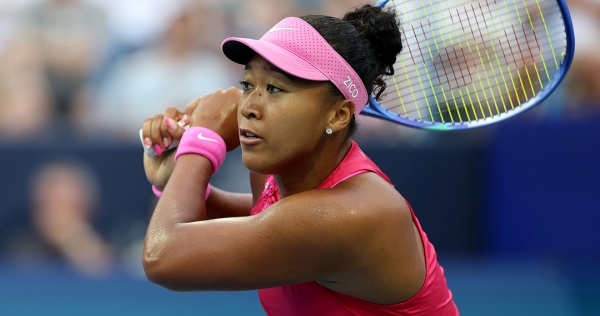
Those improvements helped Osaka improve on her natural weapons, including the serve – which as she explained at Wimbledon, she developed almost by accident when she was practising with sister Mari at age 15.
“I remember my knees always used to hurt because I kept growing,” she said. “Then one day I decided to hit my serve as hard as I could. It went in. It was an ace. I thought ‘If I can just keep doing this, keep going for it, it would be a really solid addition to my game’.”
Osaka’s power was never more evident than in her victory over Sabalenka at Wimbledon. Her 6-2 7-6(2) triumph came after three earlier losses to the world No.1 this year.
Sabalenka’s stark assessment that “she overpowered me” underlined how superbly Osaka had harnessed that power, with a clear tactical plan underpinning her statement win.
“Obviously we’re big ball strikers … it’s not like I’m going to start running around the court trying to draw an error from her,” Osaka said. “I can only focus on my strengths. I just tried to serve really well [and] to get the upper hand in the rallies first.”
The other statement for Osaka at Wimbledon was of course the fashion kind. Following her dramatic entrances at the Australian Open and Roland Garros, Osaka’s unique look honoured her Japanese heritage at Wimbledon.
“Obviously I really love fashion. That makes me excited to wake up and do the whole, like, walk-on or whatever. It just creates a little bit more joy in that whole match preparation,” she related of the signature looks that have become a talking point of the tennis world.
“But I grew up with the G.O.A.T.s of style, Serena [Williams], Venus [Williams], [Maria] Sharapova. People don’t talk about her enough, but Bethanie Mattek-Sands, too. She made it work with what she had.”