
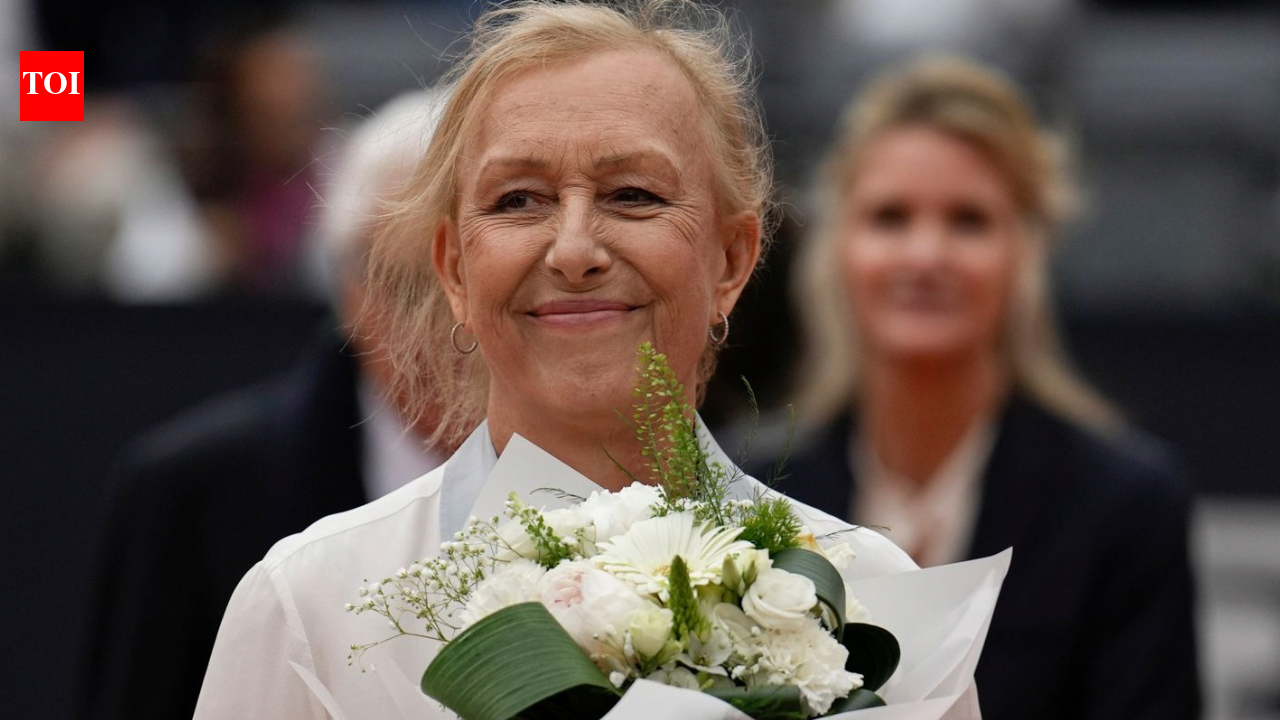
 Inspiring story of the day: “When I walked away, I knew I might never see my family again” – How Martina Navratilova turned Cold War defection and family sacrifice into tennis immortality Martina Navratilova’s tennis career is remembered for 18 Grand Slam singles titles, a record nine Wimbledon singles crowns and 31 major doubles titles. But her path to becoming one of tennis’ greatest players began with a decision that had nothing to do with a trophy. In 1975, at 18, Navratilova defected from Communist Czechoslovakia while competing at the US Open in New York. She asked for political asylum in the United States, knowing that leaving could mean years away from her parents and younger sister. That choice changed her life and, eventually, tennis history.
Why did 18-year-old Martina Navratilova leave Czechoslovakia in 1975
Navratilova grew up in Řevnice, near Prague, and tennis became a major part of her life at a very young age. Her stepfather, Miroslav Navratil, coached her and encouraged her ambitions. By her teenage years, she was already one of Czechoslovakia’s best young players.The problem was that her tennis career was not fully hers to control. The Czech tennis authorities controlled where she could travel and play. According to a Tennis.com account of her defection, the federation had also taken her prize money when she was a teenager. In 1975, officials became increasingly unhappy with her growing links to the West and told her she was becoming “too Americanized.”That pressure became impossible for Navratilova to ignore. During the US Open in Forest Hills, she decided not to return to Czechoslovakia. After losing to Chris Evert in the semifinals, Navratilova and her manager Fred Barman went to the Immigration and Naturalization Service office in Manhattan. She met FBI agents, completed the required paperwork and asked for political asylum.The decision was frightening because it meant leaving her family behind. Her parents had been part of the discussion about leaving, but when the moment came, Navratilova had to make the final move alone. Her defection became public soon afterward, turning a teenage tennis star into a political story as well.The supplied material quotes Navratilova saying:“When I walked away, I knew I might never see my family again. The hardest part wasn’t leaving the country; it was leaving my mother, my father, and my sister. I was 18, and I didn’t know if I would ever be allowed to go home or if they would ever be allowed to see me. That kind of pain never really leaves you.”Editorial note: I could not independently verify this exact quotation in reliable archival or official sources, so it should not be published as a direct Navratilova quote without checking the original interview or recording. The documented record does confirm that she feared losing years with her family after defecting.
How did Martina Navratilova’s family separation shape her early years in America
The cost of Navratilova’s decision was not just political. She spent years separated from the people closest to her.Her parents and younger sister remained in Czechoslovakia after she left. In 1979, The Washington Post reported that Navratilova had not seen them since the summer of 1975. Her family repeatedly tried to obtain permission to visit her, but those efforts were difficult.Her mother, Jana, eventually received a temporary visa to travel to Wimbledon in 1979. It was a deeply emotional reunion, coming after years in which the family had been forced to live apart.That Wimbledon visit also came during a major moment in Navratilova’s career. She won the singles title in 1979, beating Chris Evert 6-4, 6-4 in the final. It was her second Wimbledon singles championship and came only after the painful years that followed her defection.The supplied material gives another emotional quote to Navratilova:“Having my mother there at Wimbledon in 1979 was the most emotional moment of my life. To look up into the stands and see her face after all those years of not knowing when we would be together again… winning the title was amazing, but having my mother there to hold me was the real victory.”Again, this exact wording could not be independently verified in the reliable archival sources checked for this article. What is documented is that Navratilova’s mother was reunited with her at Wimbledon in 1979 after years apart, and that the family later reunited in the United States. The Washington Post reported that Navratilova’s parents and sister arrived in Dallas in December 1979 with one-year visitor visas.
What happened when Martina Navratilova returned to Prague in 1986
Eleven years after leaving, Navratilova returned to Czechoslovakia in July 1986. This time, she did not arrive as an 18-year-old player unsure of what the future held. She came back as a U.S. citizen and one of the world’s biggest tennis stars, representing the United States in the Federation Cup. She had become a U.S. citizen in 1981.The reaction from the Czech public was far warmer than the Communist authorities would have wanted. At the opening ceremony at Prague’s Štvanice Stadium, around 4,000 people were there, and Navratilova received a strong welcome. During the week, crowds continued to follow her matches, with about 7,000 spectators attending the US team’s matches on one day.The biggest moment came in the final against Czechoslovakia. Navratilova defeated Hana Mandlikova 7-5, 6-1 to give the United States the deciding point in a 3-0 victory. The crowd then stood and applauded the players, while Navratilova accepted the Federation Cup for the United States. When she began speaking in English, spectators called for her to speak Czech instead. She did.The supplied material also attributes this quote to Navratilova:“My mother gave me life, but she also gave me the courage to be free. She taught me that you must never compromise who you are for the comfort of others. If you have a gift, you have an obligation to fight for it.”This exact quotation could not be verified in the sources checked, so it needs an original source before publication.
How did Martina Navratilova turn a painful past into tennis greatness
Navratilova’s achievements after leaving Czechoslovakia are extraordinary even without the personal story behind them. She won 18 Grand Slam singles titles, including nine Wimbledon titles. She also won 31 Grand Slam women’s doubles titles and 10 Grand Slam mixed doubles titles. The WTA lists 167 singles titles and 177 doubles titles across her career.Her impact was also about how she played and trained. During the early 1980s, she became known for taking fitness, strength training, nutrition and preparation to a new level in women’s tennis. Her rivalry with Chris Evert became one of the defining stories of the sport, with the pair meeting 80 times.Yet the most powerful part of Navratilova’s story happened before many of those records were set. At 18, she had to choose between returning to a country where her career was tightly controlled and staying in America without knowing when she would see her family again.She chose the uncertain path. The years that followed brought separation, fear and difficult adjustments, but they also gave Navratilova the freedom to build the career she wanted. Her return to Prague in 1986 showed how far that journey had taken her: she had left as a young Czech player and returned as an American champion, welcomed by many of the people she had once been forced to leave behind.