
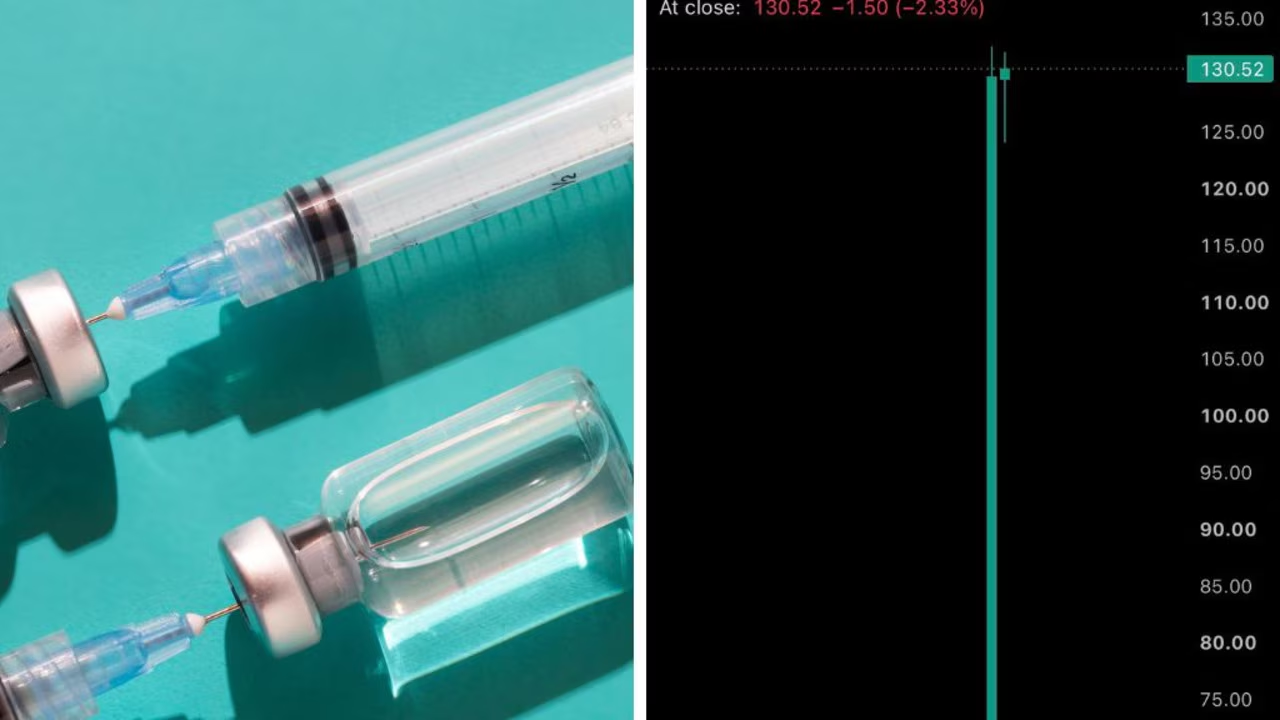
Pharmaceutical giant Moderna’s share price exploded by more than 170 per cent overnight as investors reacted to its “milestone” trial of a new skin cancer vaccine.
US drugmakers Merck and Moderna said on Wednesday an experimental melanoma drug that delivers treatment tailored to a patient’s specific tumour prevented the cancer from returning in a large clinical trial.
The news sent shares in Moderna soaring 170 per cent to US$174 ($244) while Merck’s stock was up more than 12 per cent to US$152 ($213).
Moderna’s stock price was sitting around US$62.50 before the announcement, having crashed since its high-point of more than US$300 during the Covid-19 pandemic.
Called “intismeran autogene”, the vaccine is based on the same messenger ribonucleic acid (mRNA) technology behind Covid-19 vaccines.
Researchers have been working on developing mRNA treatments against cancer, but this is the first time one has shown positive results in a Phase 3 trial.
When delivered along with pembrolizumab, an immunotherapy drug and the current standard of care, intismeran autogene prevented melanoma recurrence and prevented the cancer from spreading to other organs, the companies said in a statement.
The trial lasted approximately a year and involved 1137 patients who, following surgical removal of their cancers, were randomised into groups, with two-thirds receiving the new treatment plus pembrolizumab, while the rest received pembrolizumab alone.
The companies said they would present their data at an upcoming international conference and begin filings with regulators for approval.
“Today’s results represent a landmark moment for adjuvant melanoma treatment,” said Professor Georgina Long, the study’s principal investigator and medical director of Melanoma Institute Australia, in the statement.
“Intismeran in combination with pembrolizumab has the potential to establish a new treatment paradigm in the adjuvant melanoma setting, helping patients remain cancer-free for longer.”
Australia has one of he highest melanoma rates in the world and has been referred to as “Australia’s national cancer”.
About 16,800 Australians are expected to be diagnosed each year and 1300 are estimated to die, with the disease most common in people aged 20 to 39.
There have been significant steps in traditional treatment in recent years with the five-year survival rate jumping from less than 10 per cent in 2011 to more than 55 per cent in 2024.
The treatment works by taking a sample of the patient’s tumour and identifying its unique mutational signature, or “fingerprint,” then using messenger RNA technology to fight it.
Messenger RNA technology uses synthetic molecular instructions wrapped in tiny fat bubbles to teach the body how to make specific proteins.
The technology came to the fore during the Covid-19 pandemic, when Moderna and Pfizer developed vaccines that were highly effective against serious forms of the illness.
Melanoma is one of the deadliest forms of skin cancer, with more than 330,000 new cases diagnosed worldwide in 2022.
“Together with Merck, we are now studying intismeran in combination with pembrolizumab and other anti-cancer therapies, and as a monotherapy, across multiple tumour types and stages of disease, including melanoma, lung, bladder and kidney cancers,” Moderna CEO Stephane Bancel said in a statement.
“For many years, the idea of creating an mRNA treatment designed specifically for an individual patient’s cancer was aspirational.
“We are now helping turn that vision into a reality.”
Dr Janice Mehnert, the senior investigator of a smaller trial whose results were published in June, said melanoma is an ideal target for a vaccine because it’s “exquisitely vulnerable to the immune system, more so than other cancers”.
“I’m just excited to see science win on this one,” she told CNN.
“The idea of this incredibly novel, innovative idea actually panning out after years of work and literally over 1,000 patients is above and beyond what I would have liked to see.”
Karen Knudsen, chief of the Parker Institute for Cancer Immunotherapy, told Reuters the trial results could signal a new era for treating solid-tumour cancers.
“The positive hit here leads us into truly this next phase in immunotherapy,” Ms Knudsen said.
“This is an auspicious start – this is where things begin.”