
Australia’s unemployment rate keeps slowly drifting higher.
Data show the national unemployment rate rose to 4.5 per cent in July, up from 4.4 per cent in June.
The unemployment rate has not been this high in the post-COVID era, in trend terms.
Economists say the rise in unemployment is consistent with the Reserve Bank’s expectation that economic conditions will gradually slow over the coming year, and it makes the chance of another interest rate hike less likely.
The number of employed people declined by 15,800 in July, driven by a large fall in part-time employment, and unemployment increased by 4,200 people.
“Along with slowing house prices, and the recent lower-than-expected June quarter inflation result, it’s another reason to expect the RBA to remain benched at the upcoming late-September policy meeting,” David Bassanese, chief economist at BetaShares, said.
Unemployment expected to keep rising
In the Reserve Bank’s most recent forecasts, published last week, the unemployment rate was expected to reach 4.5 per cent by the end of this year.
It was then forecast to keep rising over next year, and to hit 4.8 per cent by mid-2028.
Inflation lower than expected in June
But it also made it clear that, at this point in the cycle, the RBA’s economists thought the labour market was probably still a “little tight” and the economy would need a higher rate of unemployment or under-employment to squash inflation.
“We need a little bit less tightness in the labour market in order to bring inflation down,” RBA governor Michele Bullock said last week.
The graphic below shows how, according to the RBA’s estimates, a majority of the labour market indicators in Australia are still close to, or tighter than, their estimated trend levels.
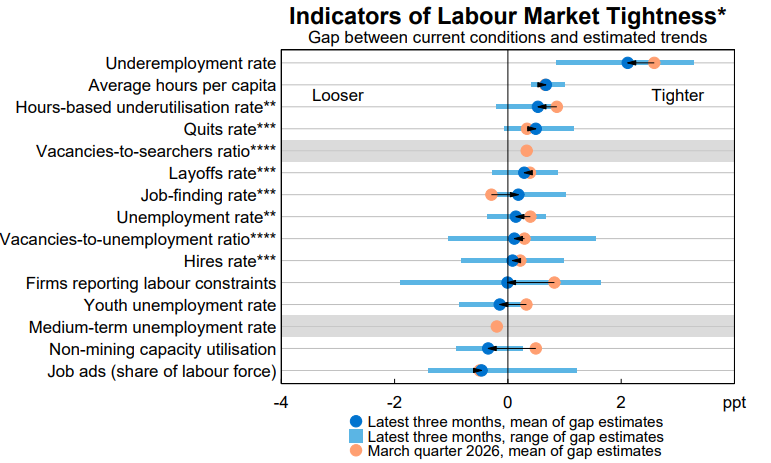
(Source: Reserve Bank of Australia, Statement on Monetary Policy August 2026, page 34.)
Callam Pickering, Asia Pacific economist at Indeed, said the July employment data was a “thoroughly mediocre jobs report”.
“The unemployment rate continues to drift upwards and should rise further over the remainder of the year,” he said.
“Recent labour market data, including both wage growth and the unemployment rate, have been weaker than expected.
“That’s bad for workers and households, but also a sign that tighter monetary policy is having the desired impact.
“With recent data flows quite positive, at least from the RBA’s perspective, we believe that another rate hike this year is now unlikely.
“However, it’d be a mistake to believe the hiking cycle is over.”