
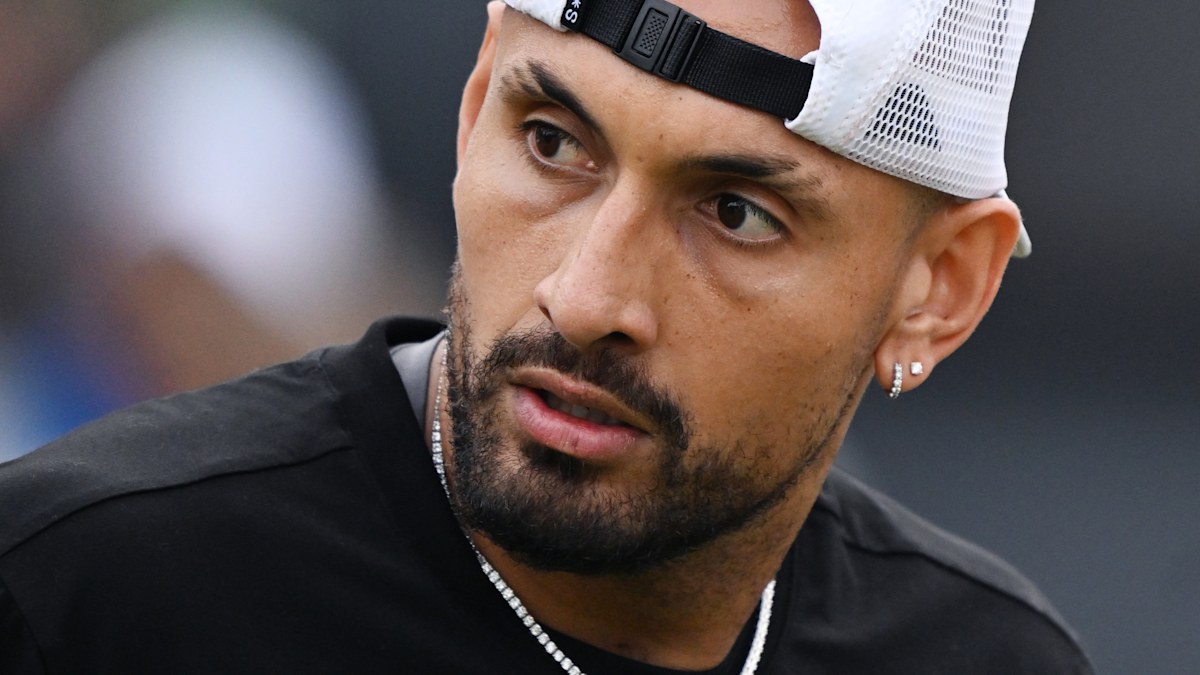
Nick Kyrgios is hoping a technicality could save him a four-year ban that would almost certainly end his tennis career after he tested positive for cocaine.
Kyrgios this week tested positive for benzoylecgonine – a metabolite of cocaine – in a sample taken during the grass court event at Mallorca in June. He is currently serving a mandatory provisional suspension.
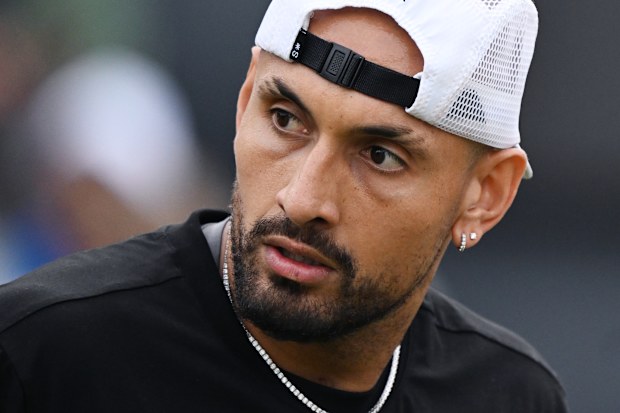
A positive cocaine test could spell the end of Nick Kyrgios’ tennis career. Marijan Murat/dpa
While the test was taken during competition, Kyrgios will be hoping to prove he took the drug “out of competition”, which would lead to a ban of only three months or less.
A player is deemed to be “in competition” from the moment play begins in the draws they are competing in, until they leave the tournament precinct after their final match.
Kyrgios was knocked out of the Mallorca Open in the first round, losing to countryman Adam Walton 6-3, 6-4 on the second day of the competition. Kyrgios was therefore “in competition” between June 21-22. The sample was collected on June 22.
His mandatory provisional suspension began on August 4, and expires on September 4.
If Kyrgios can convince the International Tennis Integrity Agency (ITIA) he took the drug before he was in competition, and also commit to entering a treatment programme, that might be the extent of his punishment.
The 31-year-old has barely played since his run to the 2022 Wimbledon final as he battled injuries. He has played only 10 singles matches since.
He played doubles at this year’s Australian Open as a wildcard pairing with Thanasi Kokkinakis, and then didn’t play again until the grass court season in June. His first tournament back was in Stuttgart, and then Mallorca. He also played doubles at Wimbledon, but again was knocked out in the first round.
Kyrgios was in competition in Stuttgart between June 8-12, and then Wimbledon from July 1-2.
Assuming a four-year ban would be backdated to August 4, he would be 35 by the time the ban is lifted in 2030.
Given how injury-prone his body already is, it’s highly unlikely he would be able to resume his career, at least in singles. There are currently only six players aged 35 or older in the top-100. Novak Djokovic (39) and Jan-Lennard Struff (36) are the only two in the top-50.
With a career-high ranking of No.17, a four-year ban for a failed drugs test would be a sad, yet also somehow fitting end to a career The Age tennis reporter Marc McGowan described as “tumultuous and eminently watchable”.

Kyrgios has played only 10 singles matches since losing to Novak Djokovic in the 2022 Wimbledon final. Getty
Kyrgios has faced accusations of domestic violence, and copped several fines for poor behaviour on-court – most notably a six-figure whack for a 2019 meltdown in Cincinnati.
But he’s also beaten each of the so-called “Big Four” of men’s tennis – Rafael Nadal, Novak Djokovic, Roger Federer and Andy Murray – on merit.
More recently, he’s also been one of the most outspoken critics of what he viewed as lenient sanctions for world No.1s Jannik Sinner and Iga Swiatek after they failed doping tests.
The irony, and undoubtedly an element of schadenfreude, of Kyrgios’ failed cocaine test was not missed by the tennis community.
Kyrgios was never going to be an Ash Barty, an Alex de Minaur, or a Lleyton Hewitt. All Aussie tennis fans wanted was for him to be a Nick Kyrgios they could get behind. It never really came to be.
A four-year ban from the sport would also likely put paid to any aspirations Kyrgios might have of a post-retirement career as a pundit or commentator. So high stakes are at play.
What is almost certain is the sad reality his legacy on the Australian sporting landscape will be as an unfulfilled talent.