
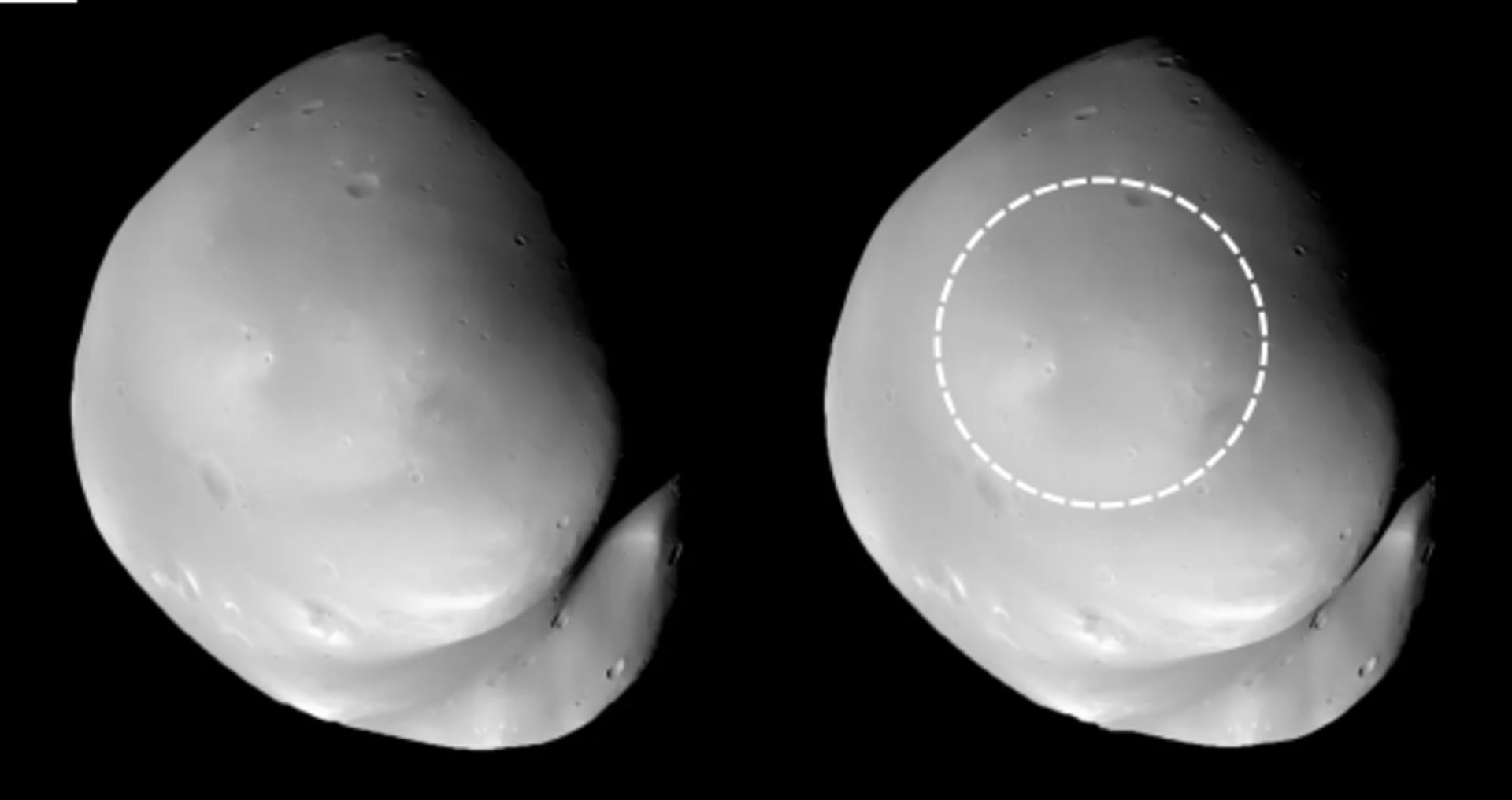
A single asteroid impact may explain both Deimos’ huge south-polar depression and the thick blanket of debris covering the Martian moon.Simulations point to a roughly 320-meter asteroid striking at about a 45-degree angle without breaking Deimos apart.Future observations from missions including JAXA’s MMX could test predictions about the moon’s weak surface, porous interior and buried craters.
Deimos looks unusually smooth for a battered moon. Its surface is muted by dust and rubble, while a broad depression cuts across its south pole. A new simulation study suggests both features may trace back to the same violent event.
The work, published in Nature Astronomy and led by Sabina Raducan, used high-resolution impact simulations developed at the University of Bern. The team found that a single asteroid strike could have excavated the southern depression while spreading debris across nearly the entire moon.
Deimos is Mars’ smaller and outer moon, measuring about 12 kilometers across. Unlike heavily cratered Phobos, it is covered by a loose regolith layer that softens older surface features. The south-polar depression spans about 10 kilometers.
Animation showing modelling of the proposed impact theorised to have created the Deimos south-polar depression and the subsequent reaccumulation of regolith, which would account for the smooth appearance of Deimos. Yellow indicates the reaccumulated material. (CREDIT: S.D. Raducan / ESA) Rebuilding a moon before the collision
To test whether one impact could explain both features, the researchers first reconstructed what Deimos may have looked like before the depression formed. They used a detailed shape model with topography resolved to roughly 100 meters.
The simulations relied on the Bern Smoothed Particle Hydrodynamics code, or SPH. It represents colliding bodies as millions of particles and tracks how they respond to gravity, material strength, friction, cohesion and crushing.
The team varied projectile size, impact angle, location and Deimos’ mechanical properties. Their simulations tested asteroid diameters from 300 to 360 meters and used an impact speed of 8.2 kilometers per second. Each collision was followed for eight hours so debris could escape or fall back.
Two independent comparisons pointed to the same best fit. An asteroid about 320 meters wide, striking at roughly a 45-degree angle and offset from the center of the south pole, produced the closest match to the moon’s present shape.
More direct or centrally located impacts created the wrong crater geometry. Larger projectiles sometimes delivered enough energy to fragment Deimos.
Hera will perform a swingby of Mars in March 2025 as a way of gathering extra momentum on its way to the Didymos binary asteroid system. The spacecraft will fly within the orbits of both Martian moons Deimos and Phobos. (CREDIT: ESA-Science Office) A global blanket of fallen debris
The favored collision was violent, but not catastrophic. Less than about 1% of Deimos’ mass reached escape speed, while roughly 10% to 20% of the moon’s material moved across the surface.
Much of that ejecta later fell back. The simulations produced a debris blanket at least several meters thick across the moon, with deposits reaching more than 200 meters on the Mars-facing hemisphere.
“Our simulation thus shows that a single impact was sufficient to decisively shape the current landscape of Deimos,” said Martin Jutzi of the University of Bern. “The impact was violent enough to redistribute material globally, but not so strong that it would have shattered the moon.”
The predicted deposits also help explain why many Deimos craters are unusually shallow. Measurements of the 14 largest craters, each wider than 450 meters, suggest older features were partly buried. The analysis independently supports a global debris layer about 120 meters thick.
Viking images also show a bright ring near the southern depression and bright streaks running downhill from ridges and crater rims. The simulations placed heavily disturbed material in similar regions.
ESA’s Hera science team, including astrophysicist, stereoscopist and guitarist Sir Brian May, foreground left, and Principal Investigator Patrick Michel, right, celebrate as images from the mission’s gravity-assist Mars flyby on 12 March 2025. (CREDIT: Max Alexander/ESA) Why ancient craters survived the shock
A collision large enough to carve a 10-kilometer depression should send strong shock waves through a moon only 12 kilometers wide. Yet Deimos still preserves old craters, including circular features seen more clearly during ESA’s Hera flyby in March 2025.
That survival gave the researchers another clue about the moon’s interior.
They tested how a pre-existing farside crater would respond if Deimos behaved like different materials. In a relatively rigid, lunar-like model, the crater vanished. With more compressible material, it survived increasingly well.
The best preservation occurred when the interior behaved like a highly porous, easily crushed rubble pile. Such material absorbs impact energy and weakens shock waves before they can erase structures on the opposite side.
“In terms of its physical properties, Deimos more closely resembles the so-called rubble-pile asteroids than Earth’s moon,” Raducan said. “But that doesn’t necessarily mean that Deimos is actually an asteroid. It could also have formed from material ejected during impacts on Mars.”
Martian moon Deimos appears dark, framed by the brighter planet Mars behind it, in this visible light monochromatic Asteroid Framing Camera image, acquired by ESA’s Hera spacecraft during its gravity-assist flyby on 12 March 2025. (CREDIT: ESA)
The surface appears similarly weak. Simulations showed that material with cohesion above about 100 pascals kept the crater walls too steep. Lower cohesion allowed the rim to collapse and debris to slump downhill, producing the shallow bowl seen today.
The impact would not have thrown Deimos off course
The collision also appears compatible with Deimos’ present orbit and rotation. The modeled strike would have changed its speed by only about 35 centimeters per second, compared with an orbital speed of 1.35 kilometers per second.
Its orbital eccentricity would have shifted by no more than about 0.0005, while its inclination would have changed by no more than about 0.015 degrees. Those changes do not conflict with Deimos’ current orbit.
Any disruption to its rotation likely would have faded relatively quickly. Depending on its tidal properties, synchronization could have returned within about 200 to 20,000 years.
The authors stress that their scenario is not the only possible explanation. Other resurfacing processes may also have contributed to the moon’s present appearance. Still, one impact provides a single mechanism for the southern depression, the global debris layer and several surface patterns.
Martian moon Deimos shines much brighter than the red planet beneath it in this Thermal Infrared Imager image acquired during the Hera mission’s 12 March 2025 gravity-assist flyby of Mars. (CREDIT: ESA/JAXA) Practical implications of the research
The model gives future missions specific features to test. JAXA’s Martian Moons eXploration mission, or MMX, is expected to observe both Martian moons in detail and return samples from Phobos.
For Deimos, high-resolution imaging could test whether the south-polar depression has the shape expected from a large oblique impact. Better crater measurements could refine estimates of regolith thickness, while spectral mapping could reveal how redistributed material varies across the surface.
The Hera flyby has already added useful evidence. Images taken during its March 2025 gravity assist exposed previously unrecognized circular features on Deimos’ farside, helping researchers test whether older structures could survive the proposed collision.
If future observations confirm the predicted weak surface and porous interior, they would strengthen the case that Deimos behaves mechanically like rubble-pile asteroids, even if its origin is entirely different.
Dig deeper into Deimos and Martian moon origins
These resources explore how Mars’ moons formed, what their fragile interiors may be like, how impacts reshape small bodies and how upcoming missions could resolve long-running questions about Phobos and Deimos.
Origin of Mars’s moons by disruptive partial capture of an asteroid
This work proposes another route for forming Phobos and Deimos: an asteroid passing Mars could have been partly torn apart, leaving fragments that evolved into a debris disk and eventually moons. The model offers an important alternative to both direct asteroid capture and formation after a giant impact on Mars. (Icarus, 2025)
Origin of Phobos and Deimos Awaiting Direct Exploration
This comprehensive review examines the competing explanations for the Martian moons, including asteroid capture and formation from material placed into orbit around Mars. It also explains which observations and sample measurements could finally distinguish between those scenarios. (Annual Review of Earth and Planetary Sciences, 2024)
Physical properties of asteroid Dimorphos as derived from the DART impact
Impact simulations indicate that Dimorphos is an extremely weak, porous rubble-pile asteroid whose shape may have changed globally after NASA’s DART collision. Those properties provide a useful comparison for the similarly weak and porous structure proposed for Deimos. (Nature Astronomy, 2024)
Mars and Deimos viewed by Hera’s Asteroid Framing Camera
ESA’s resource presents one of Hera’s close observations of Deimos during its March 2025 Mars gravity-assist flyby, including a view acquired from about 1,000 kilometers away. These observations provide new surface information for testing models of Deimos’ craters, regolith and geological history. (European Space Agency, 2025)
Related Stories