
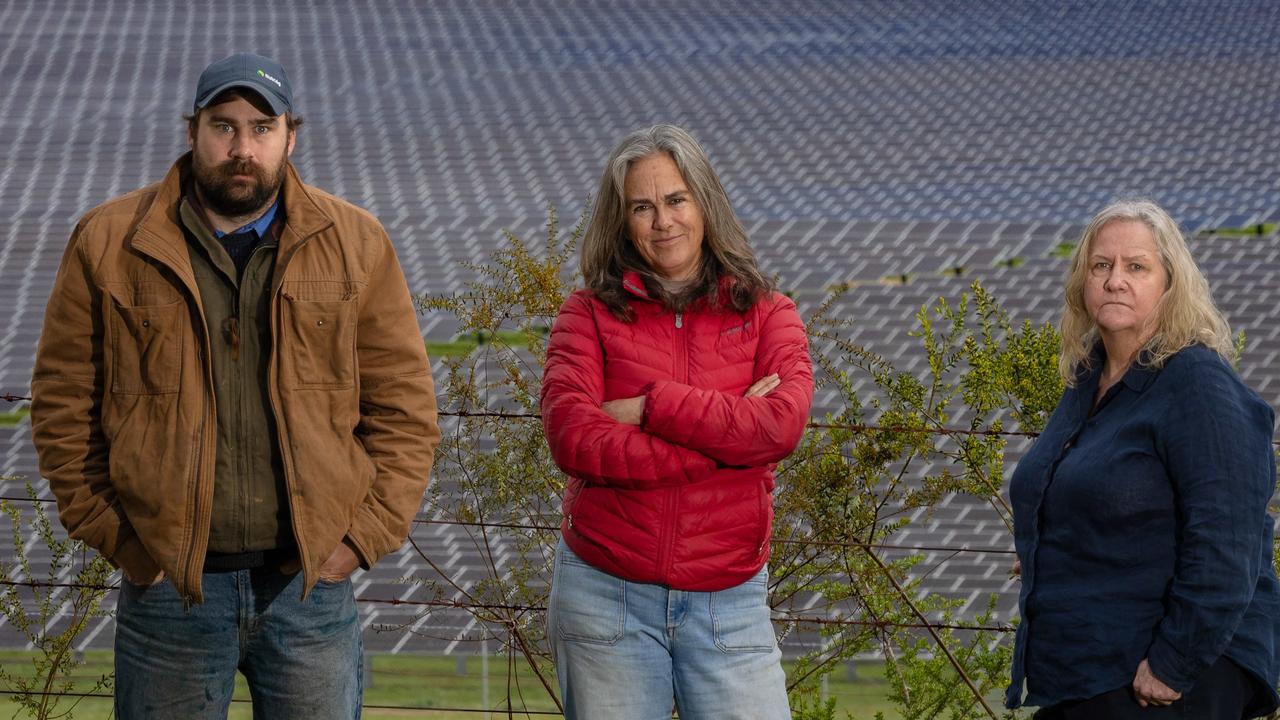
Regional communities fear prime Victorian farmland could be irreversibly damaged with more than a million solar panels to soon spring from the landscape in one northeast corridor.
The Glenrowan community is “distraught” about the cumulative effect multiple solar farm development projects in the region will have, with 420,000 more solar panels earmarked for the small community where 800,000 panels have already been installed along the Hume Freeway.
It is one of a number of renewables projects across Victoria that are tearing once tight-knit communities apart as some farmers choose to host renewables projects despite their neighbours’ fierce opposition.
Solar and battery projects are already spread across 1.6 per cent of farmland in Benalla shire.
Resident Libby Foubister said the influx of projects were concentrated in a corridor from Winton to Glenrowan, with plans for a new farm, Nioka Solar, set to increase the number of solar panels between the two towns to more than a million.
Nioka Solar is expected to power the equivalent of 100,000 homes.
The projects sit mostly in the proposed Central North Renewable Energy Zone (REZ).
A REZ is an area considered most suitable for renewable energy projects.
While other zones have been declared across the state, the zone in this region is yet to be rubber stamped and a petition to ensure renewable energy planning in the northeast does not override food security, cultural heritage, biodiversity and community wellbeing garnered more than 10,000 signatures in June.
Residents are concerned about the contamination of waterways and soil, the impact on the endangered Regent honeyeater and whether firefighters would have the capacity to fight a fire if a solar farm went up in flames.
Ms Foubister said the issue was not about renewable energy – many houses across the area had solar panels and the community was not against renewables but the farmland should not be “industrialised”.
“It’s designated farmland for a reason to provide food and fibre, and that’s why we live where we live,” she said.
Benalla Rural City councillors last month voted to write to the state government’s VicGrid, which is co-ordinating the planning and development of renewable energy zones, rejecting the proposed REZ due to its impact on the community, farming and how much land in the region already hosts renewable projects.
Mayor Bernie Hearn said the need for the council to advocate on behalf of the community was clear.
“After listening to our community, we’re exploring opportunities to work with neighbouring councils by forming a North Central Renewable Energy Zone Coalition to strengthen regional advocacy and push for better policy and regulatory outcomes for rural communities,” she said.
Sheep and goat farmer Xavier Burton said farmers should be able to do whatever they wanted with their land, however a line should be drawn when neighbouring landowners were impacted.
He said the community had contributed its “fair share” to renewables given multiple projects were already established in the area.
In the 2025 Victorian Transmission Plan, VicGrid estimated land hosting renewables would be about one per cent of Victoria’s total land area by 2040.
Currently, 0.49 per cent of the state’s land hosts renewables.
“I’m not against solar technology, but there are genuine reasons this is not the area for it,” Mr Burton said.
One of his main concerns was the loss of the area’s significant and unique heritage and the impact to tourism, with thousands of tourists visiting the area each year to see where bushranger Ned Kelly grew up and was buried in Greta and where he made his final stand at the Glenrowan Inn in 1980.
“Now people are driving past solar factories which is not doing justice to our heritage,” he said.
Mr Burton also worried about agricultural impacts, such as if sheep were grazed under the panels but the land could not be sprayed or fertilised causing it to become overrun with weeds.
“There are laws in agricultural legislation (that) if I was to spray herbicide on a windy day and it wiped out my neighbour’s crop and impacted his income then I would get in trouble so it seems interesting it doesn’t matter when solar facilities impact someone else,” he said.
It is his neighbours, sheep farmers Jonathan and Rosie Koop, who own the land where the proposed Nioka project will be developed.
With environmental and hazard assessments currently underway, a planning permit application is expected to be lodged later this year.
Mr Koop said solar panels and sheep could work together productively and believed the family could still run a viable sheep enterprise.
“We are energised by this new challenge to develop a best practice agrisolar business,” he said, adding his family had lived next to ground mounted solar for more than five years.
“Changes to our landscape are often difficult and met with trepidation and we felt the same way when solar first arrived in Glenrowan West,” he said.
“We recognise that proximity to the Glenrowan Terminal Station and existing transmission lines helps keep energy production costs down.
“This is not a decision we have taken lightly, and we want to develop a project that balances renewable energy generation, farming and community outcomes.
“We are committed to listening, learning and continuing conversations as the project progresses.”
Another neighbour, Sandra Allan, understands her two-acre lifestyle block would be surrounded by panels if the project goes ahead and said it was “devastating”.
She said she was “heartbroken” by the plans and how they would impact the environment and wildlife. She is also worried about her property value but said she “doesn’t want to leave”.
“I can’t find any peace with it because there’s nothing I can do. I’m powerless.”
“We haven’t learnt anything in thousands of years, we just go in and take, take, take, destroy the land and leave it to someone else to fix,” she said.
“This is not the answer, we’re not working smarter, we’re working easier.”
Campbell’s Bridge
In the west of the state, parts of another community are fighting a battle against the proposed hosts of Campbells Bridge Wind Farm, earmarked for land between Rupanyup and Glenorchy.
The proposal is for 145 turbines across 14,000ha and is expected to generate electricity to power about 500,000 homes.
President of the Southern Wimmera Renewables Research Association Tess Healy said the region had been inundated and overrun with renewable projects including the VNI West project, a proposed high-voltage transmission line connecting the grids of Victoria and New South Wales.
Ms Healy said there had been massive opposition to the proposed wind farm.
“It’s elevated tension with sometimes really socially damaging results,” she said.
“The project isn’t approved or built yet but should it actually occur, the fallout’s going be brutal.”
She said opponents were worried the environmental impacts would be “significant” on the naturally occurring flood plain and are gravely concerned any land clearing or changes will cause water to travel further than it used to and that mitigation measures won’t be sufficient.
There are also concerns about the impact on future fire fights and whether wind turbines would impact the capacity for aerial support, the impact on livestock on neighbouring farms, material shedding from turbines and that the tonnes of concrete used for the foundations would contaminate the soil irreparably.
“The blades being as high as they are and as big as they are, that material can shed massive distances onto non-hosting properties and contaminate the environment around it,” Ms Healy said.
While Meat and Livestock Australia’s Livestock Production Assurance program does not prohibit renewable energy infrastructure on accredited properties, producers are required to identify the infrastructure, consider potential contamination or physical risks and maintain risk management.
The proposed site only sits in part of the Western REZ and near the heavily opposed VNI West project.
VicGrid chief executive Alistair Parker said agriculture made crucial contributions to regional communities and Victoria’s economy and food security and it was “vital” the transition to renewable energy was “well planned in consultation with farmers and the agriculture industry”.
“With good planning and consultation, agriculture and renewable development can coexist.
“The physical infrastructure from renewable energy development only takes up a small amount of a land parcel and the rest of that land remains available for grazing, cropping or other land uses.”
A RWE spokeswoman said the company had been engaging with the community about the project since late 2022 and would “continue to keep the community informed and address any concerns” as the project developed.
“There are a range of views g renewa ble energy in the project community and across Victoria more broadly,” she said.
The spokeswoman said Campbell’s Bridge was selected for reasons including its strong wind resource, interest from local stakeholders and because the proposed land has already been cleared.
“The site is also close to existing grid infrastructure, enabling efficient connection to the electricity network,” she said.
The spokeswoman said the team had undertaken detailed studies and site surveys.
“By combining this data with updated climate and rainfall projections, we can design access tracks, turbine foundations, and substation platforms that work with natural drainage patterns and avoid impacts on neighbouring properties,” she said, adding measures would be taken to minimise the environmental impact.