
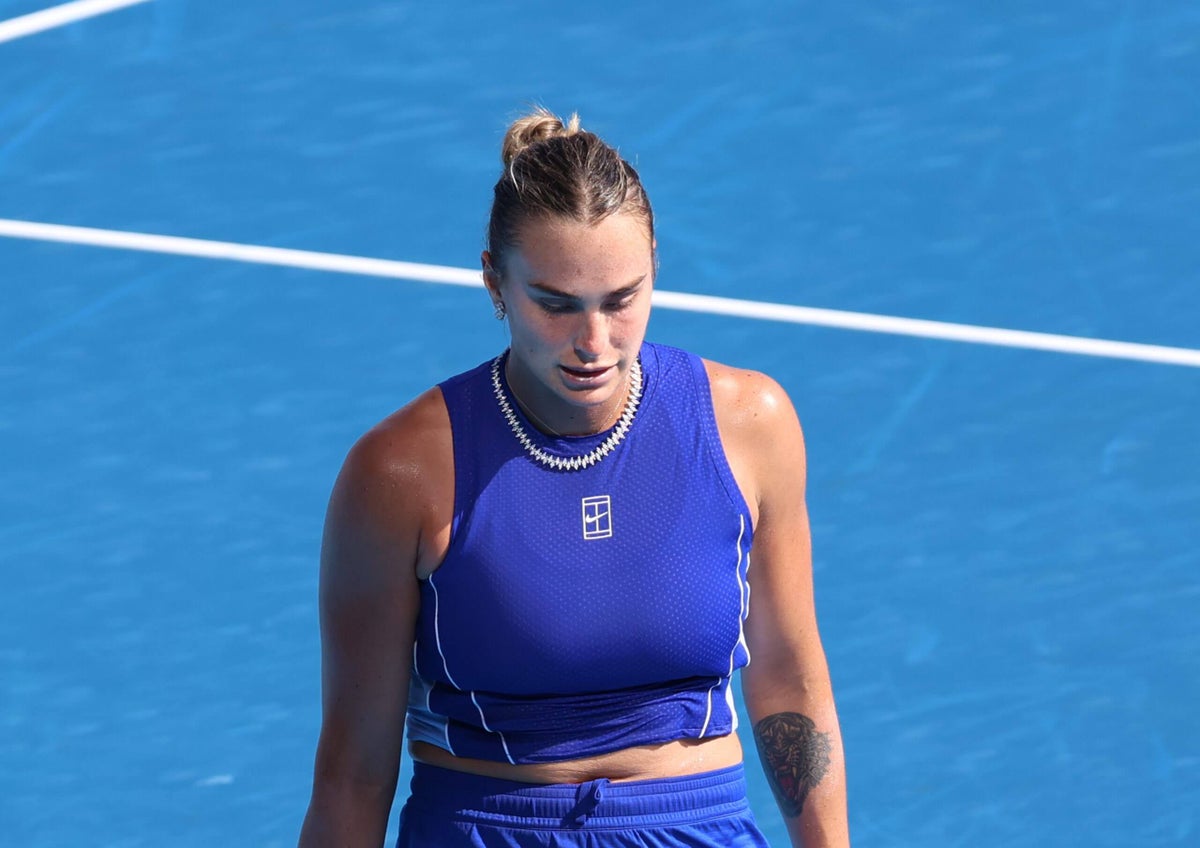
Aryna Sabalenka, the women’s world No. 1 and two-time defending U.S. Open champion, was at a roundtable with a handful of journalists last week when someone asked her about the glut of power at the top of the women’s game, mentioning Sabalenka, Coco Gauff and Iga Świątek.
Sabalenka cut them off right there, and reminded them that they had forgotten Elena Rybakina, the world No. 2, and in her view, maybe the best player in the world this season. Sabalenka, 28, who has been the dominant player on the WTA the past two years, recognized that she is in the middle of her most mortal stretch of form in that time.
Since winning the Sunshine Double of the BNP Paribas Open at Indian Wells and the Miami Open, she has made one semifinal in seven tournaments. But just as Rybakina seemed poised to overtake Sabalenka at the top of the world rankings, the Australian Open champion aggravated an Achilles injury and retired against Świątek in the Cincinnati Open quarterfinals. Whether she plays the U.S. Open, her best chance to get past Sabalenka, remains in flux.
Earlier this year, after succumbing to a combination of cramps, heat exhaustion and illness in the second round of the French Open in Paris, men’s world No. 1 Jannik Sinner, who had been on a 30-match winning streak that included five ATP Masters 1000 titles, hit on a theme that ties into all this.
“We’re not robots,” he said.
Carlos Alcaraz, Sinner’s great rival at the top of the sport, hadn’t even made it to Paris to defend his title. He had already missed more than a month with a right wrist injury by then, and he will return at the U.S. Open having missed three more. The crucible of five-set tennis, and the shaking off of plenty of rust, await as he tries to defend his singles title.
Jannik Sinner withdraws from U.S. Open with right knee injury
Ava Wallace
Given how his season has gone, it’s fitting that Alcaraz, 23, had already signaled the precariousness of his seemingly inevitable success, which has looked mostly effortless during his wildly successful six-year career.
“We’re touching wood and praying that nothing’s going to happen to my body,” Alcaraz had said at the Monte Carlo Masters, when asked whether he intended to skip any clay-court tournaments after losing to Sinner in the final.
“I don’t know how it’s going to be, the matches, if I’m going to win matches, if I’m going to lose in the first rounds, if the matches are going to be super-demanding physically or not.
“So I don’t know how it’s going to be, but what I can tell right now is I will hear my body much better this year than last year.”
A few days later, he would hear it a little too loudly. He felt a shooting pain in his wrist during his opening match at the Barcelona Open. Scans showed he was suffering from tenosynovitis, an injury in which fluid accumulates in the sheath that protects a key tendon in the wrist.
He will make his comeback Tuesday in the U.S. Open mixed doubles, where he is expected to partner Serena Williams. If all goes well, he will begin the singles competition during the next week.
Sinner, who has just turned 25, won’t be there. He’s out with a knee injury that has prevented him from playing since Wimbledon.
Following losses at the Canadian and Cincinnati Opens, Sabalenka will play the mixed doubles with Novak Djokovic, then aim to regain confidence in time for the singles. At this point, the hope is that her affinity for New York and the U.S. Open, which she has won the past two years, will help her rediscover the prowess that made her nearly invincible earlier in the season and at times last year.
Świątek, who has six majors at 25 and is so far the greatest player of her generation, is coming out of a long and challenging journey, marked by early exits and difficult losses, to rediscover the controlled aggressiveness that defines her best tennis. She is starting to surge. Sabalenka, whose dominance came late in her career after struggles with her serve and baseline control, is trying to find her juice again.
This isn’t the script anyone had written for this trio early in the year. That’s likely far more the fault of the would-be tennis script writers than Alcaraz, Sinner and Sabalenka. Those three have combined for 16 Grand Slam titles and five year-end No. 1 finishes since 2022. Alcaraz and Sinner have reconfigured the men’s game into a hyper-aggressive game of chicken, in which being at neutral in a rally is basically losing the point.
It’s a level of success that had plenty of tennis observers believing that history was about to repeat itself. For 20 years, Roger Federer, Novak Djokovic, Rafael Nadal, and Serena Williams lulled the tennis faithful into thinking that dominance on a historic level was normal. Those four combined for 89 Grand Slam singles titles. Djokovic may yet make it an even 90.
That’s not normal. That’s ridiculous.
Even more ridiculous, Federer played 1,545 matches during his career. He didn’t retire from a single one. Of all his records, that’s probably the one that will never be broken. Nadal missed a good few majors in his prime due to a cavalcade of physical issues, but Djokovic didn’t miss one until he was 30 and Federer’s absences came in the twilight of his career.
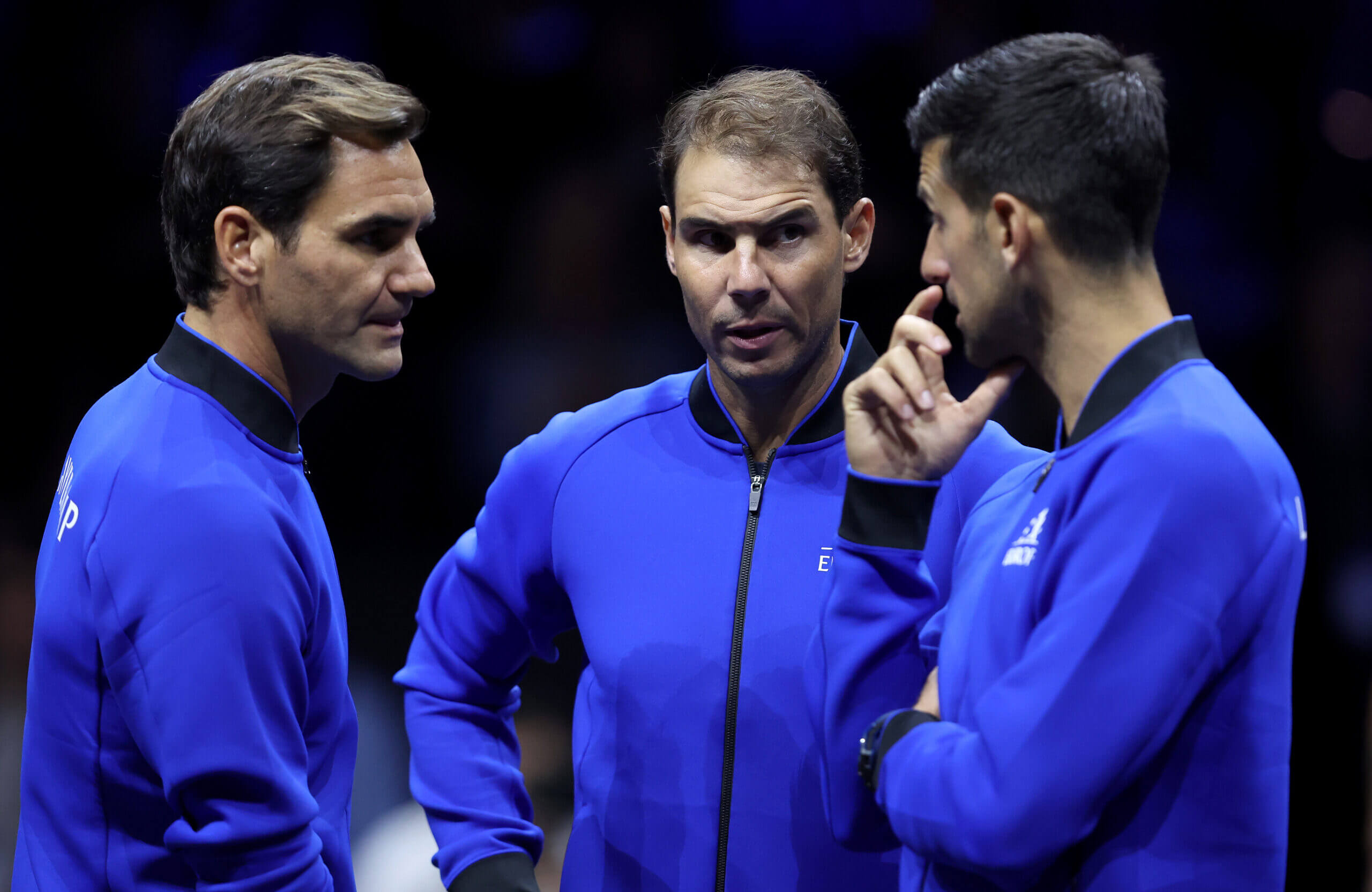
Roger Federer, Rafael Nadal and Novak Djokovic’s dominance of men’s tennis made the extraordinary appear routine. (Julian Finney / Getty Images)
What’s happening now — Sinner and Alcaraz having to manage injuries and sometimes missing Grand Slams, and Sabalenka, Świątek and Gauff going for long stretches without titles and having to reconfigure their tennis along the way, is much more like it.
It’s just become a little hard to remember that, given the past two decades.
In everyone’s defense, Sinner and Alcaraz did spend 2024 and 2025 making everyone believe that a decade of duopoly was at hand. They split eight consecutive Grand Slams. Only Novak Djokovic seemed able to consistently push one of them on a big stage every once in a while, and he was creeping closer to 40 every day.
All of this will coalesce on the eve of the U.S. Open, a week when Federer will once again suck up plenty of the sport’s oxygen. He’s going to play an exhibition at Arthur Ashe Stadium on Tuesday. On Saturday, he will be inducted into the International Tennis Hall of Fame.
Williams appears to be on the verge of coming back around, too. At 44, she is likely teaming up with Alcaraz in the mixed doubles and then may also give singles and doubles a go with her sister, Venus. Together, they won 14 Grand Slam doubles titles. Again, ridiculous.
Their presence, amid Sinner’s absence, the question marks about how far Alcaraz can go in this tournament and Sabalenka’s doldrums should serve as a healthy reminder of how rare their dominance was, and how hard it will be to match.
Alcaraz has made it clear what his career goal is. He wants to be the greatest player in the sport’s history. Sabalenka, who is already 28 and has won “just” four Grand slam titles, has already had a Hall of Fame career. ‘Best ever’ is a dream she likely let go of long ago, if she ever even had it.
As for Sinner, missing this tournament will burn. But he knows it’s with good reason. He wants a long career and to be as good as he possibly can be, whatever that is.
Like Sabalenka, he followed a devastating loss in Australia by sweeping the Sunshine Double and going on that springtime tear. He righted Paris by winning Wimbledon, his monstrous serve propelling him through a shaky period in his baseline game. Then, after tests in Italy in late July and throughout August, he pulled out of Canada and then Cincinnati and then New York.
He is not a robot. None of them are, and never will be. Even the greatest of the greats weren’t. They just made it really hard to remember that.