
Beneath forests, grasslands and agricultural fields lies one of nature’s most complex communication and resource-distribution systems. Often described as the “wood-wide web”, underground fungal networks connect plant roots, helping move water and nutrients through ecosystems. Now, new research from Japan suggests these networks may be doing something even more remarkable: distributing carbon-based energy between plants.
The study, led by researchers from Chiba University and Kobe University and published in Mycorrhiza, provides experimental evidence that the flowering plant Gentiana squarrosa can obtain carbon not only through photosynthesis but also through underground connections formed by arbuscular mycorrhizal fungi.
The findings strengthen evidence for a phenomenon known as partial mycoheterotrophy, where green plants supplement their own photosynthetic activity by acquiring carbon from fungal networks connected to neighbouring plants.
A new view of underground ecosystems
For decades, scientists have understood that mycorrhizal fungi form mutually beneficial relationships with plants. The fungi receive carbon compounds generated through photosynthesis, while the plants gain improved access to nutrients such as phosphorus and nitrogen. These fungal structures can also connect multiple plants simultaneously.
Some species, particularly those growing in shaded environments, appear able to draw carbon from these networks. Fully mycoheterotrophic plants rely almost entirely on fungal partners and often lack chlorophyll altogether. Partial mycoheterotrophs are more intriguing because they maintain photosynthetic capability while seemingly supplementing their energy budget through fungal connections.
Demonstrating this experimentally has been challenging, especially for plants connected to arbuscular mycorrhizal fungi, the most widespread fungal symbionts in terrestrial ecosystems. Carbon isotope signatures in these networks often resemble those of host plants, making carbon transfer difficult to track.
To overcome this challenge, Professor Masahide Yamato and colleagues devised an elegant experimental system. The researchers grew Gentiana squarrosa seedlings alongside either C3 or C4 companion plants in specially designed U-shaped pots. A fine nylon mesh separated the roots of the two plants, preventing direct root contact while allowing fungal threads, known as hyphae, to pass through.
The strategy exploited a natural difference between C3 and C4 plants. C4 plants contain naturally higher levels of the stable carbon isotope carbon-13 than C3 plants. If carbon moved through fungal connections, the researchers reasoned, the carbon isotope signature of the donor plant should become detectable in G. squarrosa.
The results were striking. Seedlings connected to C4 companion plants exhibited significantly higher carbon-13 levels than those connected to C3 plants. Moreover, plants with higher carbon-13 enrichment also showed greater shoot growth, suggesting that carbon supplied through fungal networks contributed directly to plant development. Professor Yamato suggests that fungal networks could function as more than nutrient-delivery systems. Instead, they may act as underground energy-distribution pathways, allowing carbon compounds to move between connected plants.
Why this matters
The implications extend well beyond a single species. If similar carbon-sharing mechanisms prove widespread, scientists may need to rethink how plant communities function. Traditional ecological models often treat plants as largely independent organisms competing for resources. Mycorrhizal networks suggest a more interconnected picture, where cooperation and resource sharing can occur alongside competition.
Such insights could influence how researchers understand forest resilience, biodiversity and ecosystem recovery following environmental stress. Many crop species form associations with arbuscular mycorrhizal fungi. Understanding how these networks move nutrients and carbon could eventually help improve crop productivity while reducing dependence on chemical inputs.
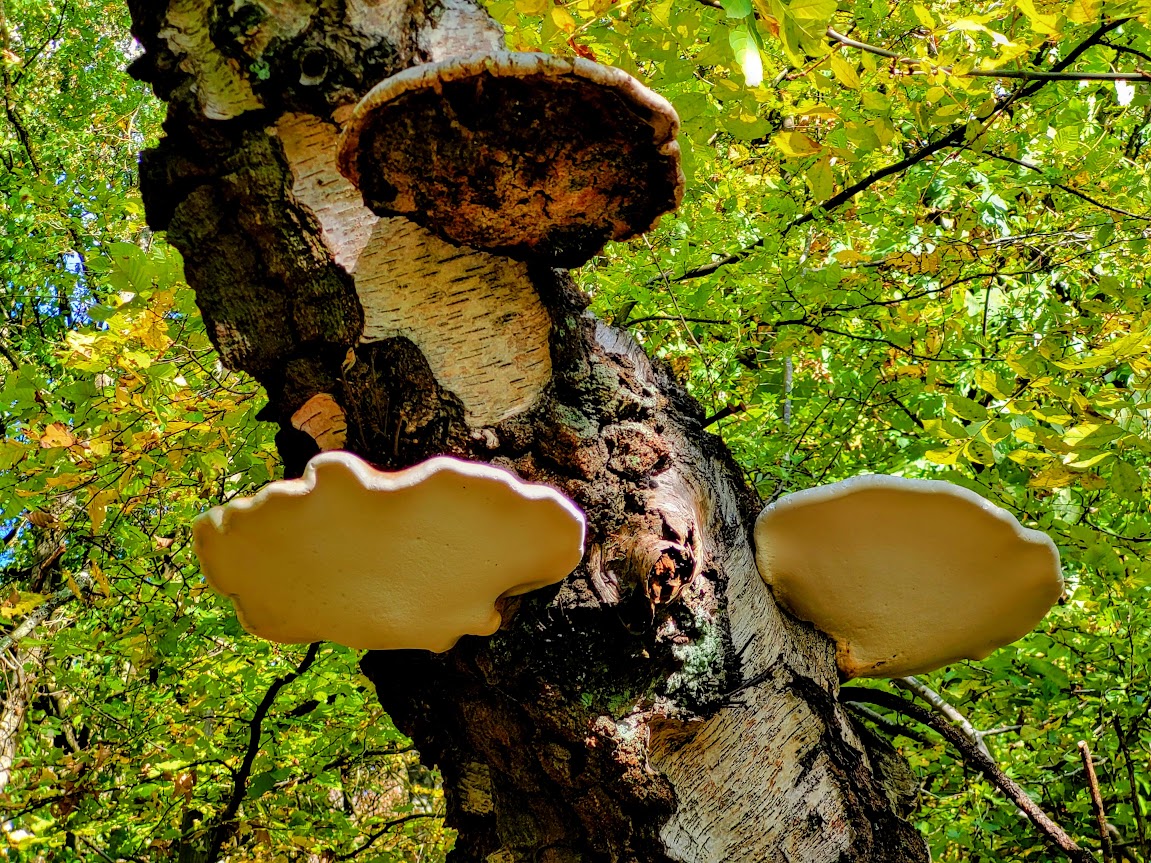 Fungi, symbiotic relationship with a tree. Image by Tim Sandle
Canadian research points in a similar direction
Canada has become an important centre for plant-soil and mycorrhizal research. In particular, researchers at the University of British Columbia and other Canadian institutions have contributed significantly to understanding underground fungal networks and plant communication. Canadian forest ecologist Suzanne Simard demonstrated that carbon and other resources can move between trees through fungal networks, helping to transform scientific understanding of forest ecology.
The new Japanese research provides experimental support for similar concepts, although through a different system involving arbuscular mycorrhizal fungi rather than the ectomycorrhizal fungi commonly found in many forest trees.
The findings may also be relevant to Canada’s vast forestry sector. Forest management increasingly considers ecosystem-level interactions rather than focusing solely on individual trees. Understanding underground resource-sharing networks could improve approaches to reforestation, biodiversity preservation and climate adaptation.
The study arrives at a time when scientists are paying increasing attention to the role of soil ecosystems in carbon cycling. Plants remove carbon dioxide from the atmosphere through photosynthesis, making terrestrial ecosystems a critical component of global carbon budgets. If fungal networks are redistributing significant quantities of carbon between plants, these pathways may need to be considered when modelling ecosystem carbon dynamics.
Canada’s boreal forest, which spans much of the country, stores enormous amounts of carbon both above and below ground. Better understanding of fungal-mediated carbon movement could therefore contribute to wider discussions around climate resilience and ecosystem management.
Despite decades of work on plant ecology, scientists are only beginning to understand the complexity of underground fungal networks. The experimental system developed by the Japanese researchers provides a valuable new tool for investigating carbon movement between plants across a wide range of species.