
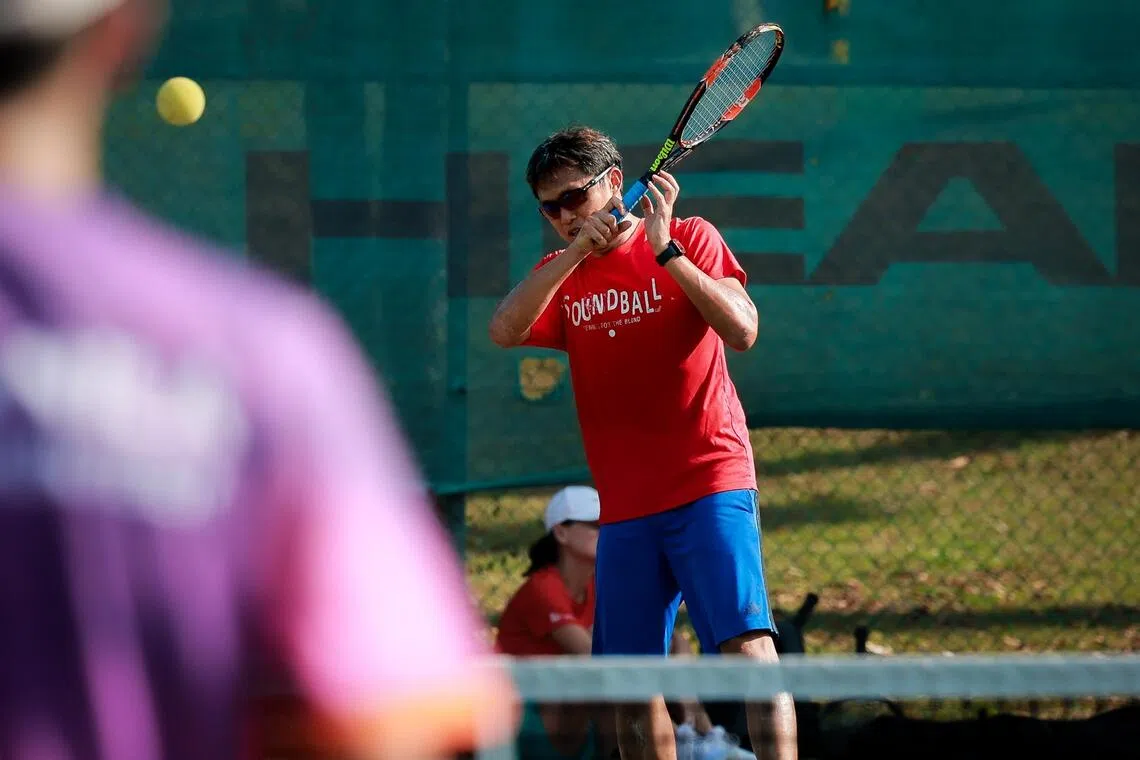
SINGAPORE – When Marc Chiang began losing his vision in 2011, he gradually gave up many of the activities he once enjoyed.
Among them was tennis, which he took up when he was 10, and for some time, Chiang thought he would never pick up a racket again.
That changed in 2015, when he joined Runninghour, a sports co-operative that promotes the integration of people with special needs through sports.
There, he met visually impaired people who remained active in sports and learnt about soundball tennis, a modified version of the sport designed for players who are blind or have low vision.
“In 2015, when I hit my first ball, I was totally blown away,” said Chiang, who mainly sees silhouettes in highly contrasting conditions and ample lighting because of retinitis pigmentosa – a condition that progressively shrinks one’s visual field.
“I never expected to play tennis again… Sometimes when we start to lose our vision, we kind of lose ourselves too; we lose our identity and something that you link to confidence or independence.
“That (soundball) really brought my passion back. It helped me a lot in my life because it allows me to travel to different countries and interact with people from around the world.”
The rules of soundball are similar to those of tennis, but it is played with special sponge balls that rattle when they bounce, allowing players to locate them by sound.
Today, Chiang not only plays the sport but is also the assistant head of Soundball Singapore, an organisation dedicated to promoting the sport.
The 46-year-old is also part of the inaugural batch of recipients for the Enabling Sports Fund (ESF), which launched in 2025 to support community-led initiatives that make sport more accessible and inclusive for people with disabilities (PWDs).
The fund is part of the refreshed Disability Sports Master Plan, announced in November 2024 by the Ministry of Culture, Community and Youth and the Enabling Sports Taskforce.
Supported by the President’s Challenge with Sport Singapore (SportSG) appointed as an Impact Partner, the fund aims to raise at least $10 million by 2030.
The ESF has supported 21 proposals since its launch and SportSG has opened a second grant call for the fund from Aug 1 to 31.
With support from the fund, Chiang started Let’s Play Soundball!, an initiative targeted at building a base of coaches and expanding the pipeline of players by introducing younger people to the sport.
He said: “With ESF, it allows us to plan what we want to do with the coaches and it builds up the overall plan to have the coaches in and build the pipeline of players.
“That allows us to have more creativity in terms of mapping out what we want to do, short term or long term.”
Unlike other variations of tennis such as wheelchair tennis – a Paralympic sport also featured at tennis’ Grand Slams – soundball is less established internationally.
The sport was created in 1984 by Miyoshi Takei, a blind Japanese athlete, but it was only three decades later that the International Blind Tennis Association was formed to regulate and oversee the sport.
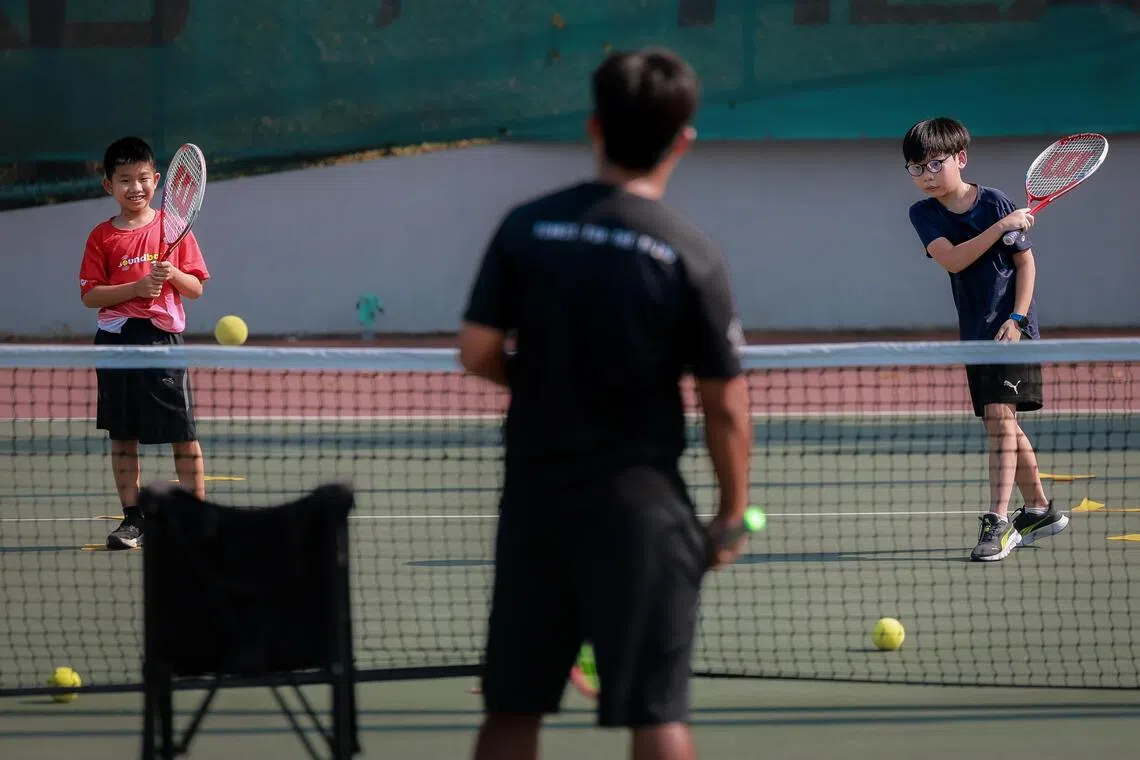
Young visually impaired beneficiaries take part in a soundball training session on Aug 15.
ST PHOTO: GAVIN FOO
As there is currently no international coaching licence, coaching in Singapore is done mainly by volunteers, whose availability can be limited.
Chiang recalled a previous instance when plans for a soundball camp for children fell through despite considerable interest from participants due to the inability to secure a coach.
He said: “When we spoke to the parents, we were not able to bring any commitments or let the parents see the pathway for their children.
“We felt that in order to upgrade everybody’s skills we need to bring in coaches.”
While conventional tennis coaches are generally able to coach the players, Chiang noted that they also need to learn the adaptive techniques required to work with those with visual disability.
He said: “The coach has to understand that vision impairments and blindness is a full spectrum, anything from total blindness to partial sightedness.
“They have to understand the visual impairment of the student and what their level of fitness is, whether they’ve seen a tennis game before or not.”
There are certain methods such as wearing goggles that are blacked out with a small pinhole that can be used to help coaches understand some forms of visual impairment.
Coaches must also be mindful that not every person with visual impairment learns the sport the same way.
A person who lost their sight after having been able to see may learn through verbal instructions, as they may already have seen the movements before.
Someone who is totally blind, however, may need to feel the coach’s body movements or use a wooden model to understand them.
Tactile models of the court can also be used to teach players about court positioning and movement.
Beyond coaching expertise, bringing younger players into the sport is also another key focus in the programme.
Since the programme began in March, the initiative has one coach and two students, aged 10 and 11, who will participate in 10 to 12 soundball sessions.
Chiang said: “It’s about getting people with visual impairment out to be active and we’re doing it using sports as an avenue.”
Those keen to apply for the fund can do so here.
Dive into all the sporting action and trends in Singapore with ST’s weekly newsletter.