
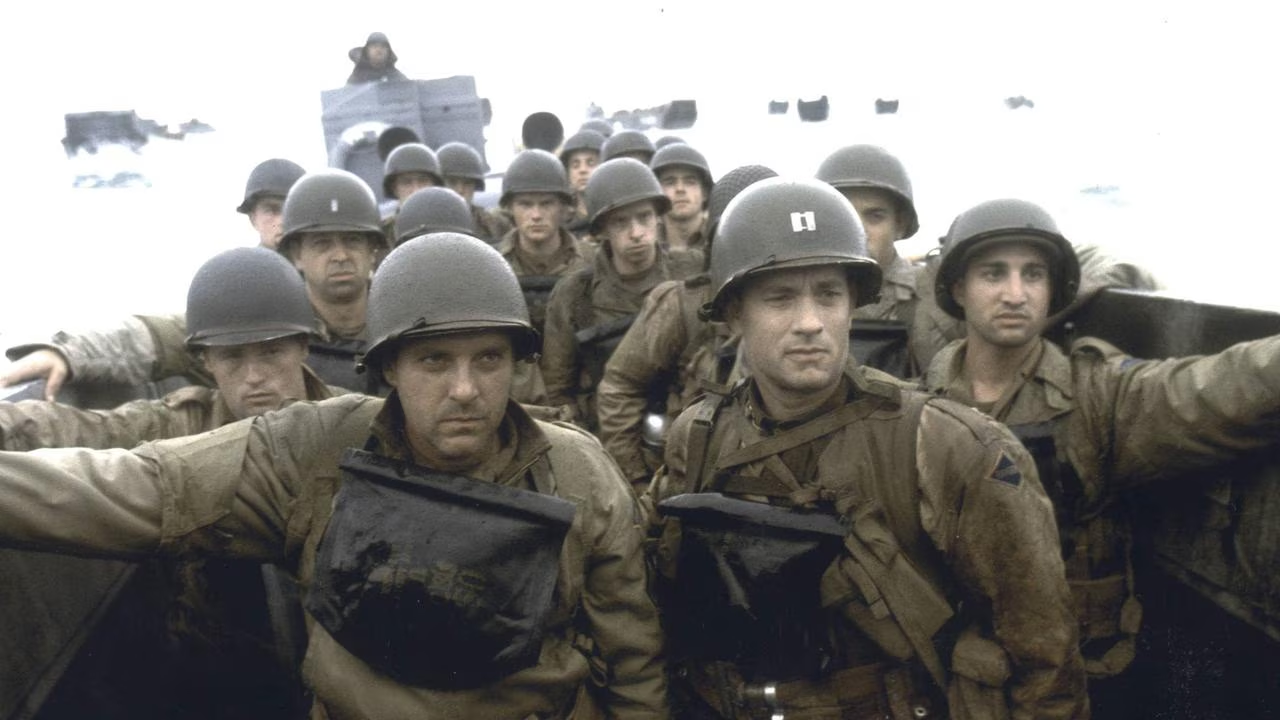
Since the end of World War II, the devastating global conflict that spanned almost six years, involved more than 70 countries and claimed up to 85 million lives has inspired numerous documentaries, TV series and films.
From the doomed romance between jaded nightclub owner Rick (Humphrey Bogart) and his freedom-fighting ex Ilsa (Ingrid Bergman) in the 1942 classic Casablanca – which was filmed while the war was still raging – to the revisionist, anarchic fantasy of Quentin Tarantino’s 2009 film Inglourious Basterds, WWII has been examined from many different perspectives and in many different styles.
One of Cate Blanchett’s first major film roles was in Bruce Beresford’s Paradise Road, in which she plays an Australian nurse held captive in a Japanese internment camp. Unlike a lot of narratives about WWII, the 1997 movie was told predominantly from a female perspective.
Blanchett’s co-star Julianna Margulies told US talk show host Bobbie Wygant that, before filming Paradise Road, she hadn’t known anything about this particular chapter of history, and the extreme hardships endured by the many British, Dutch and Australian women in these camps.
Responding to concerns about how the Japanese would react to negative portrayals in the movie, Margulies told Wygant: “I know that people were worried it seemed racist and anti-Japanese, but what are you going to do? This is what happened. It’s like in Schindler’s List.
“You know what? Ralph Fiennes played a really terrifying character, but he existed. What are you going to do? That’s history. It doesn’t mean we hate them now. But it’s important to learn.”
In one harrowing scene, Blanchett’s character is forced by her callous captors to kneel for days, with barbed wire poles behind her.
“It’s one thing to watch it, it’s another thing to imagine being on your knees,” Margulies said. “I actually knelt down with Cate – we tried, just to see how long we could last on our knees, on the cement floor – and I lasted maybe half an hour. It’s exhausting. Your back starts hurting. Try doing that for two days with your hands tied behind your back and the sun beating down on you. I mean, it’s pretty shocking.”
Since Paradise Road, Blanchett has made many more films about the period, each unique in tone and style. In 2014’s comedy The Monuments Men, Blanchett plays Claire Simone, a French art curator who assists the Allies in tracking down precious pieces stolen by the Nazis, while in 2001’s romantic war drama Charlotte Gray, directed by Aussie Gillian Armstrong, she was the titular Scottish resistance operative.
For Blanchett, 2006 thriller The Good German offered a particularly unique artistic challenge. Playing Lena Brandt, a Jewish German collaborator, Blanchett’s character is now on the wrong side of history. Directed by Steven Soderbergh, the story is also told in the style of films from the period itself.
“Once I learnt that it was going to be shot in black and white on the Universal back lot using old 1940s techniques and rear projection, that’s when the project went through the stratosphere for me because I just don’t know of another film that’s done that,” Blanchett explained at The Good German’s Hollywood premiere.
“There have been other films in black and white, but one that is so ambitious in inventing some sort of hybrid with modern actors and modern language, it’s quite Brechtian, I think.”
Fellow double Oscar-winner Tom Hanks is another star with a long history of bringing WWII stories to the screen. Beginning with his starring role in 1998’s Saving Private Ryan, Hanks has also produced the acclaimed TV dramas Band Of Brothers (2001) and The Pacific (2010), and the more recent Masters Of The Air (2024).
To prepare for their roles in Band Of Brothers, actors such as Donnie Wahlberg, David Schwimmer, Scott Grimes, Michael Fassbender and Neal McDonough were put through an exacting boot camp. The tough conditions wore the cast down, until Hanks intervened.
McDonough recalled on the Inside Of You podcast in 2022: “Tom Hanks came in a helicopter, with his Cast Away beard and hair, and gave us this speech as to why we owe it to the men of Easy Company to work our butts off to tell the truth, because they died for us. Were it not for them, we wouldn’t be speaking English right now … were it not for these men who gave their lives for us.”
Announcing in 2024 that he would be narrating World War II With Tom Hanks, a 20-part docuseries currently streaming on SBS On Demand, Hanks explained why he was so passionate about keeping stories about this turbulent chapter alive in people’s minds.
“During my formative years, every single adult in my life would make references to two words: the war,” he said.
“The lasting effects of WWII on the world and my own family wasn’t lost on me.”
In an interview with the Royal Television Society, historian Dan Snow shed light on why people continue to be fascinated by stories about WWII.
“The Second World War was the biggest political, military, human tragedy the world has ever witnessed,” Snow explained.
“It was a war that had more of an impact on our landscapes and our cities than any other war in history; we’re still living with the consequences of that war.”
To learn about just some of the stories of WWII, check out these films now streaming on Tubi:
• The Final Days Of The Nazis: This 2023 documentary details what happened in the last days before the Third Reich fell and the pursuit of justice afterwards.
• D-Day: Nicolas Cage’s son, Weston Cage Coppola, stars as one of an elite team of soldiers assigned to take out German machine gun nests in this 2019 film.
• Fortress Of War: Told from the Russian perspective, this 2010 film takes viewers inside the defence of Brest Fortress as Nazi troops launched an eight- to nine-day assault in 1941.