
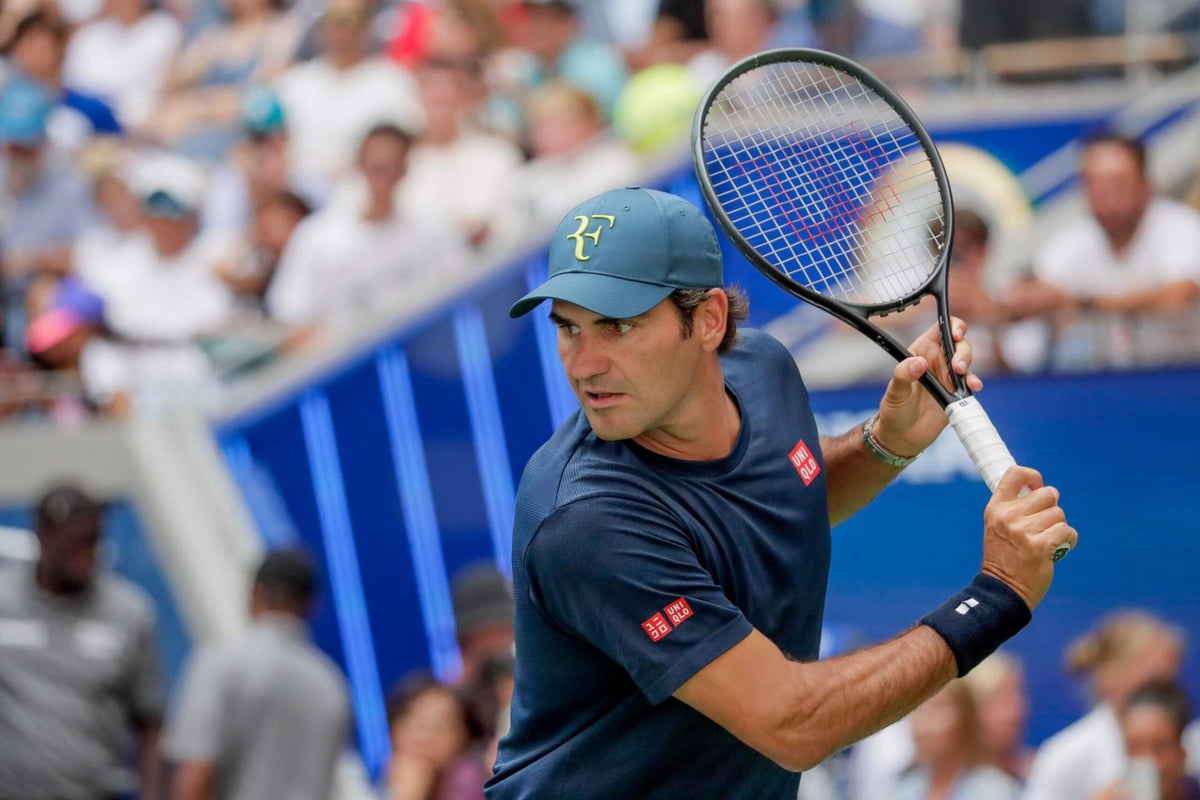
His pinpoint serve and lethal inside-out forehand may have been the bedrock of his 20 Grand Slam titles, but Roger Federer remains synonymous with the one-handed backhand, whether a ripped winner screaming past an opponent or a skidding slice leaving them a sitting duck in the middle of the court.
On his return to the U.S. Open, ahead of his induction into the International Tennis Hall of Fame, Federer, 45, spoke at a news conference about a shot that he made his own, but which has been on the decline in professional tennis for many years.
“My coaches when I was growing up were, I would say, 90 per cent one-handers,” the five-time champion in New York said. “So I think when your coach is a one-handed tennis player, you will most likely be a one-handed tennis player too.
“Nowadays, probably the coaches are mostly double-handed players, and it’s just easier to teach a kid to have two hands on the backhand side.”
Only six players in the ATP top 100 — Lorenzo Musetti, Denis Shapovalov, Stefanos Tsitsipas, Daniel Altmaier, Giovanni Mpetshi Perricard and Aleksandar Kovacevic — use the shot. On the WTA Tour, the shot is even rarer — of the top 100, rising star Lilli Tagger uses it, along with Diane Parry, Viktorija Golubic and Tatjana Maria.
How do tennis rankings work?
Ava Wallace and Lia Griffin
No player with a one-handed backhand has reached a Grand Slam semifinal in 2026. If no one does so at the U.S. Open, it will be the first year since the inaugural Wimbledon in 1877 without at least one player using the shot in the last four of a major.
Federer, who retired from professional tennis at the Laver Cup in 2022, was speaking Monday ahead of an exhibition on Arthur Ashe Stadium with Andy Roddick, Andre Agassi and John McEnroe Tuesday. It will be his first appearance on court at the tournament since he last competed there in 2019.
Federer revealed that one of his 12-year-old twin sons is attempting to switch from a two-handed backhand to one hand.
“I just see how hard it is for him to hit it and control it,” he said. “Sure, eventually you get control, but it just takes time, and nowadays we don’t have time. Everything has to happen immediately.”
Federer had to adapt his own one-handed backhand later in his career, as Rafael Nadal and Novak Djokovic’s mastery of relentless baseline tennis — accomplished with two-handed backhands — blunted his potency on clay and hard courts.
He moved from a 90-square-inch racket to a 97-square-inch one in 2014, before increasingly taking the ball earlier and attacking from that side following a six-month injury layoff in 2016. The height of this strategy shift was the Sneak Attack by Roger (SABR), in which Federer crept forward to return opponent’s serves almost on the half volley, shortening points and taking away time from his opponent.
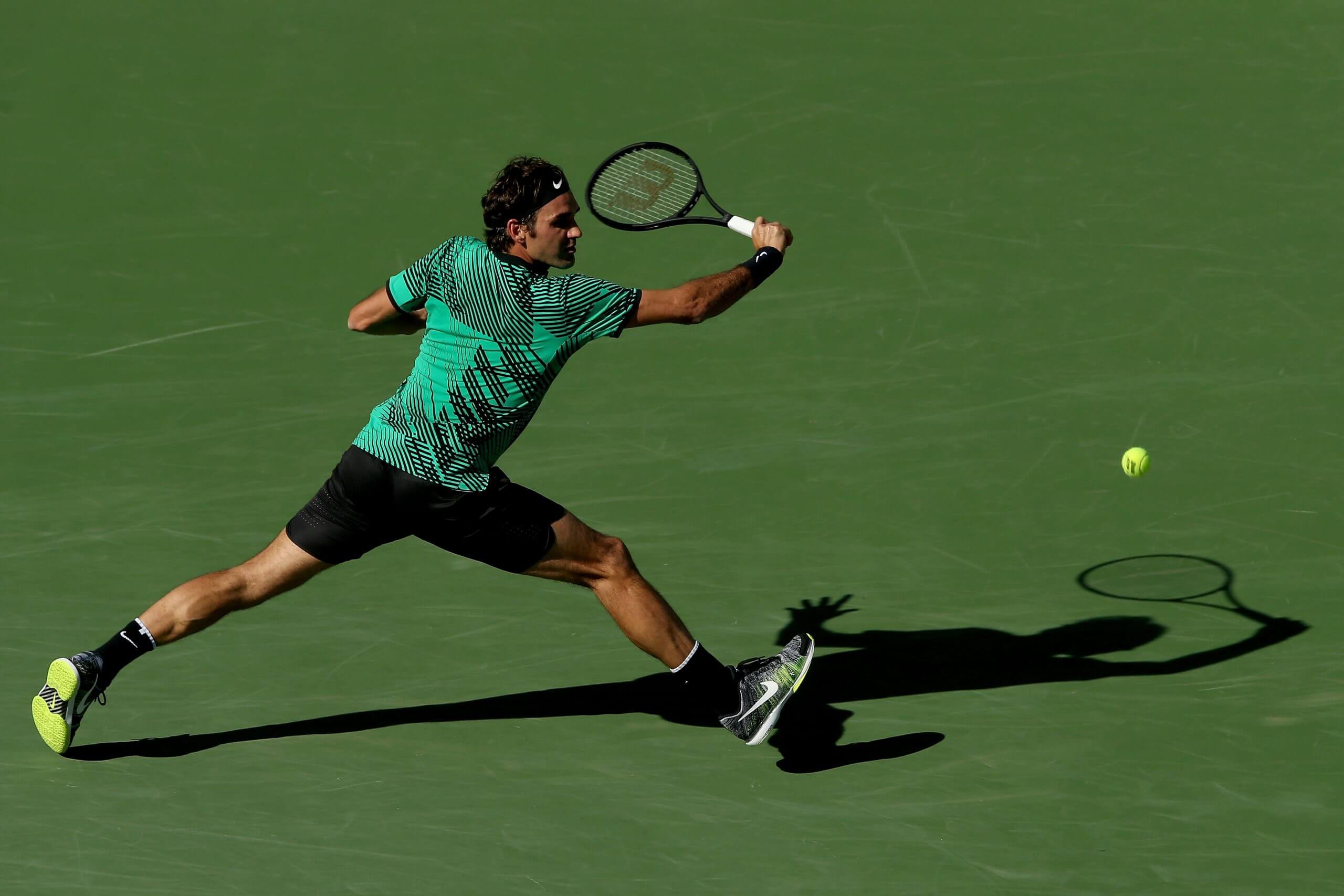
Federer made adjustments to his setup to get the most out of his backhand later in his career. (Matthew Stockman / Getty Images)
After beating Nadal at the BNP Paribas Open at Indian Wells in 2017, Federer said the additional time spent with the larger racket had improved his backhand and given him greater confidence “stepping into it” against the Spaniard.
Federer also pointed to changes in racket technology and slower balls on the tours — a change that numerous players have reported in recent years — as a reason for changes to the dominant style in tennis, which in turn have led to more players focusing on two-handed backhands.
“Back in the day I used to do 50-50 volleys and net play and baseline game,” he said. “Now it’s like 90-10, right, just baseline.”
Federer later practised on Arthur Ashe with world No. 15 Musetti, the highest-ranked player in the ATP top 100 who uses a one-handed backhand. He said in his news conference that he has no desire to return to professional tennis, and that he had not played a full singles set since his last official singles match at Wimbledon, a loss to Hubert Hurkacz in 2021.
He joked that he would try to give the Italian some “wisdom”, before adding of the one-handed backhand: “I’m still hopeful it’s not the end.”