
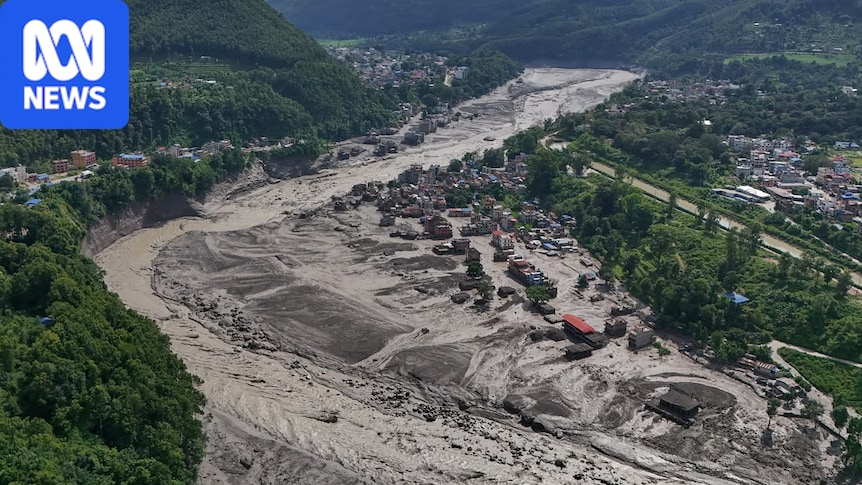
At least one Australian is missing after a deadly flash flood hit the Tibet-Nepal border, according to local authorities.
The torrent of water swept through the Himalayan border region on Wednesday morning, local time, killing at least 95 people in Nepal, according to local police.
Nepal’s tourism board said at least 340 foreign nationals had been reported missing.
The list of foreigners unaccounted for, which has been seen by the ABC, includes one Australian.
The Department of Foreign Affairs and Trade has yet to respond to the ABC’s questions.
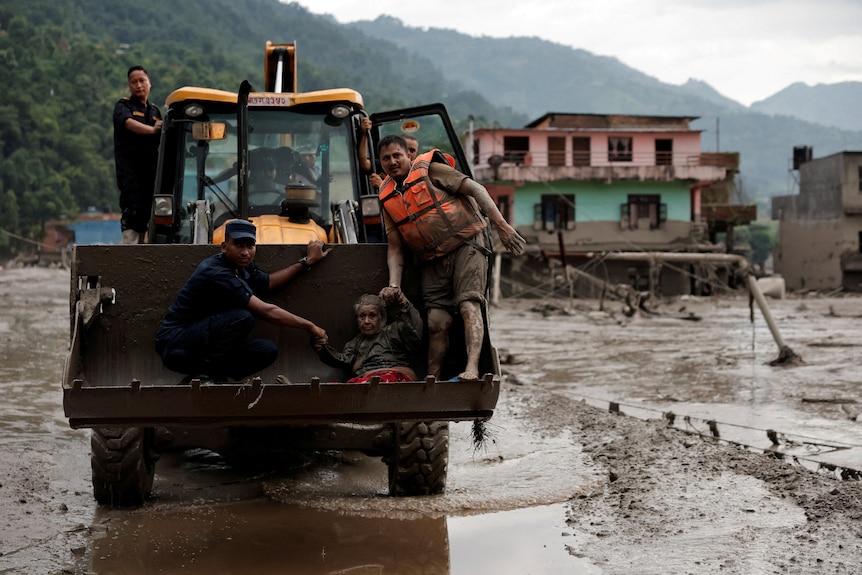
A survivor is transported out of the flood zone in Nepal. (Reuters: Navesh Chitrakar)
People from India, the United Kingdom, the United States and Malaysia are also among those reported missing.
At least 28 local police officers were also unaccounted for, while South Korean authorities said eight of its citizens who were working on a hydropower plant were missing.
On the Tibetan side of the disaster, Chinese officials said they feared “major casualties” in the the county of Gyirong after a mudslide hit a land crossing.
An earthquake caused an avalanche that triggered the flood along the Bhote Koshi river in Rasuwa, Nepal’s foreign minister, Shisir Khanal, told parliament on Wednesday.
Broadcast images showed crumbled homes, floating cars and a metal bridge being washed away in the Nepal flood waters.
“There could be heavy casualties or loss of property,” said district administrator Narendra Pariyar, who urged dwellers on the banks of the Bhote Koshi river to move to higher ground, after reports of villages and project sites being swept up.
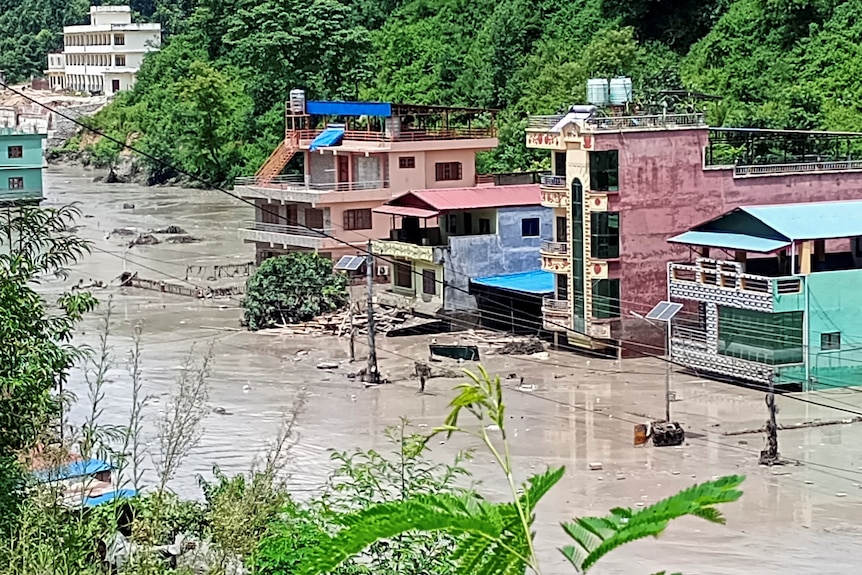
A flooded road in Galchhi in the Dhading district. (Reuters.)
‘All-out’ rescue operation underway
Nepal’s rescue helicopters would be unable to land in the affected areas until the waters recede, army spokesperson Raja Ram Basnet said.
Chinese President Xi Jinping urged “all-out” search efforts for the missing as well as stronger monitoring and early warning systems to prevent secondary disasters.
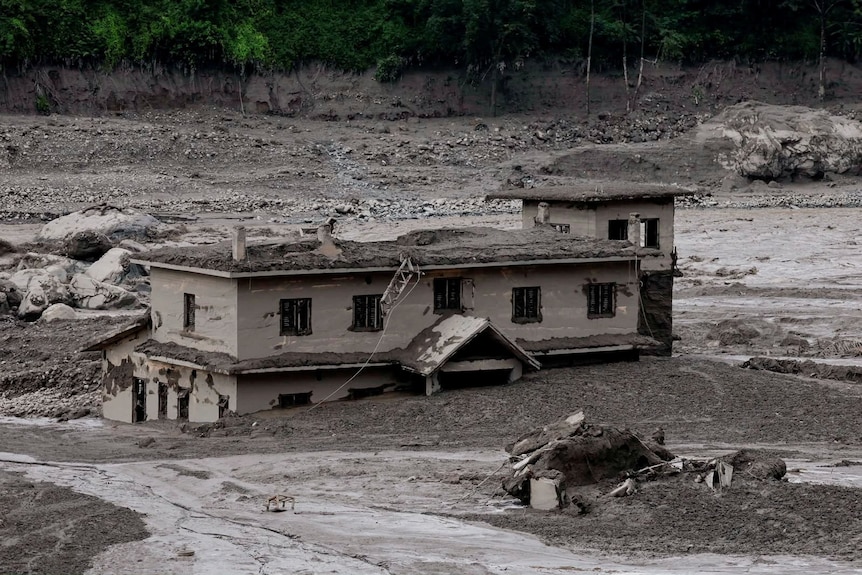
Houses have been washed away or buried under the mud following the flash flood. (Reuters: Navesh Chitrakar)
Chinese state media said access to the the area was cut off and communication channels were down.
Devendra Subedi, the senior editor at Nepal Television, told ABC’s The World the flood came from nowhere.
“It was sunny weather…all of a sudden with a massive roar, there’s a river flooding and washing away some of the settlements,” he said.
He said “almost everything has been washed away” in up to five districts and it had been hard to get exact information about what had happened.
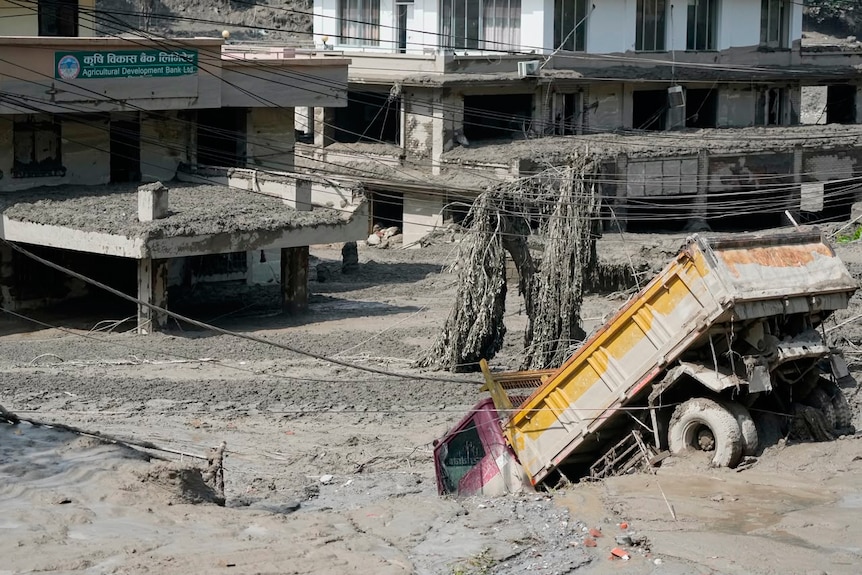
Nepal’s foreign minister said an earthquake caused an avalanche that triggered the flood along the Bhote Koshi river in Rasuwa. (AP: Niranjan Shrestha)
“The damage has been so unprecedented, it can take a few days to come up with the exact details,” he told the ABC.
“The government has mobilised all its mechanisms, including Nepal’s army, private choppers.
“The worst part is the communication has been difficult because most of the lines have just been washed away by the floods.”
Mr Subedi said people were being rescued every hour with many survivors being brought to local hospitals for treatment.
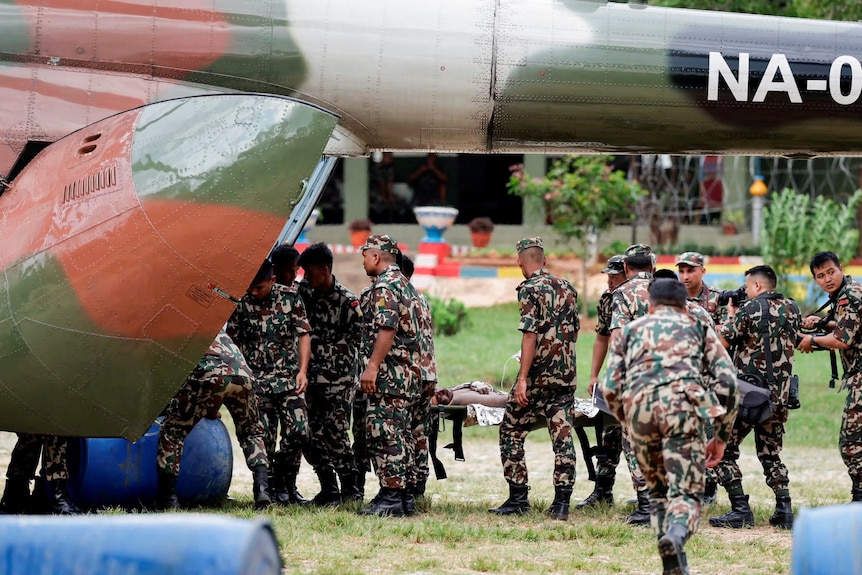
A survivor is airlifted following a flash flood in Nepal. (Reuters: Navesh Chitrakar)
Nepal tourism board officials said most of the missing were likely tourists from India and the Indian diaspora on pilgrimage to Mount Kailash in the Chinese autonomous region of Tibet, a sacred site for Hindus.
He said the flood occurred near the Langtang National Park which was also a popular place for international tourists to go hiking.
Australia urges tourists to follow local safety advice
The Australian Embassy in Nepal has issued a joint statement with other nations, including the UK, encouraging its citizens in the affected areas to follow guidance and safety advice of local authorities.
“Our thoughts are with all those affected by this disaster,” it said.
“We express our solidarity with the people of Nepal during this difficult time.”
The UK’s Foreign Office said it was “deeply saddened by the loss of life and devastation”.
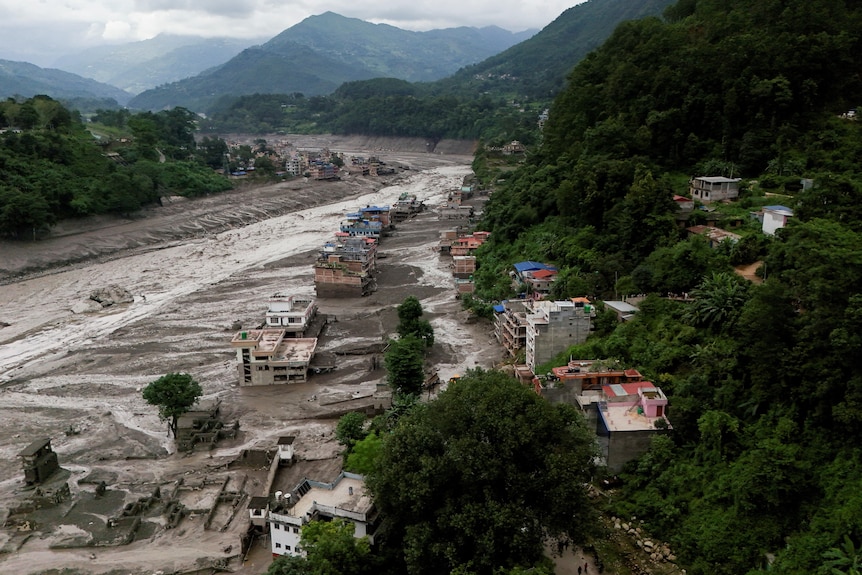
Mud has covered roads and houses after the flash flood in Nepal. (Reuters: Navesh Chitrakar)
India begins evacuations as authorities warn of another flood
Indian Prime Minister Narendra Modi has offered “humanitarian assistance” with the rescue and recovery after speaking with Nepal’s Prime Minister Balendra Shah.
Authorities in India’s Bihar state have begun evacuating up to 12,000 people from six districts fearing floods in that region.
The International Centre for Integrated Mountain Development has warned a second flood may also be imminent.
“With a blockage still lodged upstream on the Nepal-China border river, authorities warn a second flood may occur,” Qianggong Zhang, the centre’s head of climate and environmental risks, told AFP.
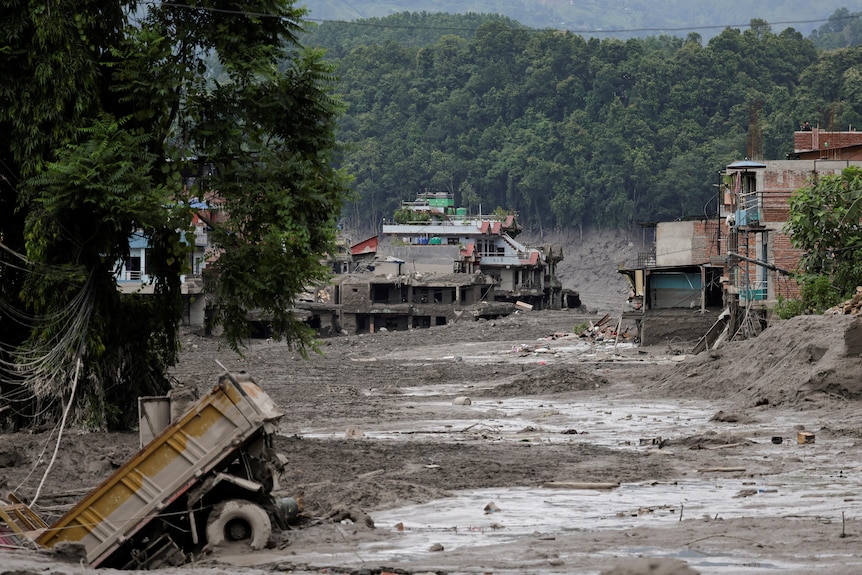
A street and houses are covered in mud in Nepal’s Nuwakot district. (Reuters: Navesh Chitrakar)
The Nepal Electricity Authority said about 430 megawatts of production capacity, including from hydropower and solar facilities, had also been damaged in the flood.
“The disaster has damaged the production, transmission and distribution facilities of the Authority… resulting in disruption of electricity supply,” it said.
Major highways and roads have also been closed in both Nepal and Tibet.
Traffic authorities in Tibet’s Shigatse said roads in the area were “at risk of mudslides and unsafe for passage”.
Nepal’s Prime Minister Balendra Shah has urged people to “be patient” and “stand together”.
“The government takes full responsibility for your rescue, treatment, food and shelter,” he said in a statement.