
A sacked ALDI employee condemned by the Fair Work Commission for using “plain wrong” artificial intelligence (AI) advice in his failed bid to reverse his dismissal says he now plans to use “two or three” different AI agents to help him appeal against the decision.
Sadnan Khan was ordered to pay $1,230 towards the supermarket giant’s legal fees after a landmark Fair Work Commission decision found he used AI as a “quasi-legal advisor” to challenge his dismissal, despite repeat warnings his case had “no substantial prospects of success”.
“I have taken the very rare step of ordering him to pay some of the employer’s legal costs, because his unreasonable conduct caused his former employer to incur those costs unnecessarily,” Fair Work Commission deputy president Michael Easton said in the tribunal’s decision last week.
“If Mr Khan had properly read his own AI generated replies … he would have known that his case was doomed.”
A sacked ALDI employee challenged his dismissal in the Fair Work Commission. (ABC News: Sarah Maunder)
Mr Khan told the ABC he used a paid version of ChatGPT to help him decipher legal cases the tribunal and ALDI had raised.
“They’re quoting me cases, right … and I as not a legal personality have to go somewhere to do the study,” he said.
“The main thing AI suffers is they do things not the Aussie [court] way.”
Mr Khan — originally from Bangladesh — said he was relying on AI advice to understand how to navigate the system, but admits he made mistakes — including forgetting to remove AI-chat instructions from his submissions.
“The way we communicate things and the legal way of communication … things are different,” he said.
Generative AI sees cases surge
The Fair Work Commission is designed to assist self-represented litigants, but a report commissioned by the workplace umpire showed a drastic uptick in cases.
The report into AI use by litigants showed:Generative AI was in part responsible for a 40 per cent surge in its cases between 2023-24 and 2024-25.40 per cent of surveyed cases involved a litigant using AI.The use of AI was more concentrated among younger and self-represented litigants.More than three-quarters of that cohort used ChatGPT and, of them, 60 per cent relied on the free version.Non-English speakers were twice as likely to use AI than native speakers.
Mr Khan contends comprehension barriers affected the prompts he fed his AI agent, but said he had now learned from the experience.
“The main problem, which I realised after the hearing, was that I was thinking oranges were apples,” he said.
“Now I’m going to use next time a mixture of Claude and ChatGPT … and two or three [others] to [get a] mixture of different views.”
The tribunal acknowledged AI was improving access to justice for applicants with genuine, meritorious claims “who might otherwise have been deterred”.
It denied AI use by applicants was inherently problematic and said sophisticated users had approached it critically as “one tool among many”.
ChatGPT ‘terrible as oracle’
Among that category is Gregory Baker, a computer science lecturer from Macquarie University who this month became the first person to successfully challenge casual employment laws using a team of AI agents.
“I used to be famous for saying to my students, ‘if you don’t use AI in my class, you will fail’,” Mr Baker said.
“When you’re teaching a class on AI, it makes sense.”
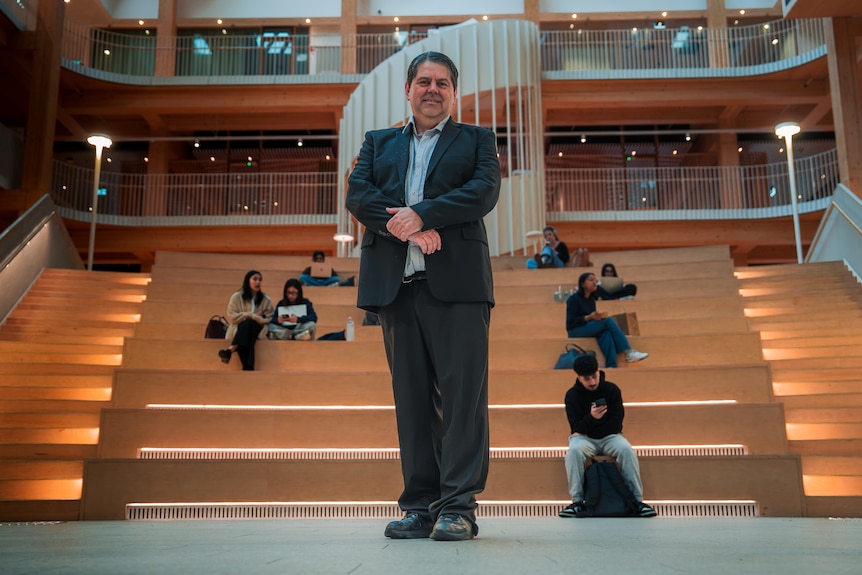
Macquarie University lecturer Gregory Baker is the first person to successfully challenge casual employment laws using a team of AI agents. (ABC News: Abubakr Sajid)
Mr Baker’s Fair Work claim was born when he asked ChatGPT for career planning options after the university denied his request to be converted from a sessional to permanent employee.
“I treated it basically as a software development project,” he said.
“I created a repository for my source code and my programs, which were my [tribunal] filings and came up with a build process that it checked.
“Are all the citations correct? Is everything logically coherent? I made sure there was a process that it went through.
“That obviously has enormous implications for how institutions operate, for how the legal systems work.”
But he said asking ChatGPT as a “kind of oracle” with no context or information resulted in “a terrible job.”
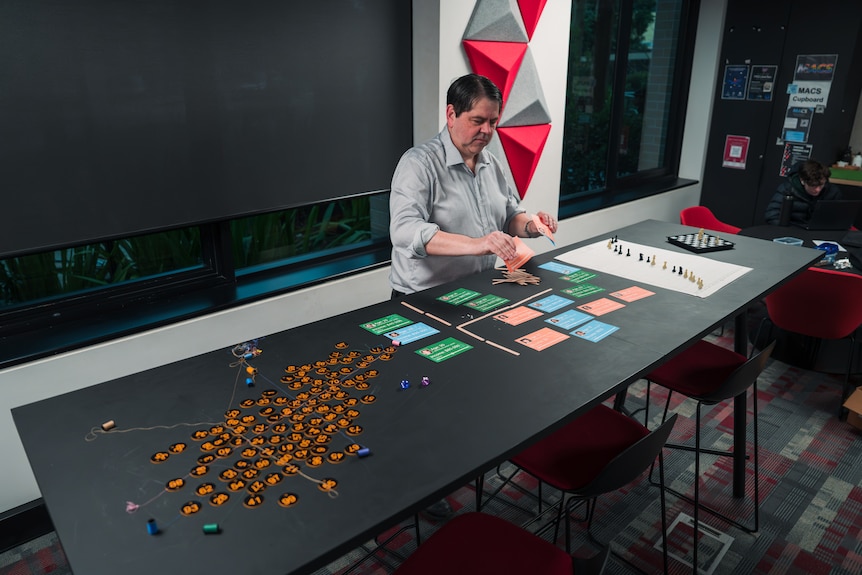
Computer science lecturer Gregory Baker encouraged his students to use AI. (ABC News: Abubakr Sajid )
Mr Baker estimated that there was roughly a five-year window between the AI frontier, which had “good framing and prompting” compared with the least sophisticated, and often free, models, which could drive inequality.
“There are a lot of people for whom hundreds of dollars a month on AI is completely out of the question,” he said.
Mr Baker did not realise he was among the first cases testing new employee choice laws introduced last year until a week or two before the hearings, where he was up against a lawyer and barrister representing the university.
He said he used ChatGPT to “grill” him to prepare for cross-examination at the tribunal hearing, but admitted, “things did not go the way I was expecting.”
“Of course, it’s a huge disadvantage in any oral hearing,” he said.How can courts, tribunals manage AI litigants?
AI can assist litigants best when the user understands the discrete legal issue they are querying, Genevieve Grant, a law professor from Monash University, said.
“If those prompts are inexpert, then the results will be as well,” she said.

Monash University law professor Genevieve Grant says inexpert AI prompts get inexpert results. (Supplied)
“Most community members are aware of this kind of property of AI now where it has a kind of sycophantic tendency … and may in fact encourage people to believe that there are legs in a claim they’re making when that may not in fact be the case.”
Professor Grant said the tribunal’s reasons in Mr Khan’s case showed Mr Khan seemed to address the wrong legal question despite attempts to put him on the right course.
“Courts and tribunals have a limited range of tools that are available to them to send messages to the community … one of those tools is a costs penalty,” she said.
“I think what we’re going to see is courts and tribunals using an increasing array of tools to manage this, and we might see a ramping up of standards around the sorts of expectations that courts and tribunals have, how much latitude they provide to litigants.
“Really we’re talking about the sorts of measures that might deter some people from bringing a claim or weeding out those claims at an earlier stage than we’re often used to.”
New template for AI-dependent litigants
The Fair Work Commission recently established a template for AI-dependent litigants, encouraging them to copy and paste prompts into their AI agent.
Guidance changes announced by the tribunal on Monday will also require applicants from October 20 this year to disclose any AI use, verify facts, authorities and hyperlinks used, and confirm witness evidence.
It has flagged consequences for those who do not comply.
Mr Khan, whose case centred on whether he was eligible to challenge his dismissal, said he was not deterred by the possibility of a more costly penalty if he followed through with his plan to appeal the decision in his case.
His window to appeal will end before the Fair Work Commission changes take effect.
“Let’s see how it goes, I will look into my options,” he said.
“AI also helped me in the past for a few other matters.”
Macquarie University has until Wednesday next week to appeal against the decision in Mr Baker’s case.