
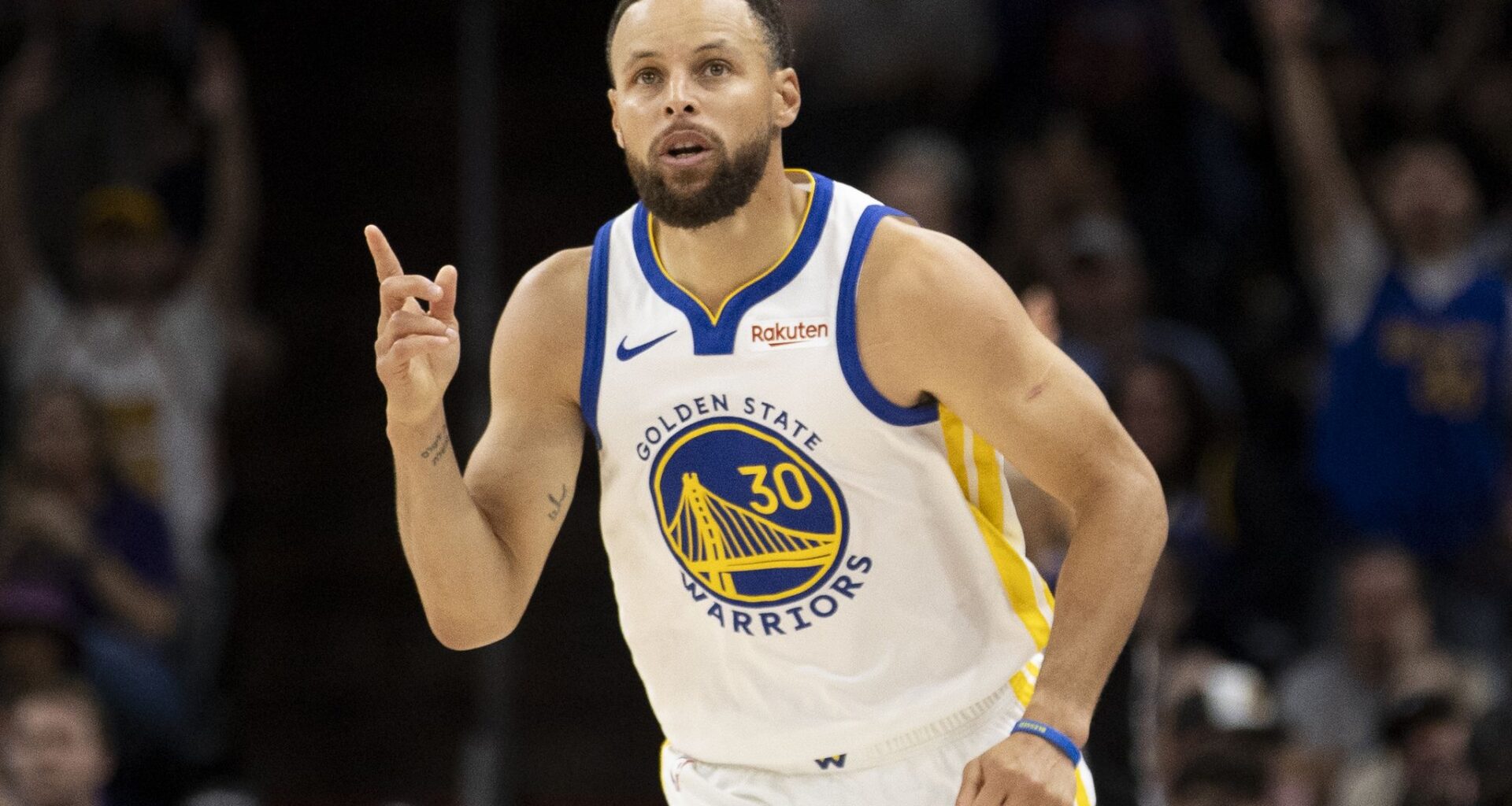
Warriors guard Stephen Curry gestures after hitting a three-point shot during the first half of Golden State’s NBA play-in tournament loss against the Suns in Phoenix on April 17.
Stephen Lam/S.F. Chronicle
Bobby Marks can’t help but remember the fall of the New Jersey Nets when he thinks about the Golden State Warriors. They didn’t win a ring two decades ago, when Marks was rising through the Nets’ front office. They made two straight NBA Finals (2002, ’03), and they missed on six straight first-round picks. They tied up money in Jason Kidd and later Vince Carter, when both had hit 30. And they then fell to suffering one of the worst seasons in NBA history — 12-70 — in 2009-10.
“I lived through it, man,” Marks, now ESPN’s NBA front office insider and formerly the Nets’ assistant GM, told the Chronicle. “When it doesn’t work, when you don’t draft great, or maybe players just don’t work out for whatever reason — there is a loud thud, from a roster-building standpoint.”
The thud may hit in Golden State whenever Stephen Curry walks off the floor at Chase Center for the last time. On Saturday, the 38-year-old Curry becomes eligible for the fifth contract extension of his career, likely his last. There’s not a dominant young cadre waiting to step in: All but one (Moses Moody) of the Warriors’ six first-round picks from 2018-22 are on other NBA rosters or out of the league.
Article continues below this ad
Golden State’s ability to sustain any kind of championship foundation, now, will trace in large part directly back to any deal their franchise icon signs at some point between Saturday and June 2027.
“The Curry part,” Marks said, “dictates what the Warriors’ flexibility is.”
The Warriors superstar is playing this season on a $62.5 million contract, and he will be eligible for a maximum two-year, $136.7 million deal on Saturday. Both Curry and the Warriors have given no public indication that there will be complications in extension talks. Golden State general manager Mike Dunleavy said in early August that Curry wants to “finish his career as a Warrior.”
Article continues below this ad
But there are plenty of interesting nuances to the negotiations of Curry’s anticipated new deal, and how they shape Golden State’s future. The Chronicle consulted Marks — an expert on the NBA’s collective bargaining agreement — and several NBA agents on the key questions at play.
How many years will Curry sign for?
Let’s start with one unmistakable reality, for a four-time NBA champion and 12-time All-Star who currently drives the top-end value of a Warriors home ticket.
“I think at the end of the day,” Marks said, “he basically writes the terms, as far as what his next deal is going to be.”
With 4,248 regular-season 3-pointers, Stephen Curry is far ahead of his closest pursuer, the Cleveland Cavaliers’ James Harden (3,390).
Carlos Avila Gonzalez/S.F. Chronicle
To a point, at least. Under the CBA’s “Over-38” rule, as Marks explained, Curry currently can’t sign an extension that would take him beyond the 2028-29 season. If he didn’t want to sign an extension now — more on this later — Curry could sign a new three-year deal worth up to $207 million total, as Marks laid out. That seems unlikely, given that four more years in the NBA would see Curry at age 42. But LeBron James is about to play a season at 42, so anything’s possible.
Article continues below this ad
“Maybe, two years,” one NBA agent said on condition of anonymity. “I think after that, you’re really handcuffing yourself to what he could be in three years.”
If the franchise icon wants to play three more seasons, though, it’s hard to envision Golden State saying no.
“You can’t not pay him and give him what he wants,” that agent put it, “as long as he wants to play.”
In one scenario — as James has commonly done on shorter-term deals — Curry could sign a one-year extension with a player option for another season. That would be unprecedented, though, as Curry has never once had an option on three previous extensions.
What about the knee?
After missing two full months last season with patellofemoral pain syndrome — runner’s knee — Curry hasn’t expressed full confidence in that right knee in public conversations. In July, the Chronicle asked him point-blank whether he was confident it wouldn’t become an issue again next season.
Article continues below this ad
“You only know what you know,” Curry said then, “but I’m confident I’m doing everything I can (for the knee) and taking advantage of the offseason.”
Golden State general manager Mike Dunleavy said in early August that Stephen Curry, whom the franchise drafted seventh overall in 2009, wants to “finish his career as a Warrior.”
Santiago Mejia/S.F. Chronicle
Dr. Kenton Fibel, an orthopedic specialist and the head team physician for the NHL’s Anaheim Ducks, told the Chronicle that the factors and severities within that runner’s knee diagnosis vary. “Many times,” though, that can involve a breakdown of the cartilage in the knee, as Fibel said. And if Curry and the Warriors’ medical team have identified the specific area of the joint that’s affected, the key is developing a regimen to limit and reduce inflammation, as Fibel pointed out.
Would that give Golden State pause in offering Curry a two-year extension? Probably not. But it is a factor.
“I think you have to take that into consideration,” Fibel said, “when you’re looking at the length of contracts for any athlete. Obviously, Steph offers so much not only just on the court, but off the court, to the team and the franchise. And so, I think it’s really trying to find — can you make it where these flare-ups are maybe still going to happen occasionally, but is it something that still allows him to be on the court more frequently?”
Article continues below this ad
Could he take a pay cut? And would he?
At the moment, Golden State is facing a unique short-term financial future, with the lowest salary commitments of any NBA team involving players signed for 2027-28. They also have the highest amount of cap-hold commitments, or money projected to go to their own impending free agents.
“Cap space,” Marks said, “is also fool’s gold, sometimes.”
At age 38, Warriors guard Stephen Curry is eligible to sign a contract extension that could be the last of his illustrious career.
Stephen Lam/S.F. Chronicle
Jimmy Butler will be a free agent. Draymond Green, too. Brandin Podziemski — whom Dunleavy said in early August the Warriors want to extend — will be a free agent. Curry’s impending big-money deal could significantly squeeze the Warriors’ ability to both keep core players and add new pieces around him.
Curry could potentially leave money on the table. There’s precedent among recent franchise mainstays: Jalen Brunson took a relative-to-the-future cheap extension in 2024 that just helped the New York Knicks win an NBA title. Dirk Nowitzki and Tim Duncan, too, took multiple pay cuts throughout their careers. But it is not the norm.
“One, it’s gotta be a player who’s made a lot of money, and they don’t necessarily define themselves by getting the last dime, right?” one former prominent NBA agent told the Chronicle. “Two, it’s got to be somebody who is a selfless player, and who values winning over getting every last dime. Three, you’ve got to have a great relationship with the team, that allows him to have faith in what they’re proposing that they’re going to do with your sacrifice.
“So those things all have to line up. And, I think the problem is — it’s pretty rare that they all line up that way.”
Points one and two are true, in Curry’s case. The third is more complicated, because free agency has become more complicated under the CBA adopted in 2023, as Marks pointed out. Fewer big names are actually hitting the open market.
Regardless, Golden State’s wiggle room to retool will start at Curry.
“If he comes in at 65 (million), or if he comes in at 45, or if he comes in at 50 — how much spending power Golden State has in free agency is based on the Curry number,” Marks said.
What if Curry doesn’t sign immediately?
Don’t panic if Curry doesn’t immediately put pen to paper, as Marks hinted.
“I do think, like, two things are going to happen,” Marks said. “One, he’s going to extend, whenever the window opens, or … sometime during the season. Or he’s not going to extend, and basically, the reason why is because it gives them the maximum spending power to go out in free agency.”
The longer Curry delays an extension would give the Warriors more time to accurately predict next summer’s free-agent market and prepare accordingly. It’s an option that “has to be talked about,” as Marks said.
That option, though, relies heavily on a star’s continued trust in a clearly communicated and specific organizational plan, as the former prominent NBA agent explained.
“I can’t cite as many examples of that,” the agent said, “as I can of teams laying out a vision that was just … underwhelming.”
Curry’s approach to his next — and maybe last — deal could reveal his faith in Golden State’s direction.