
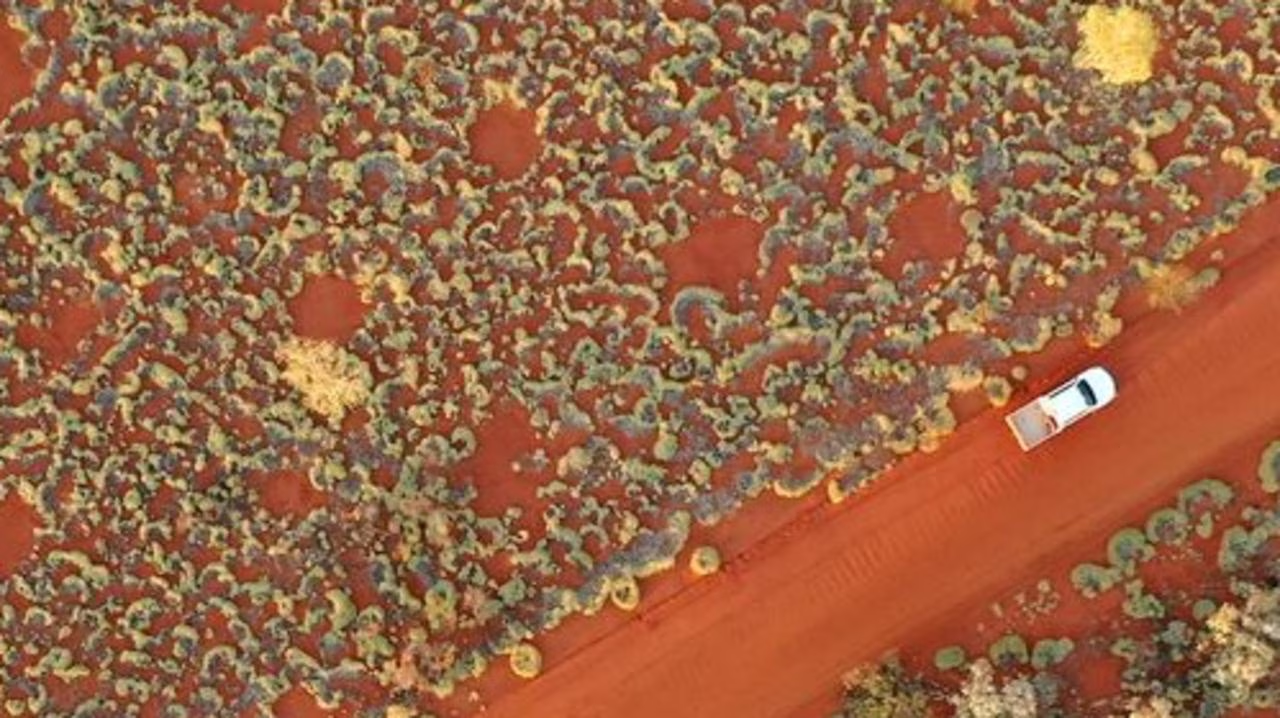
Australia’s highly politicised energy debate may be away with the fairies.
But the otherworldly rings that mark their Outback homes may represent a solution right under our noses.
Geological hydrogen.
We’ve known about it for more than a decade now.
But the subject appears to have been brushed aside by Canberra’s lobbyists.
Fairy circles are an indicator of underground reservoirs of natural hydrogen percolating up from deep within the Earth. But it’s also likely to be found in Australia’s magnetite iron ore mines.
Hydrogen means fuel.
Fuel that burns without pollution.
“Australia could be sitting on a massive, untapped energy reserve,” states Edith Cowan University Associate Professor Alireza Keshavarz.
“There is enough hydrogen for Australia to benefit for generations, and potentially enough for us to become a major exporter of clean energy to the rest of the world.”
But the science isn’t there yet.
Are there truly vast, untapped reservoirs trapped within Australia’s depleted iron ore fields? Under our ancient, eroded mountains?
Within our broad, flat deserts?
It’s a tantalising prospect.
It’s one that may even satisfy disgruntled fossil fuel mining magnates.
After all, they’re the ones who would be needed to tap it. And they already own most of the most promising land.
Now, the race is on.
Who will be the first to prove hydrogen fairies actually exist – and that they can be put to work?
Drill, Baby, Drill!
“Natural hydrogen is already made – it just has to be collected,” argues University of Kansas chemical engineer Promise Longe.
It’s about the geology, stupid.
The US Geological Survey estimates that about 5 trillion tons of natural hydrogen sits buried beneath the Earth’s crust.
“Even 2 per cent of that total would be more than all proven natural gas reserves on the planet and enough to meet projected demand for the next 200 years, even accounting for increased consumption,” Longe adds.
But the relatively limited search for viable underground reservoirs is yet to produce promising results.
Fairy circles, however, may be a dead giveaway.
Researchers say these mysterious formations are caused by pressurised hydrogen bubbling up through sedimentary soils. This pushes aside water, shaping the fertility of the surface. Thus, the appearance of stark, dead circles bordered by hardy plant growth – often hundreds of metres across.
“Fairy circles could thus serve as natural signposts in the future for finding underground hydrogen sources — a potentially inexhaustible and environmentally friendly energy source,” enthuses University of Vienna Department of Geology head Bernhard Grasemann.
Another hope is that the geological process can be hurried along.
Edith Cowan University researchers believe Australia’s Pilbara iron ore mines may conceal the key to securing our future energy needs.
Underground, iron-rich magnetite deposits produce hydrogen when combined with hot water under pressure. It’s a natural process that’s been happening for millions of years.
Then there are the ancient fault lines where igneous rocks mix with sedimentary rock. Here, water again comes in contact with minerals that react to form hydrogen.
Just Add Water?
The idea is to pump hot (250C) water into underground magnetite deposits. And catch the resulting hydrogen gas.
The Edith Cowan study says the challenge is to convert the process from a lab experiment into an industrial process.
This may require a system similar to fracking, where subterranean rock is fractured by injecting pressurised fluids. The freshly exposed rock surfaces will, when combined with water, react to create hydrogen.
Once that rock is depleted, rinse and repeat.
Catching the elusive light gas is another matter entirely.
But some mining start-ups see potential in such an industry.
Australia-based HyTerra has begun prospecting.
In Nebraska and Kansas – not Australia.
It reports having found some samples with hydrogen concentrations of up to 96 per cent.
However, Gold Hydrogen and Thor Energy have made a start Down Under – they’ve been sniffing around South Australia.
“This is not a gold rush,” Professor Sherwood Lollar told a Royal Society report into natural hydrogen last year.
“As interest grows, we need to make sure evidence stays at the centre of the conversation. We need solid science, good data, and a realistic view of what’s possible to make sure the hype doesn’t run away with itself.”
A recent Massachusetts Institute of Technology review report also expressed qualified optimism.
“There are still a ton of unanswered questions here: Hydrogen is notoriously difficult to move around and store, requiring either a lot of space or super-low temperatures to force the gas to become liquid. But if the engineering and logistics work out, this could spell a new beginning for hydrogen,” states Casey Crownhart.
Off the boil
The South Australian Labor government’s flagship green hydrogen project collapsed in 2025, alongside hopes that billionaire investor Sanjeev Gupta would save Whyalla’s steelworks.
A new furnace there was supposed to be a captive market for hydrogen generated by massive new solar and wind farms, and help the state’s economy “pivot” towards a broader, hydrogen-based economy.
The odds were against it from the start.
Only 10 to 25 per cent of the energy captured by solar cells is converted into hydrogen fuel through the electrolysis of water. It’s far more profitable to sell that electricity direct to market. Even batteries store about 95 per cent of what’s pumped into them.
Hydrogen is also a very light gas. Much lighter than liquefied petroleum gas (LPG).
Put simply, one litre of uncompressed LNG produces 2000 times more energy than the same volume of uncompressed hydrogen.
This means that, even when compressed, commercial vehicles generally cannot carry enough to produce useful mileage. And the space launch industry must freeze hydrogen to -253C to make it dense enough to store efficiently.
It’s also very corrosive.
So even adding small quantities to existing LNG gas pipelines and utilities requires substantial upgrades.
But it has a niche, critical market.
Much of the argument for green hydrogen has (unintentionally) already been made by fossil fuel lobbyists.
It’s a natural gas. Like the LPG we’re all familiar with.
It’s there when the sun doesn’t shine, and the wind stops blowing.
Only it doesn’t pump more carbon into our increasingly saturated atmosphere.
Instead, when burned, it emits water.
So what does it offer industry over battery-stored wind and solar?
Raw flame.
Like petroleum gas, jets of intense heat can be blasted into a furnace. And that’s crucial for critical industries, such as steel, glass, ammonia fertiliser, methanol and cement. Not to mention “topping-up” a fluctuating power grid.
Electric alternatives are being developed. But that makes them complicated, less efficient – and expensive. At least for the foreseeable future.
Hydrogen flow, like petroleum gas, can be turned up or down in response to demand.
Coal, nuclear and solar/wind sources are far less responsive – if at all. Which is why batteries have become such a hot topic.
That’s the underlying truth behind much of Canberra’s political hot air.
LNG is the current major (heavily polluting) source of industrial energy. Artificial hydrogen remains an inefficient and expensive alternative. Natural hydrogen, if it can be tapped, has the potential to bypass both sets of problems.
Jamie Seidel is a freelance writer