
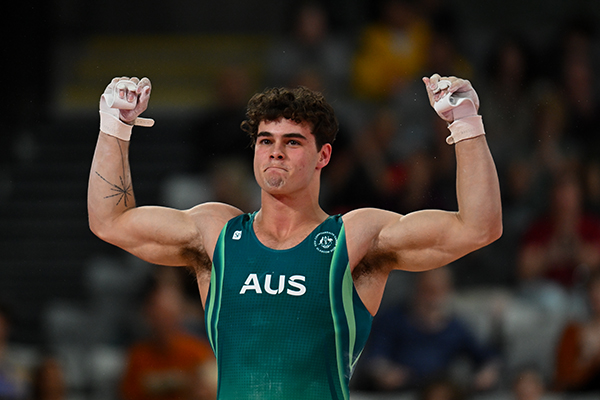
James Hardy hauled a hefty trio of bronze medals home to Australia from last month’s Commonwealth Games in Glasgow, and the enhancements he plans for his all-around program could well have him collecting more hardware from competitions ahead.
The 23-year-old Hardy claimed his first bronze in Glasgow when Australia placed third in the team final, and he continued with matching third-place performances on floor exercise and still rings in the apparatus finals. He added a fifth-place finish on vault to complete his showing at the Games.
Hardy’s results in Glasgow and ongoing training modifications have him aiming for the all-around final at the World Championships in Rotterdam in October. He finished just over a point away from the all-around final at last year’s Worlds in Jakarta, but looks forward to the chance to crack into the global top-24 in Rotterdam.
In this International Gymnast Online interview, Hardy describes the satisfaction and inspiration his Glasgow results provided, his pursuit of finals at the upcoming World Championships and his team’s potential for the Los Angeles 2028 Olympic Games.
IGO: James, congratulations on your three bronzes as well as fifth place on vault in Glasgow. How much thought and time have you given to analyzing your performances there, and regardless, what are your key takeaways from your experience there?
JH: I enjoyed a week off after the Games, and I always like to reflect on the competition and my performances during that downtime. Overall, I am extremely happy with my results in Glasgow. I would have liked to produce some cleaner landings in the vault final, but other than that, the qualifications day and all of my finals went exceptionally well, and I am very proud of the work I have done this year.
My biggest takeaway is that Team Australia is really moving forward. We set a target of being on the podium for the first time in 16 years, and we executed the plan when it mattered. Not absolutely everything went to plan, but we held strong throughout the competition and got the result we wanted. I really think we can take that momentum into Worlds this year and continue building towards Olympic qualification as a team over the next couple of years.
On a personal level, the two individual medals were really special. After medalling on floor, which was a bit of a surprise in itself, I went into rings with a mentality of “This one is for me” and just wanted to have some fun with it. To come away with another medal was an incredible feeling.
IGO: In Glasgow you competed on every apparatus except pommel horse. Why was that, and how soon do you plan to return to doing the all-around internationally?
JH: I was bumped off pommel for team reasons, with that decision being made well before the Games as part of the team structure. It is currently my weakest event, and we have a very strong pommel horse group within the rest of the team.
It is still my goal to continue building my pommel so that I can contribute meaningfully to this strong team and continue working towards the all-around. I have made massive strides in my execution on pommel over the last couple of years, so now I need to build a bit of difficulty without losing that execution. Getting the routine above a 5.0 D-score is the next target for me. Hopefully next year my pommel horse will be in a good enough place to return to competing in the all-around internationally.
IGO: Prior to the Commonwealth Games, vault has been your strength. How difficult has the challenge been for you to bring your other apparatuses up to the level of your vault?
JH: I identified rings as a gap around four years ago as a reserve at the last Commonwealth Games. I have a good build for rings and knew that it was an event where I could potentially contribute meaningfully to the Australian team, so I have worked very hard on my rings strength since then.
Pushing up into the mid-13s has been quite challenging. Building the strength required for rings without getting injured or sacrificing shoulder range for the swing elements is a difficult balance, but I have been following my coach’s plan, trusting the process and experimenting with different versions of my routine throughout the domestic season. Things have progressed nicely.
There is still work to be done on my other events to bring up my overall standard, but I am happy with how I am continuing to progress in these areas. My goal is to become a much more well-rounded gymnast rather than just relying on vault as my biggest strength.
IGO: What plans do you have to upgrade your vaults for the World Championships in Rotterdam in October?
JH: I have been working the Dragulescu and handspring 2.5 (twist) for some time now. It has been challenging to get the Dragulescu competition-ready without sacrificing the quality of my double front. I generally have a nice tuck that I seem to lose when I add the half twist, so getting that back while maintaining the execution is the big challenge.
I will be working hard over the next couple of months to get one of those upgrades ready for competition. I want to make the vault final at the World Championships, so having a second vault that can give me the difficulty and execution I need will be a big part of that.
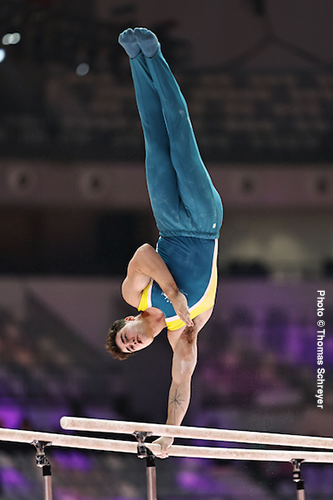 James Hardy of Australia
IGO: (Olympic and world all-around finalist) Jesse Moore has established himself as the leading Australian all-arounder, but what do you think you’ll need to add to your training or actual routines in order to close the gap with him?
JH: Jesse is an incredible athlete, and I have been chasing him since we were junior gymnasts together for over a decade. He is a massive inspiration and is driving the whole of Australian gymnastics forward with his work ethic and results.
That said, I want to be national champion one day, and I plan to close that gap over the next couple of years. Really, that comes down to my weaker events, pommel and high bar in particular, as well as parallel bars. I have upgrades coming on those events, but currently they don’t have the consistency required for a team competition.
Getting those routines consistently into the 13s and above over the next two years is a big goal for me. If I can do that while continuing to develop my stronger events, I think getting into the 80s in the all-around is a realistic target. That would put me in a much better position to challenge for the national title, and it would only benefit the team as well.
IGO: How do you feel things are shaping up for the Australian team, especially in terms of qualifying for the Los Angeles 2028 Olympic Games? What do you personally consider the areas that should be the team’s focus to climb in the rankings?
JH: I think we are in the strongest position that we have been in for years. The Commonwealth Games showed what this team is capable of when we all hit under pressure, and I think that gives us a lot of confidence heading into the next couple of years. We have an internal target of 240-plus as a team score for Olympic qualification. We will need to work very hard before the World Championships next year to put ourselves in a position to achieve that.
One of our biggest challenges has traditionally been depth. Going into benchmark events, it can be difficult to have everyone healthy and performing at their best at the same time. So, for us, it is about continuing to build that depth and raising the standard across the whole team.
We have some really strong individual events, but if we can get more guys consistently contributing 13s or better across the apparatus, that is where I think we can make a big jump in the team rankings. We have the athletes to do it, now it is about putting the work in, staying healthy and executing when it counts.
IGO: What do you consider your biggest improvements since last year?
JH: I think the biggest improvement has been in the consistency and standard of my weaker events. In Jakarta (2025 World Championships) I scored 74.031 in the all-around and finished just over a point outside the final, so I knew I wasn’t a million miles away, but I also knew there were plenty of areas where I could improve.
At this year’s Australian Championships, on Day 1, I scored 78.598. Obviously scores aren’t always directly comparable from competition to competition, but I have made some substantial improvements on parallel bars and rings in particular, and generally feel that the standard of my routines has improved across the board.
My goal is to keep building that consistency and get myself into a position where I can consistently score in the high 70s and eventually into the 80s. I am not sure yet whether I will compete in the all-around in Rotterdam, but if I am in that position, I will definitely be trying my best to put myself in contention for the final.
More about James Hardy:
Date of Birth: March 14, 2003
Place of Birth: Auchenflower, Queensland, Australia. “That is the name of the suburb of the hospital. If it is easier to say Brisbane, I am happy with that. A bit more memorable, especially with 2032 (Brisbane Olympic Games) coming.”
Coach: Jack Coates. “He has been my primary coach since 2022 and coaches me on all events.”
Club: Brisbane Grammar School Gymnastics Club, since 2022
Best results: eighth on vault at the 2019 Junior World Championships, Gyor; eighth on vault at the 2022 World Challenge Cup of Osijek; seventh on vault at the 2022 World Challenge Cup of Koper; third all-around at the 2023 Oceania Championships; sixth all-around at the 2024 Oceania Championships; first on vault at the 2024 Australian Championships; second all-around at the 2025 Australian Championships; eighth on vault at the 2025 University Games, Essen; 29th all-around in qualification at 2025 World Championships, Jakarta; team bronze medalist at the 2026 DTB Pokal Mixed Cup, Stuttgart; second all-around at the 2026 Oceania Championhips; fifth all-around at the 2026 Australian Championships; bronze medalist on floor exercise, still rings and team event at the 2026 Commonwealth Games, Glasgow
International Gymnast Online’s other features on Australian male gymnasts include: