
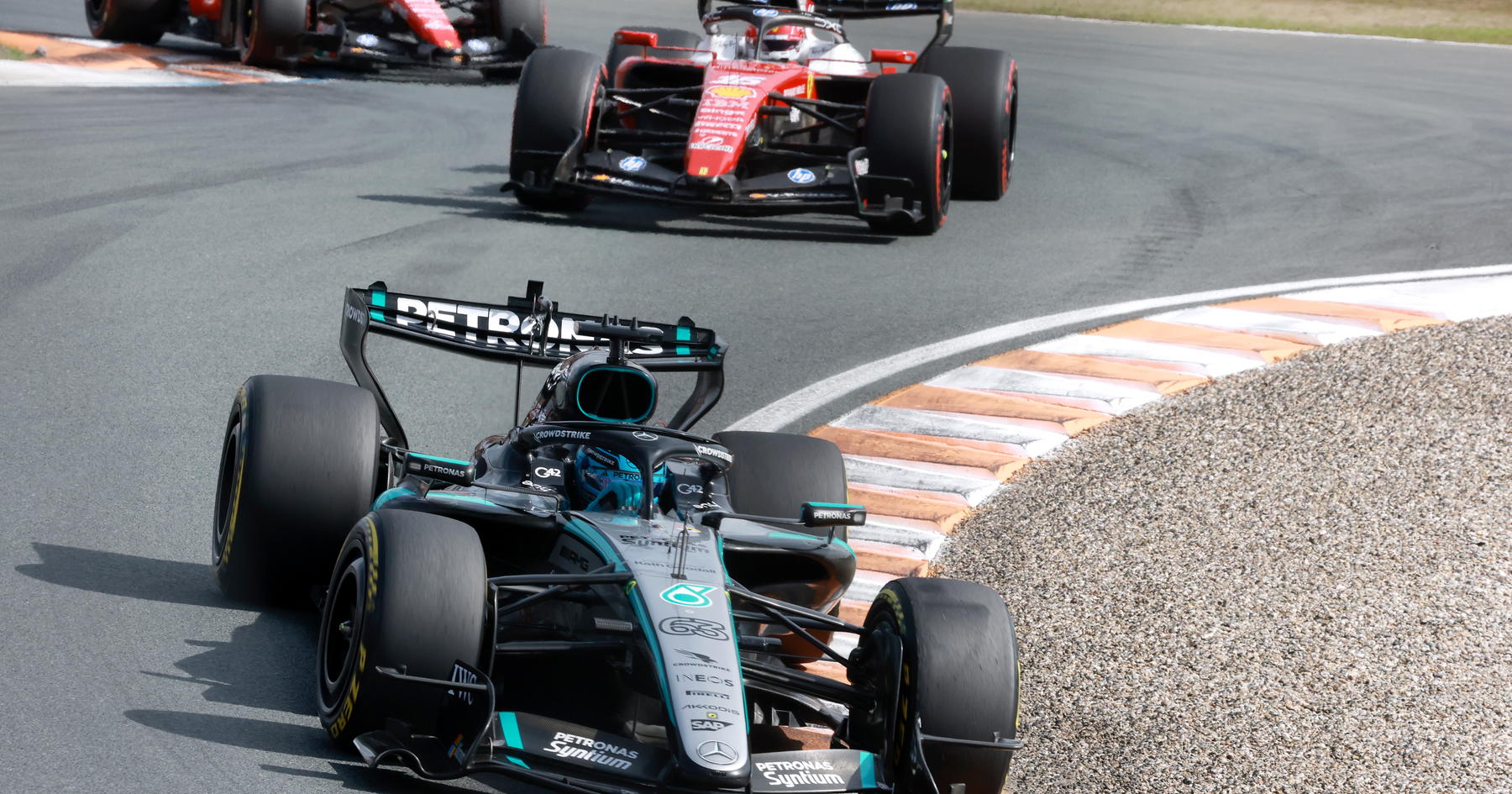
Mercedes is preparing a carefully staged counterattack against its F1 rivals, with the opening salvo arriving at Monza and the real offensive weapon saved for the Bahrain Grand Prix in Malaysia.
The Brackley-based outfit will introduce an upgraded power unit for Kimi Antonelli at the Italian Grand Prix, a move that will trigger a grid penalty and send the Bologna-born 20-year-old to the back of the field.
The updated unit will subsequently be rolled out to George Russell as part of a structured rotation of power unit components across the remainder of the season.
Beyond the engine programme, Mercedes has also finalised a significant aerodynamic package, though it will not appear at Monza.
The team believes the W17 in its current configuration is already well-suited to the high-speed demands of the Italian Grand Prix, and has chosen to hold back its development push for the return to Sepang.
Data gathered ahead of the summer break has informed the decision. The package under development targets an increase in downforce produced by the car’s bodywork, and the reasoning behind the timing goes deeper than simple circuit suitability.
The downforce-traction connection
Mercedes has identified a meaningful relationship between aerodynamic load and traction out of corners, one that carries significant implications for energy harvesting.
Its analysis shows that optimal traction, particularly in reducing wheelspin under acceleration, dramatically cuts energy wastage. The practical consequence is either a more sustained deployment window or a faster recharge cycle.
What this reveals is that a deeper understanding of the car’s dynamics, accumulated over the course of a season, enables a level of energy management optimisation that simply was not available at the start of the year.
The key question, of course, is whether the aerodynamic changes will deliver the performance gain the numbers suggest they should.
Theoretical calculations and on-track reality do not always align, and the competitive picture will be complicated further by Ferrari’s introduction of their evolved power unit featuring the ADUO system. The true measure of Mercedes’ development step can only be taken in direct competition.
For the time being, though, no alarm bells are ringing in Brackley. The strategy of beginning the 2026 season with a comparatively mature package appears to have paid dividends so far. Whether that approach holds up as the battle intensifies over the coming rounds remains to be seen.